Ag-Life

Private well owners will need collect well water samples from hydrants or faucets that are connected to the waterline closest to their well before sending the samples to the Big Upper Blue NRD for testing.

Private well owners will need collect well water samples from hydrants or faucets that are connected to the waterline closest to their well before sending the samples to the Big Upper Blue NRD for testing.

Upper Big Blue NRD supports private well safety

Without frequent testing of wells, private owners in Nebraska are at risk of drinking water contaminated with nitrates and harmful bacteria.
Above is a screenshot of a video on the Hamilton County Corn Growers Association Facebook page featuring an interview between corn growers past president Mike Bergen and Beck’s Hybrids seed advisor Luke Samuelson. This year, instead of a live plot tour, the association will feature interviews recorded at the test plot south of Aurora with representatives of each of the companies represented.

Above is a screenshot of a video on the Hamilton County Corn Growers Association Facebook page featuring an interview between corn growers past president Mike Bergen and Beck’s Hybrids seed advisor Luke Samuelson. This year, instead of a live plot tour, the association will feature interviews recorded at the test plot south of Aurora with representatives of each of the companies represented.

Corn Growers plant new format for annual plot tour

The annual seed corn plot tour sponsored by the Hamilton County Corn Growers Association will have a new name, a new location and a whole new format when it takes place on Tuesday, Aug. 25.
Larry and Jane Nunnenkamp of southern Hamilton County display the Nebraska Pioneer Farm award they were presented with at this year’s Hamilton County Fair. Their property, situated east of Highway 14 near County Road 4, was first purchased by Larry’s grandfather, William “Bill” Nunnenkamp in 1926.

Larry and Jane Nunnenkamp of southern Hamilton County display the Nebraska Pioneer Farm award they were presented with at this year’s Hamilton County Fair. Their property, situated east of Highway 14 near County Road 4, was first purchased by Larry’s grandfather, William “Bill” Nunnenkamp in 1926.

‘By God’s grace, 100 years and counting’

It was exactly a century ago this year when an acreage of farmland in southern Hamilton County came into the Nunnenkamp family, and the current owners say they have been able to hold onto the farm and keep it productive in their time by the grace of God.
A metallic green sweat bee collects pollen from a prickly poppy flower in the Nebraska Sandhills.

A metallic green sweat bee collects pollen from a prickly poppy flower in the Nebraska Sandhills.

Exploring hidden connections of the prairie

For Chris Helzer, a prescribed burn isn’t simply about managing grass.It’s about influencing where bison graze, where mice feel safe, where owls hunt, which flowers bloom, which insects survive and, ultimately, whether an entire prairie ecosystem remains resilient for generations to come.
Despite some green snap from winds associated with the July 8 thunderstorm, local agronimist Orvin Bontrager said the corn crop in Hamilton County looks good this year.

Despite some green snap from winds associated with the July 8 thunderstorm, local agronimist Orvin Bontrager said the corn crop in Hamilton County looks good this year.

Corn, bean crops reported in good shape

Despite some damage caused by the storms that rolled across the county earlier in July, Aurora agronomist Orvin Bontrager said the crops he has been scouting in the area look good at this stage of the season.
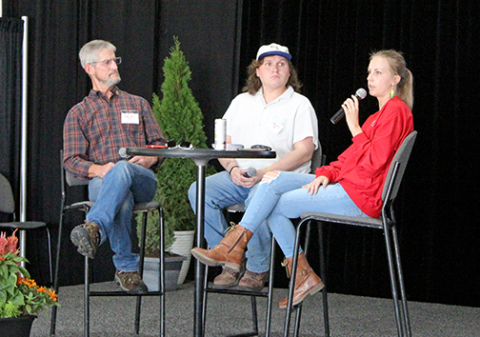
The Grain Place Foundation hosted its annual Field Day Saturday, which included three keynote speakers, all of whom participated in a panel discussion at the end. Pictured from left are: Chris Helzer with the Nature Conservancy, Dr. Jesse Bell, KSU sociology professor Matthew Sanderson and Grain Place Farms founder Dave Vetter.

The Grain Place Foundation hosted its annual Field Day Saturday, which included three keynote speakers, all of whom participated in a panel discussion at the end. Pictured from left are: Chris Helzer with the Nature Conservancy, Dr. Jesse Bell, KSU sociology professor Matthew Sanderson and Grain Place Farms founder Dave Vetter.

Changing minds about changing soil

For Kansas State University sociologist Matthew Sanderson, regenerative agriculture isn’t simply about cover crops, no-till farming or healthier soils. It’s about changing the way farmers see themselves, their relationship with the land and ultimately the future of rural America.
Regenerative agriculture is about working with nature – enhancing soil health, boosting biodiversity and building resilience – to create ecological wins and put money in the bank.

Regenerative agriculture is about working with nature – enhancing soil health, boosting biodiversity and building resilience – to create ecological wins and put money in the bank.

Regenerative ag economics: From the ground up

“If it improves the ground, it’s going to improve my potential income.” – Glenvil farmer Kipp Hinrichs. That statement captures the heart of regenerative agriculture. It’s not just about environmental stewardship – it’s about economic resilience.
David Vetter (right), CEO of Grain Place Foods, leads a tour of the organic farm near Marquette during a Field Day in 2023. Tours of both the farm and the processing facility will be part of the morning session of the 2026 Field Day on July 18.

David Vetter (right), CEO of Grain Place Foods, leads a tour of the organic farm near Marquette during a Field Day in 2023. Tours of both the farm and the processing facility will be part of the morning session of the 2026 Field Day on July 18.

Soil health to be front & center at GPF Field Day

A panel discussion on the connection between soil, human and community health will be just one of the highlights of the Grain Place Foundation’s (GPF) annual Field Day coming up on Saturday, July 18.
Emma Bullerman admits that there was a period where she thought she wanted to get out of Nebraska. Through her work at Prairie Plains, she’s come to fall back in love with her home state and is committed to following in her father’s footsteps to keep its ecosystems healthy.

Emma Bullerman admits that there was a period where she thought she wanted to get out of Nebraska. Through her work at Prairie Plains, she’s come to fall back in love with her home state and is committed to following in her father’s footsteps to keep its ecosystems healthy.

Bullerman follows family legacy into Nebraska’s prairies

Emma Bullerman is spending her summer riding around in fields with her dad, and she’s thrilled about it. It’s not just for fun, either — she’s interning for the Prairie Plains Resource Institute and working alongside her father, Mike, to conserve Nebraska grasslands.
Brian Brhel’s cattle graze on cover crops turning a row crop field into a temporary pasture meadow. (Photo by Brian Brhel)

Brian Brhel’s cattle graze on cover crops turning a row crop field into a temporary pasture meadow. (Photo by Brian Brhel)

More than a lease: The landlord-tenant relationship

At the local diner in Denton, Brian Brhel shares a booth with his new landlord. They dig into their burgers and break the ice on their new working relationship.Brian is a Nebraska Soil Health Coalition producer lead.