
KSU sociologist tells Grain Place Field Day audience: regenerative ag begins with a shift in identity
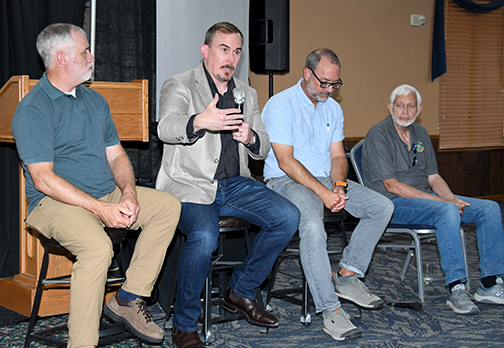
For Kansas State University sociologist Matthew Sanderson, regenerative agriculture isn’t simply about cover crops, no-till farming or healthier soils. It’s about changing the way farmers see themselves, their relationship with the land and ultimately the future of rural America.
Speaking during the Grain Place Foundation’s annual Field Day Saturday in Aurora, Sanderson said his research with producers across Kansas found that adopting regenerative practices often begins not with new technology, but after farmers reach a personal, financial or emotional breaking point that prompts them to rethink long-held approaches to agriculture.
“As a sociologist, I’ve been very privileged to be part of some very difficult moments and I get a little emotional thinking about all the conversations I’ve had with hundreds of producers,” Sanderson told a crowd of just over 100 in a presentation that reflected both gloomy clouds and rainbows hovering over the big picture horizon of agriculture. “We live in a world where stories matter and in farming stories matter a lot because farming is an all-inclusive world of identity.”
Sanderson applauded the Grain Place for hosting Saturday’s event, suggesting that candid conversation is one of the most effective ways to embrace the paradigm shift happening in regard to regenerative agriculture and soil health.
“How do we change worldviews?” he asked. “I don’t know, but there are different ways it happens, and this is one of those ways that we’re doing right now. Having conversations, making connections and sharing experiences and stories. It’s not trivial. People don’t change their ideas overnight, so these kinds of engagements matter.”
Sharing some of the insight he’s gained through his research at Kansas State, Sanderson said that when trying to encourage or talk to farmers about moving from conventional practices, tillage and so on to regenerative practices, most often the calls he gets are ‘How do we get them to do what they know is right?’
“I say it’s not a matter of dropping one thing and picking up another,” he explained. “You’re taking about changing a worldview, a way of doing things, an identity, and a way that someone sees themselves.”
One of the biggest challenges facing farmers who are open to such change, Sanderson observed, is that worldviews on the topic can change quicker than the soil itself.
“There is a gap there,” he said. “It’s a really hard time for these producers because they can’t see the results as quickly as the worldview shifts.”
KSU study
Much of Sanderson’s keynote presentation was based on a study he conducted with a KSU graduate student about farmers transitioning to regenerative agriculture (RA), which was published in the Journal of Rural Studies. The study was based on input from approximately 50 Kansas farmers at different stages on the continuum from conventional practices to regenerative practices. Using five core RA principals (listed in attached chart), he said producers were each classified by where they stood on that spectrum to help understand the experiences of someone doing one or none of the practices, and someone several years into the transition who is implementing all five.
“There is no one transition to regenerative agriculture,” he noted. “Every story is unique, but there are patterns and the biggest patterns we saw was that all of them reached some kind of breaking point. In other words, this wasn’t always a pre-thought-out ‘I’m going to do this’ process. They all got to a breaking point, whether it was financial, social or emotional.”
Plugging in fake names for those who participated in the study, Sanderson shared some of the input from Kansas producers asked to share their motivation to change the way they farm.
“Several farmers in my area almost lost their farms because they couldn’t get a line of credit because they’re so highly leveraged,” Jackson said. “They felt like thy had to use cover crops to change.”
“You can walk outside in the morning and smell chemicals,” Frank said. “When your eyes are watering and you see and smell that stuff for 10 minutes, I can’t help but think it’s doing something to you.”
“My father-in-law worked the soil eight times,” Arnold said. “He plowed it, disked it, field cultivated it over and over to look perfect. I’d have 15 percent better yields every year with my minimum tillage and my input costs were significantly less, but all he could hear in his head was the coffee shop crowd bragging about how clean his fields were.”
Sanderson said whatever the motivation, there is a clear and growing trend toward adopting practices that focus on healthier soil.
“That’s an important part of this, that people who are moving seem to be moving away from what we call the productivist idea of the good farmer, which focuses mainly on yields and output, to a more sort of holistic view, a worldview, in which the farmer is more embedded.”
The problem for those who do decide to change the way they farm, Sanderson continued, is timing, referring again to those difficult gap years.
“The worldview starts to change before the soil changes,” he emphasized. “There’s a gap there and it’s a really hard time for these producers. They can’t see the results as quickly as the worldview shifts.”
“My soil wasn’t where I was mentally,” said Aldrich, one of the study participants. “Even though I knew I could get there, it just takes time. It’s a slow building process and the first years are the hardest.”
“You know, landlords will dump you and your neighbor will come outbid you tomorrow,” Max added. “You can find a regenerative landowner that doesn’t’ care if he breaks even for a couple of years, but good luck finding them around here.”
Change in attitude
For producers who found a way to survive the challenging transition, Sanderson said there was a noticeable change in their attitude and outlook.
“Those who did persevere through year three tended to be very steeled, hardened off and the benefits became clear,” he observed. “They started to see a new form of independence, a changing identity, a sense of self, a purpose and a redefined understanding of what it means to be a good farmer.”
“If you are determined to stick it out for a couple years, you start to see that I don’t need the government to tell me what I can and can’t grow,” Lawton said. “I can do this because I’m making money, and it’s not in the form of subsidy checks.”
Sanderson also noticed repeated references to life and death, having reported earlier that farmers and ranchers in Kansas have a suicide rate that is three times the average profession in the Sunflower State. A rate of 147.5 suicides per 100,000 people is double that of veteran suicides in the state.
“So this coming back to life became more of a theme as we went further,” he noted. “Farmers were drawing contrasts between death and life in their transitions.”
Here’s how Jackson put it: “Before I changed my farm and started caring about my soil and thinking about the soil as an ecosystem, it was a very depressing life. Every day, I wake up deciding what I was going to kill next. Whether it was a pest or a weed, it was a life revolved around death. But when I completely changed the outlook of my life, I started trying to grow things and bring life to my farm. It gave me a positive attitude. It’s less draining to work around life instead of death every day.”
Summarizing the KSU study and his Saturday presentation, Sanderson said he sees hope for those looking for a path to help them through a regenerative ag transition.
“For those making it through that tough time, we do see the possibility for new stories emerging and that’s the reason for the rainbow in an otherwise pretty tough area,” he concluded. “So why regenerative agriculture? Perhaps to heal, to make whole, to put back together things that we’ve taken apart — the soil, the farmer, the community.”
The professor of sociology said his working hypothesis going forward is addressing this question: If life comes back to the soil, does the farmer come back to life?
“Another hypothesis I’m starting to think about is one level up,” he added. “If you have healthier, more whole farmers, do you get healthier places, communities of people and organisms of all kinds that live above ground and below ground? I hope this has been useful in some way to the conversation.”
Editor’s note: Saturday’s conference included in-depth presentations by Dr. Jesse Bell and Chris Helzer with the Nature Conservancy. Watch for coverage on those topics in future ANR editions.