By budgeting family living expenses into the cost of production, farm and ranch families can answer a fundamental question: Can the farm or ranch not only sustain itself but also support the family living on it?
As the cash poor winter months are coming on UNL’s Center for Agricultural Profitability is urging producers to use caution when using operating loans and lines of credit.
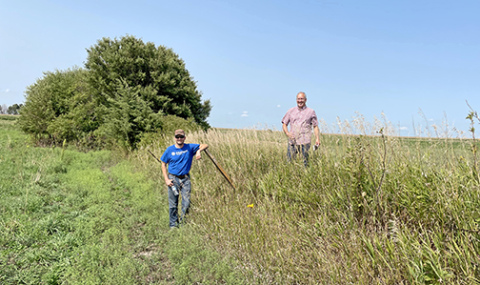
Hamilton County corn grower Nate Goertzen (left) talks with members of a Mexican trade mission group that visited his farm in October. The members of the team are wearing boot covers to avoid the risk of transporting contaminants from one country to another.
A decision made last summer to allow the use of hemp seed meal as an additive to chicken feed could give a boost to the production of hemp as a rotational crop in Nebraska. That’s according to Andrew Bish of Giltner, who currently serves as president of the Hemp Feed Coalition.
This map of the Upper Big Blue Natural Resources District published in September shows that nitrate levels in Zones 5, 6 and 11 have risen to the Phase III, with more than 10 ppm of nitrates. The area stretches from a few miles east of Aurora to south and east of Seward. Nitrate levels higher than 10 ppm in drinking water are considered to be unsafe, especially for the very young and the elderly.
The UNL Center for Agricultural Profitability warns that farmers who have incorporated their businesses could face hefty fines and even imprisonment for failing to report their beneficial ownership information to the Financial Crimes Enforcement Network.
Grant and Laura Wilson’s vintage John Deere 6600 augers a hopperful of corn into a grain cart on the Vern Eastman farm east of Giltner last Wednesday.
Student-raised, student-processed beef will be served in the UNK dining hall through the University Beef program. The beef is processed by students at UNL.
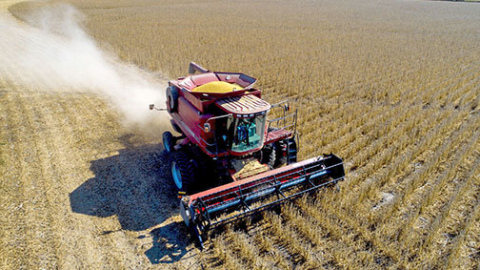
Sheila Miller carries lunch to her husband, Ray as he combines popcorn in a field south of Aurora last Wednesday. This past week’s dry conditions provided perfect conditions for continuing the 2024 harvest season at a fast pace.
With a three-year, nearly $1 million grant from the National Science Foundation, the University of Nebraska-Lincoln’s James Schnable will help develop the first digital twin of a corn field, enabling researchers to quickly test countless what-if scenarios related to corn performance. (Craig Chandler/University Communication and Marketing)