
Landlord-tenant relationships shape how land is managed
At the local diner in Denton, Brian Brhel shares a booth with his new landlord. They dig into their burgers and break the ice on their new working relationship.
Brian is a Nebraska Soil Health Coalition producer lead. His operation spans 720 acres, including 300 acres of rangeland and 420 acres of row crops.
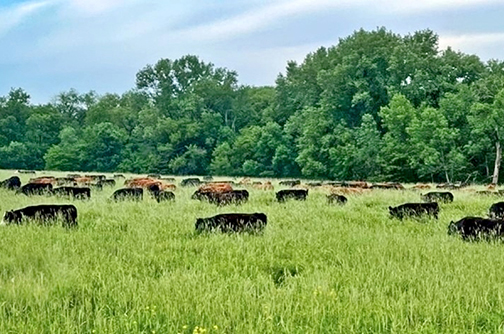
Brian grew up on a small family farm near Denton, where he developed an early love for livestock. Today, cattle continue to play a central role in his operation, reflecting both his passion for animals and his approach to farming with the long-term health of the land in mind.
Four guiding principles determining Brian’s approach with his landlords – building trust, increasing communication, understanding priorities and strengthening relationships – make him successful with his 15 landlords.
Building trust
Brian lives near many of his landlords, while others live far from the farm itself. His landlords’ motivations vary. The people who own Brian’s rented ground often value different things:
• crop returns
• cleaner water for their communities
• wildlife habitat renewal
• to know what is happening on land their families have owned for generations
One landowner enjoys looking out the kitchen window and seeing cattle roam through a sea of green cover crops. Another asks about the cleaner water leaving Brian’s farms after heavy rains. A third simply “wants a place to shoot their gun once in a while.”
Before Brian talks about their partnership, he begins with building trust. Brian stated, “This (It) is really crucial that there is trust. That is foundational. I don’t want to be farming someone’s ground if there isn’t trust.”
Increasing communication
Brian does not graze conventionally. His fields do not always fit the mold of a traditional operation. In late spring, one of his fields looks more like a meadow than a row-crop field. Purple vetch blossoms peek through oats and peas while insects flitter among the flowers. To someone expecting freshly turned black soil, the field can look unusual. To Brian, it is a sign the soil is alive and working. He emphasized these differences make communication even more essential.
Brian learned the cost of unclear communication and broken trust during a complicated seed production-rent arrangement early in his farming career. The agreement became difficult to explain clearly before harvest and strained the relationship.
“I wished I would have kept it simpler… I learned how important it is to communicate preemptively… And I still care for those people. But that’s not a farm that I am on anymore. And that’s part of reality.”
Understanding priorities
The first time Brian meets a new landlord, he begins by asking what matters most to them. Those conversations often reveal the landowner’s hopes, worries, and histories.
“There is some hesitation by new landowners…if their values align with the farmer that is operating on the land. For example, and is sold that I am farming and the new landowner wonders if they will agree with the way the land is cared for. I share how we steward the land and work to protect the soil. Many value this and it’s a tremendous weight off their shoulders. I ask what their goal is for the property? What do you want it to look like? What are you expecting?”
Brian says shared goals can turn a business arrangement into a “beautiful thing” when his and his landlord’s values meet in the middle.
“What a cool way to be in a relationship with people in your community. When you can work toward a common goal.”
Strengthening relationships
Brian says the biggest lesson he learned was the importance of relationships.
“...Especially what builds trust is when something didn’t go to plan and you share that with [the landlord]. And okay, this didn’t go how I imagined, but this is what we’re doing to make a correction... So owning your mistakes or your experimentation.”
Brian’s burger disappears and the lunch crowd thins as he and his landlord trade stories about the land, the community, and what they hope the farm will become. In the coming weeks, they will discuss weather, cattle, fertilizer, and grazing plans. There will be successes and mistakes.
But for Brian, the relationship comes first.
“Nothing is worth not having a good relationship,” he says. “The relationship with my landowner comes first and the farm comes second.”
Stories of Success
Nebraska Soil Health Coalition will continue following Brian’s story in future installments of the Stories of Success. We will explore how he navigates the opportunities, challenges, and relationships that come with caring for the long-term health of the land, animals, and people connected to it.
In our next Story of Success, one producer will discuss the equipment challenge in their soil health journey.
About the Nebraska Soil Health Coalition
The Nebraska Soil Health Coalition is a producer-led nonprofit working to advance education, outreach, and adoption of soil health principles across Nebraska. Its mission is to promote soil health systems that support resilient farms, ranches, and rural communities. For more information, visit nesoilhealth.org or contact info@nesoilhealth.org.
About the author
Bethany Zelt is the first Multimedia Storyteller with the Nebraska Soil Health Coalition. A native Nebraskan, born in
Seward, she fell in love with the land two generations after her grandparents left their Illinois farm. Through her storytelling, she elevates the voices of rural Nebraskans and helps producers share their experiences in their own words.