
Retiring Hampton supt. Holly Herzberg reflects on 30+ years with the Hawk Family
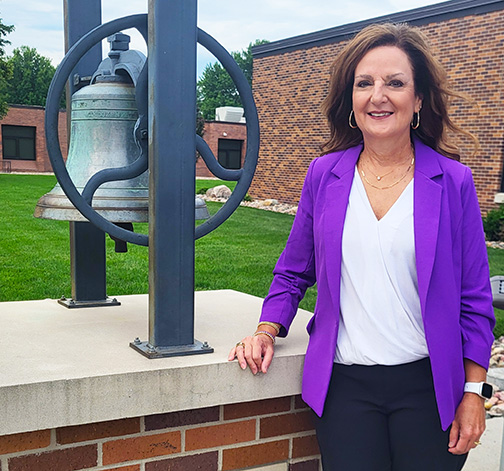
Holly Herzberg’s normally organized office at Hampton Public Schools was a little less put together than usual on a recent Thursday morning. That’s because the superintendent of the past 20 years had been busy sorting and packing her belongings in order to move out of that space in preparation for her retirement at the end of June.
Having put together an outline and a slide show for her final Community Conversations with Coffee event at the Fire Hall at the end of April, Herzberg was ready for our interview with a list of discussion topics highlighting the challenges, victories and priorities that have characterized her leadership of the district for the past two decades.
As she sat at her desk, surrounded by mementos and memories of more than 30 years as an educator and then administrator at Hampton, Herzberg said she was struggling to believe her retirement was actually happening.
“I’m not sure it’s real yet, but it will feel real soon,” Herzberg said.
Hawk Family
One of the most difficult parts of that reality may be the absence of daily interaction with what has affectionately become known in her tenure as the Hawk Family.
That family includes everyone from the students to their families to staff and board members to the supporting community at large.
“A lot of things that I think create disruptions in the superintendency happen outside of our building,” Herzberg said. “And those are things that sometimes are more difficult to work through, but once you get here during the day, and you close the door, and the day starts with your kids, that’s really where I found the most enjoyment, was being with my people here at school every day. The parents have been wonderful. It’s again a partnership... you don’t have great things happen without parent support of the students here and of the staff with what’s going on.”
Herzberg also credited her success to exceptional school board members who have served over the years.
“They’ve allowed me to do my job as the superintendent, and they’ve worked really hard at staying in their lane and being board members, and it’s just been a great relationship and partnership with the board,” she said.
Herzberg said that working partnership has extended to the wider community as well.
“The community of Hampton is just special,” she said. “This place just draws you in, and when I was hired back in 1993 as a first grade teacher... I said to myself, ‘This will be a great first teaching job, I’ll stay for a few years, get some experience, and I’ll move on.’ And 33 years later, here I still sit, and that’s because of the community and the people in the community, and who they are... Until you get here and experience it, it’s hard to put into words.”
“We do take people in and we do treat them like family, and we hope that people who move into our community feel welcomed right away,” Herzberg continued. “That’s what we want. We want people to walk through the doors of our school, and we want them to feel welcomed from the second they walk in. We talk a lot about that. It’s first impressions and how you make people feel. So I hope over the years we’ve done that as a school and as a community.”
Budget & finance
Anyone who has ever attended a Hampton School Board meeting in the last few years knows that Holly Herzberg is a numbers person. The daughter of a Wayne State math professor, she loves to crunch numbers and explain the ins and outs of the school’s finances. (She is one administrator who actually enjoys leading those infamous Pink Postcard meetings with taxpayers.) She admits that when she was putting together the outline for the Community Conversation she considered putting it first.
Herzberg’s early years as superintendent in Hampton, however, were faced by serious financial challenges which both tested and honed her abilities in that area.
“When I took over in 2006... the Department of Education came out to my very first board meeting because the school district had overspent our budget,” she said. “You can’t overspend your budget. That’s against budgeting policies and laws, and so they helped us amend our budget that very first meeting. They walked us through that, and then we had to take out a fiscal note to pay our payroll. So that was a really interesting time for me. It was a great learning opportunity, but it was an interesting time to work through all of that, but we got through it.”
“Our school district was also on what was called a levy override, so we could take our levy up higher than that lid (of $1.05),” she recalled. “But because we were on a levy override, we didn’t have enough students in high school at that time. Sixty kids had to be in your 9th-12th grade, and there was a law. It was Statute 79-458 – I’ll never forget it – and it’s called the Freeholding Law. And so, if you didn’t have enough kids in your high school, and you’d overridden your levy, people who lived on the borders of your school district, that was called contiguous land, it touched another school, they could petition to move their land into the other school district that had a lower levy.”
“In July I got my first freeholding letter at school as a superintendent for people requesting to freehold their ground into the neighboring district,” Herzberg said. “And that was really hard...
In your mind you start thinking, ‘Oh, what’s going to happen?’ because if one piece of ground is allowed to move to the next district, then it opens a new piece of ground, and it can just be a domino effect, and so very concerning.”
Herzberg said taxpayer dollars couldn’t be used by the district to hire an attorney to fight the freeholding requests, so four individuals from the community stepped up to hold a meeting and raise funds to challenge the requests.
“It was Karen Bamesberger, who’s still instrumental in the community in many ways; Gene Winters, who’s also in the community a lot; Phil Troester and then Dale Young (both of whom are now deceased).
“And we ended up not losing a lot of land,” Herzberg said. “I think we lost a couple tracts of land during it, but we ended up getting it closed because we got enough kids in high school.”
Facilities upgrades
The next big challenge came in 2014 when the school board began discussing a much-needed renovation of the 1956 grade school, installing air conditioning in the newer high school building and the possibility of building a new gymnasium.
Believing that “the community is who owns this school,” Herzberg said she and the board members set out to find out what the community wanted.
“And so what we did at that time was each school board member nominated I think it was six individuals whom they felt would be really representative of our community,” Herzberg said.
Those community members were to serve alongside staff members and parents on a steering committee to discover how the patrons wanted to proceed.
“I’ll never forget one of the earlier meetings,” Herzberg recalled. “We had gotten to the point of ‘Do we want to knock the elementary down or do we want to renovate it?’ and I remember (the architect) sharing the price tag. The price tag at that time to knock our elementary down, and build new was $30 million, and I remember going home, and I was sick to my stomach. I’m like, ‘Sitting in my seat, I cannot ask my people to support a $30 million initiative when I know we can do it in less and it will be as good of product or better!’”
In subsequent talks in the steering committee, Herzberg said the group decided that since the shell of the elementary was still structurally sound, the elementary building could be gutted and remodeled. That plan also included connecting the elementary and high school buildings with a new addition that would house new administrative offices, a commons area and new kitchen, as well as a new competition gym and locker rooms.
After two more meetings with the wider community, the bond issue needed to finance the project was ready to be put to a public vote with two options presented to the voters.
“So the board really took that information and that feedback to heart, and they said, ‘Okay, we need to break that off in a two-part election,’” Herzberg said. “So when people got to vote they could vote to renovate the elementary and connect us with this beautiful office space that’s secure, so everybody enters into one door. They could vote on that, and that cost $5 million. And you could choose to also say yes to the gymnasium and the locker rooms, which was $2.25 million, so if you said yes to both, you were approving $7.25 million. Or you could just say yes to one, but the gym could not happen without the elementary.”
Herzberg said the night before the election, the group had little idea how the voting would turn out but was committed to listening to the community and submitting to the will of the voters.
“We had this saying, and it was called P.R.I.D.E.,” she said. “It was an acronym for ‘Patrons Respectfully Interested in Developing Education,’ and it was about the patrons. So we were respectful of people who said, ‘No, I don’t agree with this. I don’t think you need it. I think you need to close and you need to consolidate.’ We heard that. We were respectful of that... but when you go through really big decisions like that as a community, you have to respect each other’s opinions and what works for them financially, because it doesn’t fit for everyone financially to say yes... We were such a close-knit community, we were a Hawk Family, and I didn’t want to divide our family, and so we asked people, ‘Please don’t put signs in your yard. Please don’t do things like that. That will divide us. We will respect your no vote.’ We don’t need to sever who we are and how we are family.”
In the end, the planning, the listening and the respectful attitudes paid off when the elementary part of the bond issue passed with an 80 percent vote. The additional $2.25 million for the gym was closer, passing by just 22 votes, but still Herzberg recalls the vote was close to 60 percent for the project.
Herzberg recalls the process of moving out of the elementary so the renovation and construction could take place was a huge task that called for many extra hours put in by staff members and, again, the involvement of many volunteers from the community. But 12 years later, she says the community’s investment in its school district has paid off.
“I would say it’s positioned us as a small, rural, viable school district,” she said. “Without the facility, it’s difficult to stay viable. I would say also it’s made our community stronger – a strong school, strong community. I feel like you drive around our community, the presentation of the school, how the school looks and how beautiful it is and the community is the same... It’s kept Hampton on the map, and we’ve done it together as a community and as a school. My husband hosts a big basketball tournament here every February over two days. People come from Kansas and from all over the state, from Millard and Omaha, and they will walk into our school, and they will say, ‘This is a class D school?’ People are blown away by how well kept it is and the layout of the school.”
Community partnerships
Herzberg said another thing she is proud of as she looks back on her leadership in Hampton is the partnerships that have been developed with various entities in the community.
“In a rural Nebraska school, your partnership with the ag community is huge,” she said. “Because the way the school finance system is funded, so much of the of the tax burden falls on our ag community, so it’s really important to make sure that you continue that close partnership with the ag community, and we’ve had some great ones who have served on our school board... Our Hawk Herd (the school’s beef cattle lab) is a great reflection of that community partnership.”
She said another vital partnership is reflected in the school’s involvement in the annual TDLC Cruise Night Car Show started by the late Roger Bamesberger.
“I’ve always looked for opportunities for our staff to get out in front of our community and give back,” she said. “(Roger’s) allowing us to serve that meal was great, and he and I developed a close relationship during that. It allowed him to go be with his car club, and we could be behind the table serving his food. So that was a great partnership over the years.”
The latest partnership the school has fostered is its groundwork for starting the new community daycare center. The Hampton School Foundation helped kick start the effort by purchasing the former Lutheran school building which became home to the daycare center.
Future hopes & plans
Looking to the future of Hampton Schools, Herzberg said she has high hopes under the leadership of Hampton native and former high school principal Carson Klute. At the Community Conversations event, Klute, who was a student under Herzberg, recalled that she had given him his first detention after he transferred over from the Lutheran School in 7th grade. (He admits he had attempted to “sharpen” a mechanical pencil using a school pencil sharpener.)
“I knew three years ago I knew I was going to be retiring,” Herzberg said. “So you start looking for people who you know are committed to the same goals and initiatives that the school is and the school board is and the community is. Well, Mr. Klute fits that bill. He bleeds purple, and he will commit his heart and soul to this place, just like I did, just like Mr. Hoppner did. We’ve had two superintendents in 55 years, the community wants to have three superintendents in 75 years, and Mr. Klute is the right fit to do that for this community and the school.”
As far as her own retirement plans, Herzberg said a new title she’s quite excited about is “Grandma.” Her oldest son, Jayden, a CPA, and his wife, Lauren added baby girl Riley to their family seven months ago and just recently moved to York.
“We’re excited to have them just 30 minutes away,” Herzberg said.
Her other son, Jameson, also a CPA, recently received his master’s in accounting and finance from UNL and is working for a firm in Lincoln.
Herzberg said she is also looking forward to spending more time with husband Mike, who is also retiring from his job this summer. He has served as a K-8 principal at Grand Island Northwest School District in St. Libory for the past several years.
Both are avid golfers and they hope to be able to travel to warmer climates in the winter and spend more time on the golf course, but they have no plans to move from the home they built several years ago in Aurora.