
NE governor stands at intersection of state, ag power
In July, Jim Pillen flew to Vietnam for his first trade mission as Nebraska’s governor. Pillen was there in part to promote the state’s livestock exports, such as pork. As demand for pork stalls in the U.S., Vietnam has become a key market.
Including for a business with close ties to Nebraska’s governor.
Pillen helped found Fremont-based meatpacker Wholestone Farms in 2018. His family owns a stake in the company. His son, Brock, still sits on Wholestone’s seven-person board, as did Pillen until stepping down this year. Wholestone slaughters more than a third of the hogs produced by Pillen Family Farms, the company Pillen founded and his children now run. Wholestone shipped to Vietnam 16,000 times between November 2019 and November 2020, records show.
The Vietnam trip, and Pillen’s ties to a country halfway around the globe, underline a simple truth: He’s more connected to the agriculture industry than any U.S. governor in recent history.
He’s also no regular farmer.
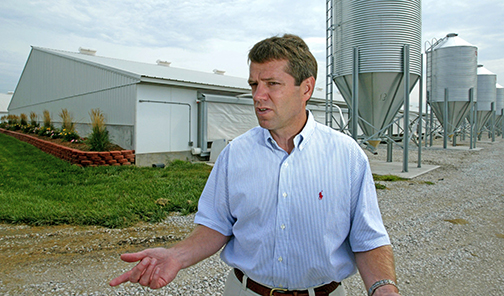
Pillen Family Farms is Nebraska’s largest pork producer – and one of the largest in the nation. From humble roots in the 1990s, the Pillen operation has spread from its eastern Nebraska home base to points across the globe.
It’s a bona fide success story. And its latest chapter, with the main character serving as governor, concerns experts who spoke to Investigate Midwest and the Flatwater Free Press.
As governor, Pillen has control over state regulations, an economic agenda and trade policies that could boost or harm the profits of Nebraska’s pork industry – the industry he dominates.
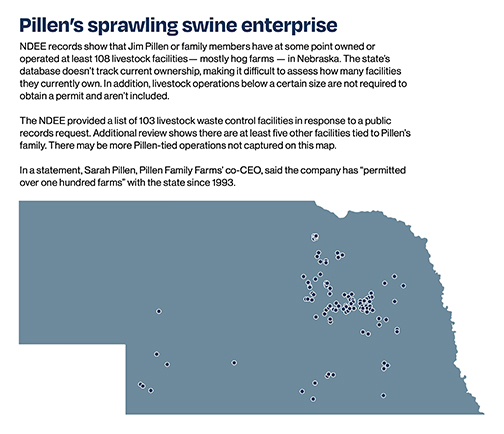
Pillen now oversees the government agency that regulates the waste produced by Pillen Family Farms’ 100-plus Nebraska hog farms, some of which have violated state rules.
He met with the head of that agency, the Nebraska Department of Environment and Energy, two weeks after taking office, an official calendar shows.
As governor, Pillen has pushed for policies that would benefit the state’s pork industry. In June, he asked Congress to override California’s Proposition 12, a measure requiring more space for pigs in concentrated animal feeding operations, or CAFOs.
Pillen maintains a stake in dozens of businesses, according to a financial disclosure. He’s required to disclose if any public policy would benefit them. As of August, he’s filed no such disclosures. Then there’s Vietnam. After returning, Pillen told Brownfield Ag News he’s thinking about making the trip an annual event.
Pillen and industry officials say what’s good for the ag industry is good for the state.
“We in agriculture are driving the future of the state of Nebraska,” Pillen said at a conference this year. “If anybody doesn’t believe that and you’re in agriculture, please get up and get the heck out of here. The future is so cotton-pickin’ bright.”
It’s good that a farmer sits in the governor’s office, said Al Juhnke, executive director of the Nebraska Pork Producers Association, noting that it’s been a century since one held that office.
“He lives and breathes our issues in agriculture,” Juhnke said. “In our case, in pork production, that outweighs any negative there might be. It’s a big positive for us.”
Juhnke previously visited Vietnam on a trade mission with former Gov. Pete Ricketts. Pillen didn’t extend the same invitation. That’s just fine, Juhnke said.
“We were very confident he could represent our industry,” Juhnke said of Pillen’s trip.
But Nebraska’s governor owning hog farms while controlling their oversight is an “absolutely present” conflict of interest, said Kathleen Clark, a government ethics expert at Washington University in St. Louis.
Pillen’s stake in a pork powerhouse makes it hard to untangle his actions as governor from his business interests, said Anne Schechinger, Midwest director for Environmental Working Group, a national research and advocacy organization.
“I don’t know any other governors that have a bunch of CAFOs,” she said. “Legislation he might pass through about CAFOs will directly benefit him.”
Pillen himself repeatedly declined to speak for this story. Laura Strimple, the governor’s spokesperson, directed questions to Pillen Family Farms.
In a statement, Sarah Pillen, the governor’s daughter and now co-CEO of the Pillen business, said the company helps feed more than 13 million people a year and provides jobs in rural Nebraska.
“Our business has always been guided by our core principles: 1) Do what is right; 2) Do the best you can; and 3) Treat others the way you want to be treated. These commitments will never change,” she said.
Now 67, Pillen has explained his company’s explosive growth many times. But specifics have been murky. As a private business CEO, Pillen didn’t have to release financial information. When he’s been sued, he’s often followed common practice by petitioning to keep business records sealed.
Using lawsuit exhibits, court testimony and affidavits from Pillen, Investigate Midwest and the Flatwater Free Press pieced together his rise from a small farm on a dirt lot to his leadership of a sprawling pork empire.
Dirt lot to pork powerhouse
Pillen began with one hog farm in Platte County in the early 1980s. With his father, he raised 60 sows.
Around him, hog farming was changing. Industrial operations were squeezing out smaller family farmers. Nebraska attempted to slow the trend.
In 1982, the state enacted Initiative 300, an anti-corporate farming law. Owners of multiple farms had to maintain full legal liability, just like farm families.
The point: Keep farm money in farm communities, said Chuck Hassebrook, a former University of Nebraska regent who pushed for Initiative 300.
But pork production skyrocketed in states that allowed corporate farms to grow. Farm industry groups argued Nebraska would be left behind because of Initiative 300.
One man led the charge against it: Chuck Sand, owner of one of America’s largest hog operations.
To grow his business, Sand worked to ensure he wasn’t in “direct conflict” with the law, the Omaha World-Herald reported. The Nebraska attorney general deemed the setup legal.
Sand created multiple farms, each a separate legal entity. He shared ownership with various employees so, critically, he didn’t own 100 percent of any farm. Then Sand, through a separate company, provided management services to the farms.
In 1993, Pillen purchased a 3 percent stake in the Sand-owned Furnas County Farms. Sand and Pillen verbally agreed the former Husker football player would manage the operation.
Pillen incorporated Progressive Swine Technologies, the forefather of Pillen Family Farms. He began emulating Sand, starting other ventures and sharing ownership with at least one partner. Like Sand, Pillen charged his own companies for his management.
Years later, in court records, Pillen explained, “I started certain partnerships due to Initiative 300.”
In 1995, Pillen changed his relationship with Sand. Pillen sold his interest in Furnas County Farms, netting him $270,000.
The two agreed not to poach each other’s staff. But, two years into a five-year contract, Sand sued Pillen, accusing him of trying to hire six employees.
Pillen’s lawyers called the agreement an “unenforceable restraint on trade” and alleged Sand had also broken the deal.
Sand and Pillen’s fortunes diverged. In the early 2000s, Sand’s Furnas County Farms fell into bankruptcy. Sand died in 2012.
Other long-term relationships have gone smoother. Brett Bonwell used to own part of a Pillen company, then served as a CEO of a Pillen pig genetics company until recently. Dave Domina, a Democrat who ran for U.S. Senate and represented Pillen against accusations of endangering the environment, said his former client is “conscientious.”
“I just remember thinking he was professional,” Domina said.
By 1998, Pillen owned one of America’s largest hog operations. Five years after incorporating Progressive Swine Technologies, he appeared on Successful Farming’s “Pork Powerhouses” list, a ranking of the top 25 producers. He was 22nd. The company is now 15th.
Getting bigger meant Pillen had more leverage in negotiating prices with meatpacking companies, said Austin Frerick, a Yale fellow who studies the hog industry. Smaller farms often took what they could get.
Pillen had another advantage, Juhnke said. “Why is anyone successful in business? Mainly,” he said, “it’s because of the ambition and drive of the owner.”
In 2007, a judge ruled Initiative 300 unconstitutional. Pillen planned his next move — consolidation.
Investing in ‘future operations’
Pillen entered public life in 2012. As he campaigned for University of Nebraska regent, he transformed his business.
At the inception of Pillen’s management company, Deb Rasby handled its finances. He’d hired her away from Sand, giving her ownership stakes in Progressive Swine Technologies and other businesses.
Rasby declined to be interviewed for this story.
“I respect my mom’s words of wisdom, ‘If you don’t have something good to say about someone don’t say anything at all,’” she wrote.
Hundreds of pages of a lawsuit tell the tale.
Around 2011, Rasby decided to retire, counting, she said, on continued payouts from her 10 percent stake in Progressive Swine.
In 2012, the payments stopped. When she didn’t receive two checks in a row, she emailed her former boss.
Pillen had told her a couple days earlier she’d get paid, she wrote. According to Rasby, the plan was for her to come to the office and collect. If she didn’t get the payments, she said, “this means you are not a man of your word.”
“Deb,” Pillen replied. “Please don’t plan on coming by the office.”
Months later, Pillen sent Rasby an explanation.
In an April 2012 letter, he said his plan was to liquidate Progressive Swine Technologies because it “no longer meets our business objectives.” Cash distributions were done.
He offered to buy Rasby out for about $1.9 million. She protested, claiming her stake was worth twice that.
Eventually, she sold to Pillen for $2.3 million.
With Rasby bought out, Pillen owned many of his operations outright. He shed the name Progressive Swine and rechristened it Pillen Family Farms.
By this time, Pillen was a millionaire. The size of Pillen’s wealth is difficult to determine because his companies are private.
But by 2012, he was receiving $2.7 million in annual payment distributions because of his ownership stakes, court records show. He had been drawing a salary of $110,000. Around this time, he gave himself a raise — to $1 million a year.
After consolidating his hog farms, Pillen brought another business under his umbrella.
In the early 2000s, he and a couple of partners had purchased the North American distributor of Danbred. It provided the semen that producers bought to inseminate their sows.
In 2013, Pillen took ownership, renamed the company DNA Genetics and invested $5 million.
DNA Genetics now has facilities in five states and sells globally. It focuses on the Duroc, sometimes called the pork industry’s “Angus” because it’s so popular.
In recent years, Tyson’s plant in Madison slaughtered about 900,000 of Pillen’s hogs a year — half his production, Pillen said at a 2021 ag conference. But Wholestone slaughters more than a third, he said. The rest are sold to Smithfield’s plant in Crete.
The hogs slaughtered at Wholestone’s Fremont plant have been shipped to Mexico, Costa Rica and Vietnam, according to Panjiva, a company that tracks global shipping.
While beneficial to Pillen, vertical integration limits competition, said Bill Bullard, CEO of R-CALF USA, which advocates for independent cattle producers.
“The growth and development of the industrialized model that he represents has really taken away economic opportunities for literally hundreds of thousands of hog producers in the United States,” he said.
In 2021, three years after achieving vertical integration, Pillen announced his bid for governor. As he pitched himself to Nebraska voters, a controversial campaign unfurled in South Dakota. Wholestone was at the center.
Continued growth
When Wholestone announced plans to build a meatpacking plant in Sioux Falls, some city residents balked.
The proposed facility would process millions of pigs a year — so massive it would require its own wastewater treatment plant.
Worried the plant would foul the area’s water supply, a group named Smart Growth Sioux Falls gathered signatures to place a question on the November ballot: Should new meat processing plants be allowed inside city limits?
To counter Smart Growth’s campaigning, Wholestone created a political action committee named Sioux Falls Open for Business. Wholestone poured tens of thousands of dollars into the committee. Company executives also donated — including Brock Pillen, Pillen’s son and Pillen Family Farms new co-CEO.
On Nov. 8, 2022, 52 percent of Sioux Falls voters rejected the ban. News reports say construction on the new plant may start in 2025.
An empire, complete?
In 2021, months after declaring his bid for governor, Pillen stepped onto a stage in Des Moines, Iowa. Clad in a suit jacket and blue jeans, for 40 minutes he described to the conference audience the intricacies of his vertically integrated pork empire.
He owned the semen of the most valuable pork breed. He owned the farms that raised the most valuable hogs. And he partly owned a growing business that slaughtered those hogs. The lesson?
“There’s been enough consolidation,” he said. “Family businesses have to stay successful.”
Written by Sky Chadde, Investigate Midwest and Yanqi Xu for the Flatwater Free Press, Nebraska’s first independent, nonprofit newsroom focused on investigations and feature stories that matter. Investigate Midwest is an independent, nonprofit newsroom that covers the agriculture industry.
Sara Gentzler of Flatwater Free Press, Stefanie Monge of Silicon Prairie News and Mónica Cordero of Investigate Midwest contributed to this story.
This article is part 1 of a four-part series.
Read Part 2 of the series here.