
Hamilton one of 11 counties reporting no overdose deaths
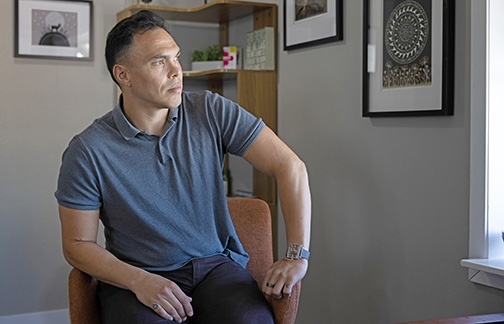
Derrek Cocchiarella died slowly, lying in his mother’s bed on a June afternoon in a house full of family.
He was napping, they thought. Over four hours, they checked on him often. They didn’t recognize his breath gurgling. They didn’t see the foam forming around his mouth.
Then one of Derrek’s sisters tried to wake him for a slice of cake. He was cold to the touch.
In the days after his death, Linette Cocchiarella, Derrek’s mom, struggled to understand. Derrek had freshly returned from rehab. He was finally doing better.
How could he suddenly die?
She called the county attorney’s office, which in Nebraska doubles as the coroner’s office, to ask about an autopsy.
No, she was told, your son’s cause of death has been determined: Natural causes.
“And I’m like, ‘No,’’’ said his mother. “‘That’s not even possible. He’s 23.’”
In 2021, the year Derrek died, the state reported 234 deaths from drug-related causes. Nebraska boasted the lowest drug death rate in the country — fewer than 12 deaths per 100,000 people. That’s less than half the national average, continuing Nebraska’s decade-long run as one of the best states in the country at preventing drug overdose deaths.
It’s a point of pride among state leaders, cited by Gov. Jim Pillen when he vetoed a safe syringe bill in 2024. It’s a rationale for inaction, cited by state senators as they debate drug-related bills.
It’s likely costing us serious money, too. Nebraska receives the lowest dollar amount per person of any state in the country from federal substance abuse treatment funding.
Just one problem: Our lowest-in-the-nation drug death rate is likely false.
The state has long undercounted drug deaths, say state officials, public health researchers and a new Flatwater Free Press analysis of Centers for Disease Control data showing that Nebraska’s overdose rate and its death rate don’t match up.
Consider: Emergency departments in Nebraska, Montana and Texas all reported the same rate of nonfatal overdoses in 2023, about 85 per every 100,000 residents. But data show Montanans and Texans died of overdoses at double the rate of Nebraskans.
Those missed cases add up. If Nebraskans died at the same rate as Montanans, 338 would have died of overdoses in 2023. The state reported 187.
“It’s clear that there’s underreporting based on our existing systems, and that’s unfortunate because everything we do depends on understanding what’s going on in the community. … If you don’t, it’s like driving a car without headlights,” said Dr. Ali Khan, dean of the University of Nebraska Medical Center’s College of Public Health.
Possible explanation
There’s a potentially simple explanation, experts say: Both Montana and Texas have medical examiners who determine causes of death.
In Nebraska, that job falls to county attorneys. Many haven’t reported a drug death in years, even decades.
That’s in part because their main responsibility is prosecuting crimes. The county attorney responsible for investigating Derrek’s death told the Flatwater Free Press he doesn’t order autopsies for overdose deaths because “an overdose is not a criminal act. An overdose is an accident.”
Nebraska’s low overdose rate sets the tone of legislative debate. In recent years, the Legislature has cut $15 million from the state’s behavioral health budget, declined to legalize syringe exchange programs and stalled efforts to enhance penalties for drug-involved deaths.
Along the way, public officials have repeatedly warned that they think deaths are being missed. Last year, Assistant Attorney General Mike Guinan told lawmakers he’s often heard that “we are woefully underreporting overdoses in this state.”
That committee hearing concerned an overdose mapping program — an attempt to better understand Nebraska’s drug problem in real time.
State Sen. Ben Hansen, a Republican from Blair and chair of the committee, pushed back on the need to more closely track overdoses in rural areas, saying he “wouldn’t imagine they have that many out there.”
Nathaniel Cacy, a public health analyst for the state, cut him off.
“You would be surprised, sir.”
Gone and uncounted
Paul Weishapl began counting on the day his old friend called, sobbing as he shared the news: My girlfriend died.
Weishapl knew why. The friend did, too. The girlfriend had recently overdosed on opioids on his kitchen floor, and he’d revived her with Narcan. The police also knew of her drug use and previous overdoses.
Through tears, his friend then said something that caught Weishapl’s attention: “I just don’t understand why her death certificate says heart problems.”
Weishapl, a harm reduction instructor at UNMC, knew that wasn’t right. He started paying closer attention at the almost monthly funerals he attended, counting the people he knew were involved with drugs.
Weishapl long ago grew used to morbid tallies, counting up friends he’d buried. That includes his closest friend in prison, who overdosed and died the day he was released. Weishapl barely escaped the same fate himself, “on a death march” of overdoses and prison stays until he got sober after a two-decade opioid addiction.
But now he started asking more questions about what, exactly, had ended up on each person’s death certificate.
After four years of counting, Weishapl tallied 96 Nebraskans he believes died of overdoses.
Only 25 had an overdose listed on their death certificate.
“Seems like there’s a hell of a lot of people under 30 dying of heart attacks here,” Weishapl said.
His counting led him to Dr. Erin Linde, one of Douglas County’s contracted forensic pathologists. That team performs almost all of the state’s autopsies.
Nebraska autopsied only 12.5 percent of deaths that happened outside a medical setting such as a hospital. That ranks among the bottom half of states, according to a FFP analysis of CDC data.
Hall County Attorney Martin Klein, responsible for handling Derrek’s death, said he orders an autopsy only when he believes the cause of death is a criminal act and may need it as evidence to prosecute.
He does not order autopsies for suspected overdoses.
When asked how he would know if someone dies of an overdose, Klein said, “We wouldn’t necessarily be able to. We don’t always have a specific cause of death for every person that we encounter.”
Linde tracks the disparity in reported overdoses from her lab. She knows which deaths are sent in to be autopsied and which aren’t.
Some regions of Nebraska report relatively high numbers of nonfatal drug overdoses — people who overdose and show up in emergency rooms. Yet many counties in those regions have never sent a single suspected drug-involved death to be autopsied.
Nebraska’s low overdose rate doesn’t mean there are few overdoses, Linde said. It just means we’re completing fewer autopsies.
“The bottom line is that we have absolutely no idea of what’s actually going on.”
Unlikely zeroes
Eleven rural Nebraska counties haven’t reported a single drug-involved death over the past 20 years. In county after county, reported numbers don’t align with expected outcomes.
Hamilton County, home to Aurora and near Grand Island, has nearly 10,000 residents. The health district there reports nonfatal overdose rates similar to the statewide average. Even at the state’s undercounted overdose rate, that would have led to around five deaths from 2019 to 2023.
Instead, Hamilton County reported zero.
The same is true for Butler County, which would have reported about five deaths. And Richardson, which would have another five. Both reported none.
From 2019 to 2023, 25 different counties reported zero drug-related deaths. If those counties were actually at the statewide rate, 43 more people would have died of overdoses over that time. Those counties alone would have eliminated Nebraska’s best-in-the-country overdose rate in 2021, the year Derrek died.
The inconsistencies also exist in cities. Between 2019 and 2023, Nebraska’s metro counties reported lower overdose fatality ratios — the portion of overdoses resulting in death — than similar counties, according to an FFP analysis.
In Lancaster County, roughly 13 out of every 100 overdoses were fatal. Douglas County, too, was lower than its peers, reporting about 15 deaths per 100 overdoses.
Struggling for answers
In the week after Derrek died, his mother Linette, who lives north of Hastings in Hall County, repeatedly called that county attorney’s office. She says she was bounced between the county attorney and others as she tried and failed to find someone who would help.
Derrek couldn’t possibly have died naturally, she thought. He was young. He’d been sober, living at a treatment center.
But he’d been in and out of the emergency room. He’d been struggling to breathe. Doctors told him it was panic attacks. Maybe something was wrong with his lungs, his mother thought.
Initially, Hall County authorities said no to an autopsy. They told her that, if the family wanted further answers, they would have to pay for a private autopsy. The cost: $4,500.
Klein, the county attorney, confirmed he does not order autopsies, even on young people, unless law enforcement suspects a crime — even when loved ones plead for one.
In Derrek’s case, after Linette said she spent a week making frustrating phone calls and “jumping through hoops,” the county attorney changed his tune. He would order an autopsy.
Klein said he doesn’t recall why Derrek was ultimately autopsied. But the grieving family’s frustration was just beginning.
The county attorney’s office told Linette she couldn’t have a copy of the toxicology report. She’d need to get the results through Derrek’s primary care physician.
Klein said his policy is to never release these reports, even to family members. He does allow families to bring in a doctor to review reports and explain them from a medical perspective.
Derrek’s mother viewed this refusal as a callous dismissal of Derrek’s death and believes the county attorney’s office “just discounted him as another drug addict.”
County attorneys, doubling as coroners, can generally set their own rules. They can also be influenced by social pressures, especially when they know the family, said Ryan Carruthers, chief clinical officer at CenterPointe, a treatment center in Lincoln and Omaha. They can view leaving overdoses and other stigmatized causes of death off of death certificates as a kindness.
But Derrek’s family wanted to know the truth about his death, even if it involved drugs. They didn’t want to keep secrets. They wanted his death certificate to be factual.
There’s a way to understand how Nebraska’s undercounting could matter, calculated in potentially lost cash.
In the past decade, Nebraska has received a total of roughly $63 per person — lowest in the country — from SAMHSA’s Center for Substance Abuse Treatment. The national average over that time: $93 per person.
It’s impossible to know exactly how much Nebraska costs itself by failing to accurately tally drug deaths. But if Nebraska had received even the average amount, the additional funding flowing from D.C. to treat substance abuse would have been $50 million.
This is just one potential impact from the state flying blind on its true number of drug deaths, advocates and experts say.
Less information generally leads to both different public policy decisions and less funding, which is often tied to proving the problem exists, Carruthers said. Less money and less effective laws widen the gap between the resources a community needs and what it gets. And that, in turn, leads to more people at risk of dying.
From 2010 to 2022, the drug-involved death rate in Nebraska increased by 73 percent, said Khan, from UNMC. That worries him, especially because it’s cloaked by the state’s likely undercounting of deaths. Carruthers thinks overdoses are rising, too.
In 2024, the Nebraska Legislature attempted a solution, passing a bill 30-7 to legalize syringe service programs, which harm reduction workers say reduce drug deaths by introducing resources like Narcan and clean needles. Pillen vetoed the bill and the Legislature’s attempt to override his veto failed.
Derrek’s truth
Summer turned into fall, then winter, as Derrek’s family waited for the toxicology results. His mom Linette reached out to his pediatrician, the only doctor he had regularly seen before he died, who agreed to review the results.
He called to tell Linette what they found: Derrek’s lungs were in perfect condition. He hadn’t died of natural causes. He had died of a fentanyl overdose.
The news hurt because Derrek was a “momma’s boy through and through,” his mother says, a boy who’d grown into a young man whose “honesty was overwhelming” and who had never held back telling her the truth.
But he had not told her that he was using again. He’d participated in a treatment program in Norfolk just months before his death. And he seemed to be doing better.
“I thought, ‘Man, he’s finally doing it,’” his sister Lyndsey Lyons said.
The knowledge that he’d died of an overdose didn’t shake his family. They wanted to know more. Lyons said they wanted to openly discuss Derrek’s substance use history, which already wasn’t a secret.
They wanted his death certificate to be as factual as possible. And they wanted to remember Derrek as he was: witty, caring and smart, Linette said. He had a talent for doing quick math in his head. He loved sneakers. His family is still finding pairs tucked away, years later.
But Derrek also struggled with his mental health. He felt alone, his loved ones say, even in a room full of people.
“He just never found peace. He just wasn’t OK being OK,” Linette said. “He was just looking for something or anything to make him fill whatever void was missing.”
In the Hastings area, Derrek, a kid that he’d gotten in trouble with growing up and the person who had sold Derrek the pills that killed him all died within a six-month period in 2021, Lyons said.
Fewer than nine drug-involved deaths were reported in Hall County that year. Derrek was one of the first known fentanyl overdoses, Lyons said.
The paramedics who rushed to the home that day didn’t use Narcan to try to revive Derrek, his mother says. Instead, she saw them — three times — administer an EpiPen, a common treatment for cardiac arrest and allergic reactions.
When Derrek died, his family did not know what the blue tint around his lips and fingertips meant. They didn’t know about the pinpoint eyes or the danger signaled by the gurgling sound he made.
They, and most Hastings residents, did not know what an opioid overdose looked or sounded like. No one had Narcan.
“If I would have, I think Derrek would be alive today,” Linette said.
Derrek’s mom and sister have since started a foundation in Derrek’s memory, taught residents how to recognize overdose signs and advocated for Narcan to be widely available. Hastings came a long way fast, Linette said.
Not long after Linette took the phone call from her son’s pediatrician, telling her the truth about why he’d died, she got another call.
A friend told her that a couple of young girls had overdosed at Derrek’s old friend’s house. This time, the people around them knew what to look for. This time, they had Narcan and gave it to the girls.
This time, they survived.
Written by Destiny Herbers for the Flatwater Free Press, Nebraska’s first independent, nonprofit newsroom focused on investigations that matter.