
Edgerton students standby for hawk release

Subhead

Miller informs students on raptor conservation efforts
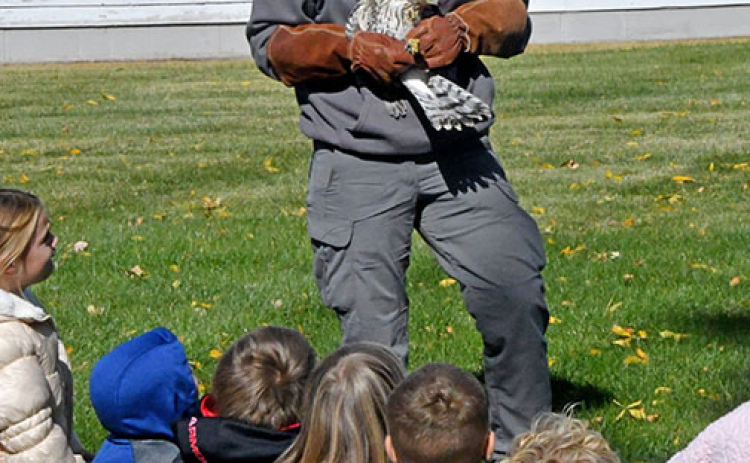
Students at the Edgerton Explorit Center’s Afterschool Club were treated to a special send off as they witnessed the successful release of a Cooper’s hawk back into the wild.
The launch was done with care by Edgerton educator and Raptor Recovery volunteer Deb Miller.
“It’s really cool process that way,” Miller said. “It’s very rewarding, like today seeing the success that he was well enough to go and flew really well to go back and be a raptor again.”
The Cooper’s hawk species can found throughout North America with small birds being their main source of food.
“They usually have maybe two to three babies,” Miller explained to the students. “They come back to that area every year and raise their babies. Now, the babies have to go off and find a new place to live, but their mom and dad always come back to that same area and live.”
The bird had been discovered three weeks prior by Plainsmen director Tina Larson who found the hawk on the ground between Museum and the Edgerton.
“Tina goes, ‘I think one of your birds got free,’” Miller explained. “We go, ‘Oh that wouldn’t be good if one of our guys got of their enclosure.’ So we go out there. No, it was this little Cooper’s hawk.”
While unsure if the hawk had hit one of the buildings or was side-swipped by a passing vehicle, the hawk’s drooped wing had prevented the hawk from getting back off the ground.
To make the transition back into the wild as smooth as possible, the Cooper’s hawk was released back in the area where it was originally found.
“Like anybody else, you get a bruise it takes while for it to work itself out and get good again,” she said. “Because we had observant person, we got right person informed, we went and got him, and we got to release him back here in his area.”
The hawk’s successful recovery was in thanks to the Raptor Conservation Alliance (RCA), which was started by RCA director Betsy Finch to nurse raptors, such as owls, eagles, hawks and vultures, back to health and be released back in the wild. 
“He went to the hospital a couple weeks ago and he had to get some medicine, some rest, because he had a bruised wing,” stated Shawna Vinkenburg, the after school program director. “When he started feeling better, started exercising and being able to fly again, then what happens is he gets to come back to where he was living.”
When a bird is found injured anywhere in Nebraska, the raptors will be transported to a raptor rehabilitation center in Lincoln by transporters.
“We have volunteer transporters all over the state, which act like ambulance drivers,” Miller explained. “When a person finds a bird that’s on the ground that they know is not normal, they will call in and then it’s dispatched to the people in the area.”
The rescue had been a crucial moment that is often not a fortunate ending for other raptors that have been found.
“We pretty much have about a 40-45 percent survival and release from birds that are injured,” she said. “Which you might not think is great, but some of these guys are hurt when a car hits them. They’re tough. They don’t die right away, but their bones are just shattered and you can’t fix them.”
While other birds have survived and recovered from their injuries, the extent of the damage done to their wings prevent them from ever flying again.
“Their only chance then that survival was either to be put to sleep or become an education ambassador,” Miller stated. “We have some that have programs you have to have a special permit to have them and that’s their sole job is to be out for education programs.”
She also commented that birds that are unable to be released back into the wild have been used as foster moms to chicks that have fallen from their nest.
“We can put (chicks) with those foster moms, she will raise them and then we will be able to release those babies when they’re old enough to be out on their own,” Miller stated.
Miller currently has four education ambassadors that had been in her care since 2019. An eastern screech owl, a Swainson’s hawk, an American kestrel and a bald eagle.
While the birds are not on display for viewing at the Edgerton, the birds are taken for various programs in Nebraska to help spread awareness to RCA’s mission and conservation efforts.
“You need to have 12 programs a year to make sure that they’re maintained on their permit,” Miller explained, referring to the permit through Fish and Wildlife to care for the raptors. “But for us, because of the programming we do, one year we had 56 programs. So we get a lot of programs. They get a lot of work.”
During such programs when she shares what may cause a raptor to become injured, she informed that other human factors have caused declines in the raptor population and the actions conservationists have took to help the populations.
“We learned that DDT was a very detrimental pesticide that almost debilitated the bald eagle raptor population until we got rid of that,” Miller said. “Now the bald eagle has rebounded is off of the endangered threatened list.
“I just think starting young is very important for them to respect them and not to be afraid of them,” she added. “They serve a purpose and I think the more we can get that information out to them, they will respect those birds.”
With the Cooper’s hawk back in the wild, Miller spoke to the students with hope that the hawk will continue to live a healthy life and reconnect with his mate and chicks should he had any prior to being injured.
Prior to being released, she had shown students a band that will identify the hawk should he found once again.
“If he gets hit and dies somewhere and they find him, they can look that (band number) up and they can say where he was banded and you know when he was released,” Miller said. 
While being an unique experience for students in the after school program, Miller commented her hope that it will fuel their desire to learn more about science. 
The Afterschool Club, offer learning activities to students from kindergarten through fifth grade on Wednesdays.
“It gives the opportunity for parents to not have to try to find daycare for them for that couple hours,” Miller said. “The way the program is set up, it’s very stimulating. They get to do hands-on projects, science experiments and they go on field trips... It gives some of these kids the opportunity that they wouldn’t normally get the chance to do.”
Parents interested in having their child enrolled in the Edgerton’s after school program can contact Mary Molliconi at (402) 694-4032 or at mary@edgerton.org to check for potential openings.
If a injured raptor is found, Miller encourages people to call RCA at (866) 888-7261.