
Mission Critical highlight of busy ADC year

Subhead

Bergen recaps projects during group’s annual mtg.
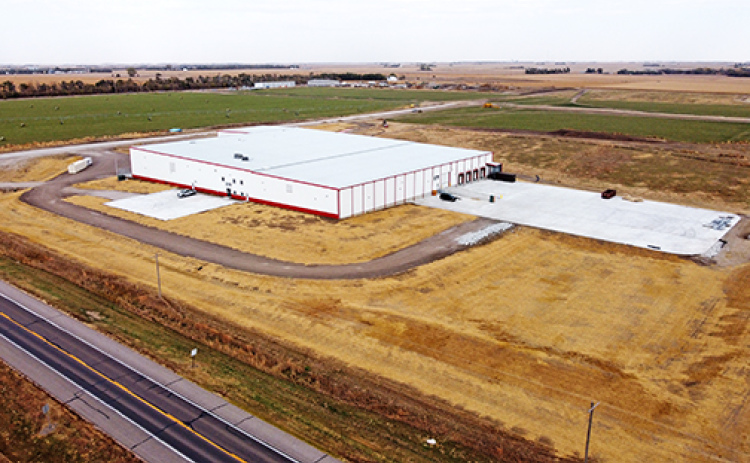
The Aurora Development Corporation highlighted a busy year of activity during its annual meeting last week, completing its 60th year as an organization.
Shareholders gathered at the Bremer Center for an overview of past and planned activities, while also hearing from several local businesses on their status and plans for future growth.
Kelsey Bergen presented details of the year’s progress during her executive director’s report, noting how the ADC is reinvesting funds to continue to help grow the community.
“We’re coming to the close of our 60th year as an organization and we’ve really taken it up a notch over the last couple of years with the activities we’ve had,” she began. “I think probably the most important thing to touch base on is Mission Critical, since that’s where the bulk of our time has been spent over the past year and where most of our development has happened.”
At last year’s annual meeting, Bergen noted that Illinois-based BRANDT, Inc., had just named its Aurora project as Speciality Ag Formulations, a company that is now preparing to bring its new 100,000 sq. ft. micronutrients production facility online. AAIM Data Centers is also nearing completion of its new facility on the north edge of the Mission Critical Subdivision, and just to the east Mid-Nebraska Land Developers continues to expand its operations as well, having recently purchased additional acreage to the south.
Bergen noted that one of the biggest factors in the Mission Critical development over the past year can’t be seen driving by, but was critical to its success. Aurora was one of several Nebraska communities to receive a Community Development Block Grant from the state in 2010, she noted, which helped ADC purchase the 135-acre site on Highway 14. One of the requirements of that grant was to create 22 Low to Moderate Income (LMI) jobs in a 10-year period.
“We asked for two extensions from the state and they told us last year, after we were already working on Specialty Ag Formulations, that this program ends in February of 2024 and that we cannot extend any more. You have to create your jobs,” or return the grant funds.
“We were really excited that Specialty Ag was coming, but then we went back and worked with Mid-Nebraska to capture all the jobs that they have created here, because they’ve also had a lot of growth and development.”
Through those efforts, she reported, 24 new jobs were documented, with 71 percent of those offered to LMI candidates, which completed the CDBG requirements.
“That was a huge deal for our community,” she emphasized. “Several communities across Nebraska had to pay those funds back this past year, so this would be a completely different meeting if that had been the case here.”

Business retention, expansion
In addition to ADC’s work on the Mission Critical Subdivision, Bergen noted that part of her time is spent working with local businesses on retention and expansion projects, including grant applications for the city’s Downtown Revitalization Fund.
“There has been a lot of working with these businesses to make sure they fill out the paperwork right and they dot their i’s and cross their t’s, but it’s something that’s definitely needed,” she said. “Whenever I talk to people outside the community, which I do a lot, they always talk about how great Aurora’s square is, so it’s nice to be able to help maintain and preserve that.”
Bergen also reported on her continued work with the Nebraska Department of Economic Development, which provides requests for information (RFIs) on companies looking for potential development sites.
“We did a target industry study in 2021 and it said that one of our areas that we are strongest and that we can serve really well is chemical manufacturing,” she explained. “It’s not a surprise that companies like Specialty Ag want to locate here and a lot of that is driven by having our ethanol plant, because we already have those skilled workers here. We also have the ammonia pipeline that’s right here and we have a large amount of farmers that are using these products in our area. And then with the CO2 pipeline that they are working on and connecting with KAAPA, that is just another project to further open the door to additional opportunities.”
Another development Bergen mentioned briefly is a construction project now beginning in the Matson West Subdivision, which is located just south of Highway 34 west of the new housing subdivision. 
“That is a smaller scale version of what we’re doing at Mission Critical, where we pulled in some state Site Building Development Funds,” she said of a project involving construction of a new facility for Kiner, Inc. “I helped with that, the city was a partner, and Streeter was a partner in helping Kiners build a standalone location. They have been working primarily on site before now, so it’s exciting to see those local businesses grow and expand in that, together.”

Housing efforts
Finally, Bergen reported on ADC’s role in supporting efforts to expand the local housing market, working closely with the Aurora Housing Development Corporation.
“As an organization, the Aurora Development Corporation has contributed $212,000 to the two revolving loan funds, so that has helped create $3.5 million in funding that’s available for builders to come and build different types of houses in our community,” she said. “We’ve had partnerships beyond the revolving loan funds with AHDC and the city to build out a 60-lot subdivision, kind of taking on the same thought process that we’re doing at Mission Critical on the housing side.”
Those efforts have proven successful, she reported, with the first grant creating 13 single-family homes and 16 duplex units in Aurora, with infrastructure in place for an 18-unit 55-plus duplex subdivision. The second grant, she added, was earmarked for apartments, noting that the 12-unit Streeter Apartments complex opened within the past month.
“Coming down the road there are three more houses that are coming later this year and early next year four more duplex units, and then a couple other single-house projects that they’re working on,” she concluded. “So it’s just really great to add all those additional houses to our housing market because it’s something that we really need to make sure that we’re addressing workforce. We’re working really hard at housing and we’re adding a lot of houses to the market, but we are still down 10 houses on the market today than we were a year ago, so it’s definitely an ongoing issue that we have to keep working on.”
Board members present for the annual meeting also approved a slate of five officers to be re-elected for three-year terms. They include Jacob Arendt, Mike Morrow, Kurt Johnson, Kirk Penner and Jill Myers.