
Pawleys took training on storm preparedness
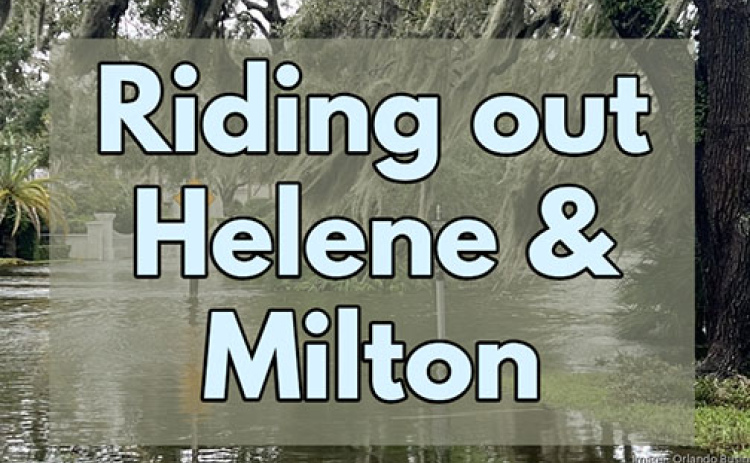
Having moved to Florida less than a year ago, an Aurora couple survived their first two hurricanes in good shape, despite the Category 5 storms Helene and Milton being two of the worst storms in recent history.
Retired Aurora school teacher Marsha Pawley and her husband, Steve, moved to the Orlando area last November to be near her parents, and the recent one-two punch of Helene and Milton was the first time they had experienced such storms. Although the town of Lake Wales where this live was in the direct path of Milton, since they live more in the interior of the state, the damage they saw was mild in comparison with the devastation faced by residents along the gulf coast.
“During the Helene storm, we had about 2-1/2 inches of rain and wind gusts up to 40-45 miles an hour, so we did not have any major impacts from Helene at all,” Marsha said.
Pawley said they were somewhat prepared for the storm, because, being newcomers, they had taken some hurricane preparedness training after making the move to the Sunshine State.
“They talked about supplies that you needed to have on hand in case you were without electricity for a given amount of time and how to pick up the area around your house to make sure that nothing became a projectile in the wind,” she said. “So the training was definitely helpful, and we were thankful that for Helene, nothing really affected us.”
However, Milton, which made landfall two weeks later on Oct. 9, had a bigger impact.
“With Milton, the eye of the storm, went over Lake Wales and my mom and dad, Cliff and Jessie Jensen, also live in the area. They are former Aurora residents as well. We spent the night at their house and you could hear the wind gusting. We just thought it would be easier to all be together, and we played games that took the attention away from the storm and just kind of gave us something to do together. And afterwards we found out the wind gusts were probably about 80 miles an hour. We stayed up till 1 o’clock in the morning. We were playing cards just to divert our attention from the wind.”
She said when the eye of the hurricane passed over between 1 and 1:30 a.m. the two men went outside to see if there was any damage.
“There was some damage in the area, mostly tree damage,” Pawley said. “We live in a 55-plus community that has a lot of modular structures, and some of the skirting around the bottom had blown off, and then after the eye went through, then the winds continued to blow. But again, we were very, very blessed with mostly tree damage and, like I said, some skirting in the area. After the men went out and surveyed the area, we decided we should at least try to sleep. There were some guests that woke us up during the night, but we were able to sleep as best as possible.”
Pawley said their house lost power at about 10:30 the night Milton hit Lake Wales, but it was restored by 1:30 p.m., a day and a half later. The only other impact at their home, according to Pawley, was some downed branches and scattered Spanish moss from their live oak trees.
Having moved from Tornado Alley in Nebraska to Hurricane Central in Florida, the former teacher said Helene and Milton provided a learning experience.
“Well, we know we can do it,” she said. “But it’s not the most pleasant experience in the world. If you live in Tornado Alley, a tornado doesn’t last very long, and although you do have warning most times, as we had warning with both of the hurricanes, it just lasts a lot longer, like four hours before the eye and four hours after the eye.”