
Smith reflects on 32 years with county EMS

Subhead

Outgoing county emergency manager started as an EMT
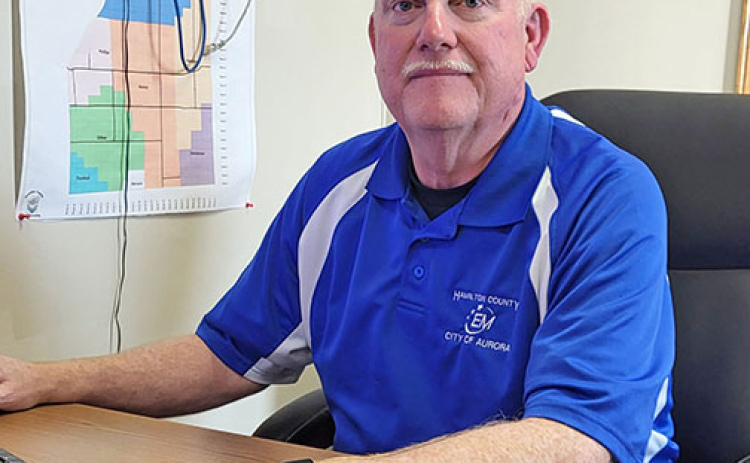
 

Hamilton County’s first full-time and now outgoing emergency management director, Kirt Smith, looks back on his more than three decades of working in local emergency services with a great deal of satisfaction and gratitude for those around him who he says have made his job easier. Smith recently resigned from the position after serving in it for over 20 years, but plans to stay on to see his successor through the transition period before moving into a new job he accepted as Aurora’s new EMS director. 
A life-long native of Aurora, Smith was gone from the county for only four years to serve a hitch in the U.S. Air Force before returning in the early 90s. 
“When I first came back in June of 1992 after four years in the Air Force, I got a job as an EMT part-time, and then I got hired on as the full-time person,” he recalled. “I was a medic in the Air Force, so I was kind of wanting to get into that field.”
Over the next two years, Smith trained to become a paramedic and worked in that capacity, becoming the county ambulance director in 1999. In 2007 Smith also took on the job of county emergency management director working in both jobs for the next two years before becoming the county’s first full-time person in that position. 
“By state law, you’re supposed to have a full-time Emergency Management Department,” Smith said. “So if that’s either the director or an assistant or whatever you have, they want that position. Obviously, it’s a pretty important position, and there’s also funding there from FEMA. Basically, the feds push the funding down to the states and the states pass it through to us.”
The federal grant pays 50 percent of Smith’s wages, health insurance and other benefits. Smith said the grant also helps pay for some equipment, phone bills and other expenses. 
The days following his taking over as EMD were a kind of trial by fire, Smith recalls. First there was a tornado in 2008 that narrowly missed downtown Aurora, but did significant damage on the ground near I-80 before finally dissipating near Hampton. 
“And then we had another tornado after that,” he recalled. “The tornado was coming right down Highway 34 in June of ‘09. It destroyed a house there on the highway and did damage to IAMS and to the Koch (anhydrous ammonia) plant. That was coming straight down the highway, and it started veering off to the north just a little bit and dissipated, so otherwise, that thing was coming straight for town.”
In all, Smith has dealt with 13 presidential disaster declarations in his time as EMD. Those situations involved severe wind storms, flooding, ice storms and blizzards, but the biggest and longest lasting crisis he has had to deal with was the COVID pandemic of 2020 and beyond. 
“COVID, obviously, was a large, on-going, long-term disaster that we were involved with constantly at the emergency management level,” he said, joking that it may have taken a few years off his life. “It was very long and enduring. Most of our disasters, they happen right away and you get through that period of time where you’re really going after it, and that kind of dies off a little bit when you’re starting to do the damage assessment. And then you have the time period of making sure everybody’s alright, figuring out how many damages there are... FEMA comes out and does their thing, and then you get to the recovery phase, which can drag out on some disasters. But when we were in the response phase for so long with COVID, I mean, we had meetings seven days a week, twice a day, at the very beginning. 
“We’re very fortunate,” he continued. “Our health department was really good here and we met daily with our Central District Health Department – the three emergency managers and the three counties that they cover and the hospitals that were in those counties. We had a unified command meeting twice a day at the beginning, and we were together via Zoom on that... But that was a long-lasting disaster. It was just one of those things that just kind of went on forever.”
Looking back on all of it, however, Smith said he is extremely grateful for all of the people he has worked alongside down through the years. Included in that long list are the various county boards he has served under; state, county, city and village elected officials and staffs; hospitals and health agencies; schools as well as private individuals and organizations such as churches. 
“I’ve helped plenty of churches with their emergency action plans,” he said. “For them it’s kind of wide ranging. People just don’t understand that. It covers the whole community, and I’ve enjoyed every bit of it, and I couldn’t have done it without all those people helping all the way.”
“I’ve worked with all those people,” he said. “Obviously the law enforcement and all the local fire departments. I really want to make sure that the local fire departments get a big thank you, because they make my job a lot easier. They’re very good at their jobs, and they take everything seriously as to their training and their dedication to help the people. So it helps me feel a lot better knowing that those people are out there doing that, and it’s a lot easier for me to get the messages out to them, and they take care of things and let me know back what they need.”

Unsung heroes
With regard to law enforcement, Smith called dispatchers the unsung heroes.
“I mean, they do a lot of stuff, and are getting hit from every different direction as things are happening -- especially the disasters like tornadoes,” he said. “They’re getting citizen calls in, they’re getting emergency responders traffic in, they’re getting all that stuff at the same time and trying to get that information out.”  
Smith also expressed his appreciation to the forecasters at the National Weather Service office in Hastings whom he has worked with for many years. 
“I have very good working relationship with them,” he said. “We work with them constantly and they’ve all been really great to me over there.”
Smith said thinking about all of those relationships down through the years made his resignation before the county commission an emotional experience.
“It was hard for me to read the letter to them,” he said. “You get used to something for 32 years, and it’s hard to just give it up, but I’m not totally giving it up. I’m gonna be here through the transition. I’m helping them, and I’m still going to be a part of the community, and I hopefully will still get to work with some of the partners and I hope they appreciate it. I want them to know that I really appreciate everything everybody’s ever done to help me throughout these 32 years and I just look forward to the future and watching this emergency management be good in Hamilton County and grow and keep us protected and keep up on all that paperwork.”
Smith and his wife are both Hamilton County natives. Teresa is a graduate of Hampton High School and Kirt is an Aurora grad. Their two daughters graduated from Aurora as well. Their oldest daughter, Katie, lives in West Des Moines, Iowa and Elizabeth lives in Lincoln. His parents still reside in Aurora as well.