
Jeremy Burgener enjoys the fellowship of the hunting blind

Subhead

A decade after taking up hunting local waterfowl hunter is all in 
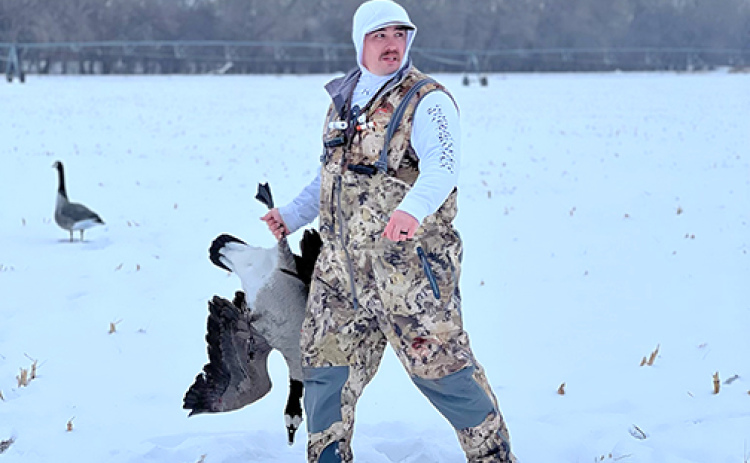
Since Jeremy Burgener became an avid waterfowl hunter several years ago, he suspects his wife, Tessa, sometimes regrets she urged him to take up the sport after the couple moved to Aurora. After all, he spends many weekends in blinds from roughly the first of September through the middle of February, their garage is now full of goose decoys and he recently invested in a Labrador Retriever puppy he is training to be a hunting dog. 
Burgener said although in his growing up years in the Panhandle he had been around guns and had shot prairie dogs, he never hunted birds until the winter of 2014. And that was at Tessa’s urging shortly after they got married in October of that same year.
“We get to the winter, and she’s like, ‘You have to go find something to do!’ So she told me to reach out to Zack Tesar and Kyle Howland and go hunt, try to hunt waterfowl with them, hunt geese with them,” he said. “So that’s what I did, and she gave me a little budget. I didn’t own a gun at that point and I actually bought two shotguns, because I didn’t know which one I wanted. And I bought some snow boots, some camo coveralls, a coat, and then I kind of just hopped in with those guys and started hunting.”
While he already knew how to shoot, Burgener says he knew little about how to hunt waterfowl. However, that first season he shot a handful of Canadian geese and a couple of snow geese and was starting to get hooked. 
“And then that next fall was my first duck season, and then that’s kind of when I got really hooked at that point,” he said. “I think she kind of regrets it now, because it has actually took over. I’m going to North Dakota in October and this will be I think my fourth or fifth year in a row in North Dakota, the same week.”
Burgener said since he started hunting regularly he has shot a turkey using a bow and has tried bow hunting for deer but finds himself drawn to waterfowl hunting because it’s something that can be done with a group of friends. 
“I like the camaraderie of waterfowl hunting,” he said. “You don’t have to be quiet. You can kind of screw around, cook breakfast, all that kind of stuff. I don’t like sitting in a tree stand by myself and being quiet. It’s just not really for me.”
He said he took a deer hunting trip to Minnesota with friends a while back but found that all the other aspects of the trip were more enjoyable than sitting for six hours by himself in a tree stand and being quiet.  
“I think the first year I got a bow, I sat for 100 hours and never even pulled my bow back,” he recalled. “And then the next year, because I sat for so long the year before, I didn’t sit nearly that long, but still didn’t really have an opportunity.”
However, he said what he enjoys most about waterfowl hunting is the camaraderie of the blind.
Speaking of duck hunting, he said, “Typically you’re going to spend more time in the blind without birds working than you are with birds working, so a lot of the guys that we hunt with are like-minded and we joke around. A lot of times we’re watching football or something in the blind too, listening to the Husker game or something like that, especially during goose season. We probably chase geese more than we do ducks, just because of the access that we have. During goose season they’ll get up and feed in sort of large groups, but it’s constant (activity) for like, an hour, hour and a half. You don’t always know when that hour and a half is going to be, so you show up early (in the afternoon), typically, and then they fly. We’ll say shooting time ends at like 5:30 and they’ll go hard from like 4 to 5:30. But we usually get set up by like 2 o’clock or 3 o’clock, so you have an hour to kind of screw around and we usually cook breakfast, lunch and stuff. If you ask my wife, we just go out there to eat breakfast and hide from our wives.”
In addition to the hunting trips being a time to spend time with friends, Burgener said it also gives hunters an opportunity to get the younger generation involved in the sport, while getting some additional help with the big job of setting up and taking down things like the dozens and dozens of decoys they use. He said until the recent dry conditions began to impact the bird seasons locally, the group often took along one or two young hunters during youth season. 
“When you put out a lot of decoys or are setting up blinds and stuff like that – I’m still gonna go regardless – but if three or four people come with us, then you just have to put out less stuff and pick up less stuff,” he said. “So that’s kind of how it started, and now we’ve kind of all gone hunting together for a while... Some of our best hunts last year were when all of us were in the blind.”  

Decoys
Speaking of decoys, Burgener said they switched from full-sized 3D decoys a few years ago to silhouettes which he described as being a picture of a bird printed on yard sign material, cut out and staked out much like a campaign sign. He said that makes it easy to carry in and place hundreds of decoys that look just like real birds from the air. 
“They stand up straight up like a yard sign, but unless you’re straight above them, the geese can still see them,” he explained. “So they’ve done drone footage, where, if you’re a goose and you’re flying around the spread, or right above it, you can still see them, and actually, when they lose the image of them, if they get straight with them, it makes it look like they’re moving in the field. It’s pretty crazy.”
In addition to geese, Burgener says he enjoys hunting a whole range of waterfowl, everything from teal to spoonbills, gadwall, pintail, wigeon, red heads and as many as seven other species. While he has traveled to hunt, such as with his annual trips to North Dakota, Burgener said he often hunts close to home on local wetlands. However, he said the drought of the past couple of years has impacted that. And he said the wet spring and summer this year hasn’t helped as much as one might think.
“Yeah, everything’s green, but we used to have a really good private marsh that we had access to – awesome landowner. Well, the first year I hunted it, it was like belly button deep water. The next year we hunted it, it was about knee deep and by the end of that season, it had drained out, and it hasn’t filled back up yet. It’s a pretty big spot of land, a really cool spot to hunt. But now we don’t have any water so we don’t have any ducks. It did have water on it early, like June and July, but then by Sept. 1 when teal season opened it didn’t have any water in it, so it’s not holding any birds and we couldn’t hunt it... You have to have the right conditions, so you have to be really wet for multiple years in a row, and then your marshes, your lowlands, they’ll start filling back up.”
If the dry trend continues, Burgener said he’s concerned the local waterfowl hunting might be impacted for years to come. 
“Ducks and geese migrating are very patterned, so they remember what route they took,” he said. “So if we end up with very little water, eventually they’re going to stop going with us. They’re going to hit the Missouri River and go down that way. I don’t think that’s changed yet, but I’m worried that it could be the case.”  

Gun changes
Those two shotguns Burgener started off with when he started hunting waterfowl were a Mossberg 835 and a Browning BPS, both 12 gauge pumps. 
“I’m left handed and they both had tang safeties, so it was a thumb safety instead of underneath on the trigger guard,” he said. “I ended up selling the Mossberg first, and then I sold the Browning, and I went to a Winchester SXP, which is still a pump.” 
He ended up with a Franchi Affinity semi-auto 12 gauge followed by the same gun in a 20 gauge, which has become his go-to gun for waterfowl hunting.
“I mostly shoot a 20 gauge and I hardly ever shoot a 12 gauge,” he said. “A lot of guys will say, ‘Oh, I shoot a 20 gauge because it’s more sporting.’ Well, you know, maybe that’s why I switched, but it’s so much lighter. It swings so much better, packing it in and out of marshes and stuff like that is really, really easy. I think it hits just as hard. I mean, I’ve probably already killed as many birds with a 20 gauge as I did with the 12 gauge.”
Because lead shot is prohibited for waterfowl, Burgener said he usually shoots bismuth loads from his 20 gauge and steel shot out of the 12 gauge. 
“It’s still got to be non toxic, but the bismuth hits like lead used to, so it just carries more momentum and it’s a bigger payload,” he said.