
Proposed city tax hike stirs heat during pink postcard hearing

Subhead

More than 130 residents voice concern with lack of information
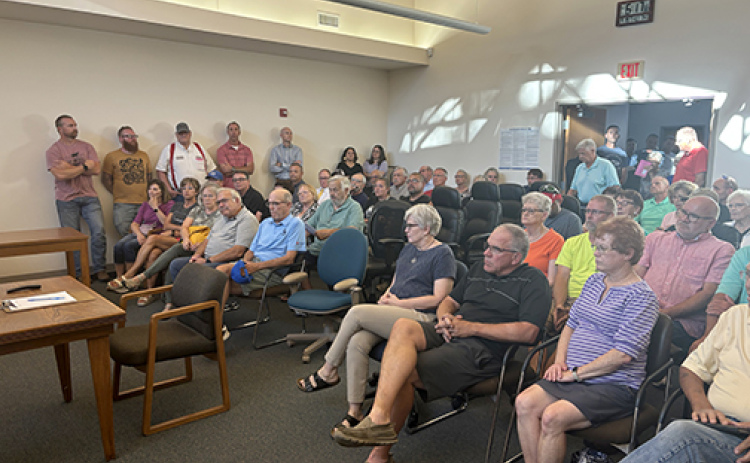
More than 130 people filled the council chambers at City Hall Thursday, many venting frustration at the city’s proposed 38 percent jump in tax asking, as well as a lack of information explaining the $751,816 increase.
Proposed budgets for both the City of Aurora and Hampton Public Schools were the reason for a joint “pink postcard” public hearing, though the majority of the 90-minute meeting was focused on the city’s budget. One person spoke in favor of the Hampton school budget after Supt. Holly Herzberg’s detailed presentation (see related article elsewhere in this edition), while 18 people raised questions or offered feedback on the city’s proposal to City Administrator Rick Melcher and Mayor Marlin Seeman.
Melcher began the meeting by reading a prepared statement listing the city’s proposed tax request at $2,714,840, also announcing that the city’s levy is proposed to increase from 37.9 cents to 52.5 cents per $100 of assessed valuation.
Long-time Aurora resident Jim Koepke challenged Melcher after his presentation, noting that the city is required by law (LB 148) to show comparisons of this year’s proposal to last year’s budget, explaining any increases.
“You’re asking for $756,000 in new money, but you didn’t break down where it is going to be spent,” Koepke said. “This is a public hearing where the council people come to hear us before they vote. I can’t believe this.”
Melcher responded by saying that he presented the information required by law and invited anyone in the room to come to his office for a more detailed explanation.
“What we’re using this money for is a couple of different reasons,” he later said. “We’ve had the EMS system since 2019, and not just that but inflation cost is increasing our cost, so that’s two parts of it. The rest of it is that our reserves are used up, so we’re not relying on them anymore.
The city’s auditor reported in March that the city’s reserves have dipped from $1.53 million in 2019 to $681,677 this year.
“The reserves are gone that we were using to help with the ambulance service, the fire service, the police department and other general fund obligations that we have and that’s precisely why the city council decided to go with a resolution on the sales tax,” Melcher said of a 1-1/2 cent sales tax proposal voters rejected by a vote of 822 to 325 in May. “When that didn’t pass we have to get our revenue from something.”
“This has nothing to do with the sales tax,” Keopke responded. “This looks like the sales tax didn’t pass so you’re saying we’re going to get even with you and we’re going to ramrod this thing through. We have no say. We spoke at the ballot box, but here we don’t have a chance.”
Seeman said the proposed budget is a result of the city not having another funding alternative.
“I don’t really care one bit about sales tax,” he said. “We have one source of funds so we have to go to you and say to fully fund the expenditures that the city anticipates in the 2024-25 budget that we have to have an increase in tax asking, so that’s what this is about.”
“But why 38 percent?” Koepke asked. “If you were talking 8 or 10 percent I could understand that and I wouldn’t even be here.”

Citizen feedback
Several citizens shared concern not necessarily that the city is proposing a tax increase, but rather the amount of a one-year jump.
“Things are getting out of hand,” said Dean Amundson. “It’s getting to be a struggle for I think a lot of people. This is my first time being here and I think I’m here under the wrong reasons because it shouldn’t take something like this to get somebody like me to come in. But I’m here and I’m a little ticked off about the property taxes.”
Aurora native Chris Patton agreed that many local citizens are struggling in today’s economy, noting that his mortgage may go up as much as $300 a month.
“Why hasn’t the budget or the city finances been managed more properly?” he asked. “It’s obvious to us all that there’s something kind of funny going on and maybe now is not the right time for community development,” he added, in reference to Seeman’s comment that he wrote a check for $500,000 recently to the Aurora Development Corporation to help fund infrastructure costs at Mission Critical. “Maybe since the community is struggling, our people are struggling. Why hasn’t that conversation come up?
“I would wager to say that none of us here are saying we’re going to eliminate taxes because we understand as citizens that there is a cost associated to running a government,” he continued. “But what I think we’re seeing now with these consistent hikes is that there is some mismanagement of funds and that’s why we’re here. We’re concerned about the way our government’s being run right now. You guys’ lack of preparedness for this meeting is indicative of that.”
Josh Ommert, who moved to town in 2020, said in his opinion it is getting harder to raise and support a family in this community, comparing Aurora’s property taxes to that of Grand Island.
“So to address the sales tax thing, who wrote that proposal because it was horrible?” he asked. “If you want people to vote for something give them information … It’s getting to the point where it’s not manageable anymore, so what are our options but to come to these meetings and voice our frustration, even though nobody’s here to hear them.”
That comment was in reference to city council member attendance. Three of the five council members were present, in addition to Melcher and Seeman, though it was later explained that only three members were encouraged to attend to prevent there being a legal quorum for what was not advertised as a public city council meeting.

Seeking transparency
Jannelle Seim raised several points during her testimony, saying she was speaking as president of the Aurora Housing Development Corporation.
“People didn’t vote down sales tax because it was a sales tax. People voted down the tax because it was a double-digit tax increase and we weren’t sure where the money was going,” Seim began. “All we wanted was transparency and so we are here today asking for transparency.”
Seim also weighed in on the topic of economic development.
“I want to say that development is definitely where we should be putting our money, but development is not where that increase is going,” she said. “That is done by ADC, AHDC and the foundations. The city has a part it in. It’s a small part, but saying that that’s the root cause of this 38 percent increase is crazy to me.
“All of community development is an investment, not an expense,” Seim continued. “We did a huge housing project … on the west side of town and that whole project was $2.2 million. The city did pitch in $283,000, which was fantastic. That was a great partnership, but it’s not the reason for the pink postcards.”
Gary Warren, a long-time resident who has been involved with local development projects over the years, also addressed the city’s role and investment in economic development.
“The $500,000 that the mayor mentioned is not in this 38 percent,” he said. “That is a capital expenditure. They are either bonding the indebtedness or whatever, and they get paid back over time out of real estate taxes from the place south of town.” 
Warren also noted that the city’s investment in the housing project was classified as an operational expense and was not part of the general funds budget.
Seim want on to say that she was dismayed by the city’s lack of information on the budget and the need for a tax increase.
“I have worked in private industry, for a non-profit, for the government and for the college,” she said. “Even where I work now, if our budget increases more than 5 percent I have to tell my board of directors why my budget is going up. We are your board of directors. We are your constituents.You should really be excited to show us what you’re doing. If you’re truly proud of it, then show us your work and stand behind it. Not saying anything is cowardly and unacceptable.”
Salary issue
Near the end of the hearing, Melcher said that the city’s salaries are below average as compared to other communities, noting that salary increases were a key part of the budget increase.
“We’re short personnel now and we can’t hire them to do the job now and if we don’t pay them what we’re paying them now, they can go somewhere else, and they have,” he said. 
Local resident Ann Ashburn challenged Melcher on that comment, saying she had done some research to try and figure out how Aurora compared to other Nebraska communities.
“There are only three other communities in the entire state of Nebraska that are paying the same rate that we’re being asked to pay and they have over 8,000 people living in the city,” she said. “You’re making almost what the city administrator in Hastings is making and they have 27,000 people, so I would say that is not true,” she later added. “The lack of transparency makes us even more skeptical about anything you say.”
After 90 minutes of often heated discussion, Warren suggested that city leaders listen to the citizens and work to amend the budget before Tuesday’s schedule vote of approval.
“You’ve obviously lost some trust and I have a suggestion for trying to go about mending that,” he said. “I would have the information at your council meeting Tuesday night. I would reduce the tax asking. I know you’re not going to take it to zero and I’m not asking you to do that, but as a sign of good faith I’m suggesting you reduce the tax asking. You’re going for the maximum mill levy, just like, in my opinion, you overreached on the sales tax. Don’t do it. Back off. Struggle with the details. Let’s rebuild the trust so we can work together.”