
Wayne County showmanship program has roots in Hamilton County
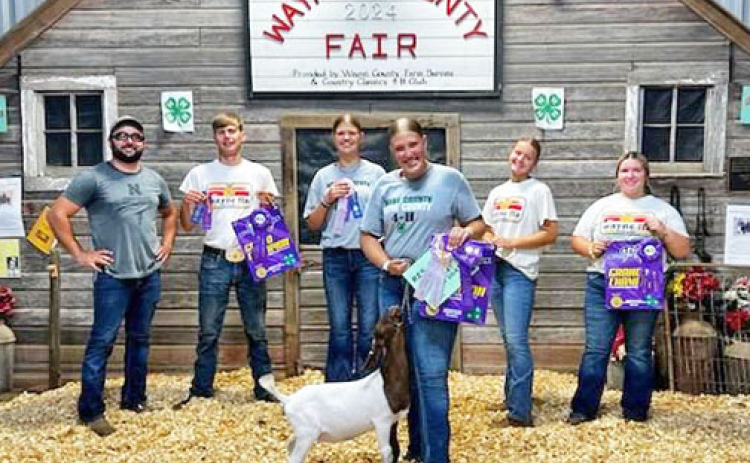
The common expression “pay it forward” refers to a person who has received a gift or an act of kindness doing something kind or generous for someone else, rather than simply accepting to repaying the original good deed. The beauty of paying it forward is that the good deeds tend to multiply, impacting many others into the future.
A real-life example of this concept has played out during this summer’s fair livestock show season as one young man is paying forward a kindness extended to him during his years as a 4-H club member in Aurora by local sheep producers, Andy and Bonnie Jensen through their former urban sheep program. Trevor Sullivan, who now owns a construction business in Wayne and is married to a high school ag teacher, has started an urban goats program and is helping city kids in Wayne be able to become FFA showmen by providing goats for them to show. He said the program is creating an interest in agriculture among the town kids and is causing other rural people to think about how they could be involved in helping urban young people to get a hands-on experience with farm life.
The beginnings
Several years ago when Sullivan and his younger brothers, Jared and Kyle, were living on the edge of town and attending Aurora Elementary, the Jensens, who ran a nearby sheep operation, were looking at their empty nest and thinking about how they could help other young people become sheep showmen as their two now adult children had been.
Bonnie says her son Rob and daughter, Ang, had shown sheep all through their high school years, and Ange especially had traveled around the state participating in market and 4-H showmanship competitions.
“We would go to shows all over the place,” Bonnie said. “And so I really missed the young people and interacting in young people’s lives to be able to to see what it did for for my kids, you know. And so the idea came up one day of, ‘Let’s be able to share this with the youth of the area, if they would be interested, to be able to give them a little bit of piece of what we had in life raising our kids.’”
The Jensens took their idea to then Hamilton County Extension Agent Andy Christensen, who helped them design a contract for in-town 4-H clubbers to be able to use their sheep to learn about animal husbandry and participate in 4-H showmanship. Under the terms of the program, the students would give the Jensens a check for a certain amount estimated to be the price of the animal, essentially purchasing the animal for use in the competitions, while agreeing to work with the animal and see the program through to the end of the season. If the students completed their part of the contract, the check would be returned to them at the end of the show season. Needing a name for the program they decided to call it urban sheep, since they were giving kids living in town an opportunity to participate in something usually reserved for rural kids.
That, however, created some controversy in the early days of the program, according to Sullivan.
“As a showman, I wasn’t in charge of feeding, of watering, of providing shelter, of a lot of these things,” he said. “And some of the other showmen... didn’t see that as fair, where these kids were getting up and they were feeding every morning, or they were providing this and that, and it wasn’t fair... We weren’t doing the daily chores.”
However, Sullivan says, in addition to going out to the farm and training the sheep in preparation for shows, he and his brothers did lots of other things at the Jensen farm, learning a great deal about agriculture in the process.
“There were multiple summers where Andy would call us and we’d go help him put up hay or or shut off irrigation pipe or whatever... It was the three or four nights a week of going out there and working with them. And Andy would say, ‘Hey, I’m going to show you how to clip this lamb and shear the wool off, and then you’re going to do it. And if it’s not perfect then that’s what it is, because you’re doing it, and it’s your project.”
Bonnie also fondly recalls how the relationship with the Sullivan boys grew over the years and how much they grew in their agricultural knowledge.
“As they got a little older, if we were going to be gone, they would come out and help feed,” she recalled. “They would help when it came time to sort for breeding. They would help maneuver the animals for sorting. And when it was time to move from the pasture back to the home place here to lamb out, they would come and help drive them down the road to be able to get to where they needed to be.”
Sullivan says while he and his brothers learned much more than showmanship through the experience, that was the primary focus and they learned it well.
“We were always told showmanship is the division at the fair where you’re judge based on your ability to work with your animal,” he said. “It has nothing to do with whether you have a world class lamb or goat. It has nothing to do with whether you’ve spent all the money on the feed to get them as beefy as possible. It has nothing to do with that. It has to do with the amount of work that you put in with that animal to get it ready for the show. And that was what we were pushed from a young age.”
In addition to the Sullivan brothers, the Jensens provided sheep to more than 20 town kids over the years of thier urban sheep program and never had to keep a check at the end of the season.
Paying it forward
Sullivan says he has attempted to keep that same emphasis with the urban goat program he started in Wayne this past year. He said the concept actually developed between he and his brother, Jared, in 2017 when he was living back in Hamilton County after graduating from college with a degree in civil engineering.
“Jared was in college down in Curtis, and one of his professors was big on rotational grazing of goats in pastures,” he explained. “So in improving the health of your pasture, the goats come in, they eat all the junk and just leave the good grass for the cattle next year. So that’s kind of where we started on goats. And once we bought our first six, that was a passion that both Jared and I shared of we got to figure out how to get kids involved... So Jared has had a couple students... who have been able to come and work with his goats out at his farm and bring them to the county fair.”
Sullivan says his own entry into providing goats for urban kids to show began after he moved to Wayne and married married high school ag teacher and FFA advisor, Toni. He says Toni had grown up raising goats for meat but had not participated in showmanship with them. Having goats on their acreage outside of town, the Sullivans decided to work with FFA students to come up with an urban goat program and this year five of their showmen entered the Wayne County Fair in July showing their goats.
“The kids all did really well, and we got a lot of positive feedback from people involved in the fair,” he said. “The superintendents and extension agents and so on, they were all very excited that there are finally going to be meat goats again, because for so many years it had been kind of a dying project or an industry that was losing steam up this way. We were able to bring 10. Everybody was super excited about having the barns full and having kids out there doing chores and talking about their projects and stuff. So that was really neat.”