
Moratorium discussion passed over on agenda
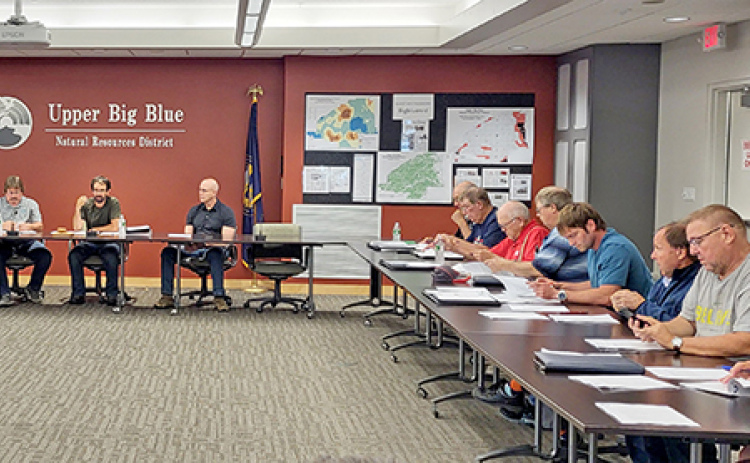
The Upper Big Blue Natural Resources District (NRD) Board of Directors appears to be determined to put the issue of the Synergen Green Energy water permit and also any discussion of a moratorium on large water user applications in the district behind it. However, in a meeting Thursday night in York, the NRD’s Water and Regulations Committee did initiate discussions on making changes to the regulations concerning any application process for such users.
As has been the case in the months since the Synergen issue first came up, the gallery was full in the meeting room at the Upper Big Blue headquarters in York, with several Hamilton County residents in attendance, including Tina Oswald, Justin Elge, Ruth Peters, Aurora Development Corporation Executive Director Kelsey Bergen and former Dist. 34 Sen. Friesen. Also in attendance were several members of the NRD board who are not members of the committee, including Anthony Bohaty, who at the June meeting was a vocal proponent of reconsidering the Synergen large water user permit approved by the board at its meeting last December.
At last month’s NRD board meeting several individuals in the audience spoke up during the public comment time, however, at this meeting, Oswald was the only one to come to the microphone to address the committee. She used her time to read a statement from Iris Bergen who could not attend the meeting due to an injury. The statement contained several suggestions from Bergen pertaining to possible rule changes for LWUs.
The second item on the agenda after the meeting was called to order and the public comment time was completed, was labeled “Large Water User – Moratorium Discussion.” However, before even addressing the first agenda item — a routine water transfer request — committee chairman Kendal Siebert quickly made it clear that there would be no more talk of moratoriums or of reconsideration of the Synergen permit at the committee level.
“Synergen, as far as that topic was concerned, they did everything they were supposed to do and we did the steps that we were supposed to do and now they legally have a permit that allows them to drill in those places and also legally have the right to withdraw that amount of water,” Siebert told the committee. “So we’re no longer going to direct any attention in that direction... Moving forward, I think the best service we can do to the community at this point is to be able to address the rules and just kind of focus on what this board can do to protect people around those areas. And if there’s parts in our process that we’d like to be more thorough or be able to go over more directly that we can do. I’m just making that as a statement. We’re not taking any conversation on it. It’s just so everybody knows the direction this committee’s going to take.”
Following the approval of the water transfer the committee moved into agenda item four, “Large Water User – Possible Rule Changes.” What ensued was a wide ranging discussion involving members of the committee, members of the at-large board, staff and audience members. Siebert said his goal was to discuss a broad range of topics pertaining to rules changes for large water users, indicating that this would be an ongoing topic to be hammered out in discussions at future meetings over the next several months.
Upper Big Blue Water Department Manager Terry Julesgard said in discussions with the NRD’s legal counsel, it was suggested that LWUs should have their own section in the rule book. He also suggested that a guidance document should be published for those applying for such permits. Later in the meeting LWUs were defined as non-irrigation users pumping more than 500 acre feet of water a year. The way the water is used is not defined.
Other items of discussion included the spacing of such permits; the viability of establishing different levels of LWUs; permit fees and the method of paying for the required peer reviews.
One committee member suggested that instead of requiring a peer review of the hydrology studies used in the permit process, the NRD should require two different hydological studies for purposes of comparison and accountability.
Another item of conversation focused on the possibility of LWUs impacting wells in the surrounding area, especially domestic wells. Siebert suggested enacting consequences for the LWU if it interferes with the level of a domestic well including restricting the amount of water the industrial user could pump. Attorney Don Blankenau of Lincoln, who serves as the NRD’s legal counsel, was in attendance at the meeting and said the district could put in place rules stating that if an LWU pumped enough water to negatively impact other wells in the area, the LWU would have to “make it right” with the impacted water user. However, he also stated that there have been very few cases in Nebraska where such impacts have occurred.
Siebert had also stated earlier in the meeting that research has shown that existing LWUs are using less than 75 percent of the water allotted to them on average.
The full NRD board meets again on Thursday, July 25 and it remains to be seen whether the Synergen issue will come up again then.