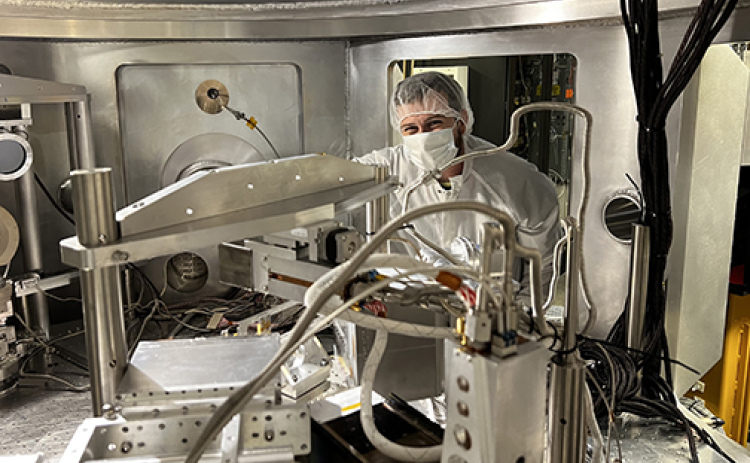
Aurora grad on developing applications for laser technologies
Some people find fulfilling lives in tried-and-true careers, but others want to be the first shimmer of light in the darkness of the unknown.
Daniel “Dan” Haden has always had a laser-sharp mind when it comes to learning about new subjects, and is now on the cutting edge of scientific breakthroughs in laser technologies with research he has shared all around the world.
“I like to learn new things and learn a lot about a lot of different things,” Haden said. “The research I’ve done sounds really general, but that’s all been super interesting to me.”
Haden graduated from Aurora High School in 2009 and has gone on to the University of Nevada in Reno for post-doctoral work. However, even in scenic Nevada, he remembered his roots.
“It was good; it was a nice environment to grow up in,” Haden recalled. “It is nice knowing everyone around me, knowing everybody in elementary school all the way up through high school, seeing some familiar faces and people that really cared about you throughout your younger years.”
Haden, the son of Ron and Diane Haden of Aurora, grew up with his brother, Matt, taking to learning at a young age due to their science teacher father.
“Dad was a school teacher, an eighth grade science teacher at Aurora Middle School, who was kind of the synthesis behind me being interested in science. He had a passion for especially astronomy and how the earth worked around you,” he said. “That really was a good background for me becoming interested in math and science.”
He also was involved with Future Problem Solvers as a way to think critically about problems.
“Future Problem Solvers really kind of helps you become successful in things where you need to lay out what the challenges are and solutions for important problems,” he explained. “So it was a good basis for understanding research development. That’s the whole basis behind developing a research program: laying out all of the challenges and figuring out the solutions for them.”
When he graduated, Haden’s path was originally to the stars. He considered becoming an aerospace engineer by going to Wichita State University before starting out at Nebraska Wesleyan University with pre-engineering while also running cross country and track. While there, he also had a chance to work at the Extreme Light Laboratory at the University of Nebraska-Lincoln.
“In my junior and senior year, I ended up working on the laser lab at UNL and that got me interested in physics,” he recalled, noting that he decided to go ahead and finish a degree in physics. “I worked for a year at the lab as a research scientist, after graduating my undergrad, and then applied for grad school there.”
Haden graduated from Nebraska Wesleyan in 2013 and pursued his masters and doctoral degrees in physics from 2014 through 2021. During his PhD studies, Haden worked with high-density lasers in a variety of ways such as using them in a way similar to X-rays.
“So my PhD studies were all about how you can use these lasers for secondary radiation generation and by radiation that’s similar to X-rays, but these would be much higher energy X-rays so they can go further through materials,” he explained. “They can scan deeper.”
Lasers could also be used to release energy from excited atoms.
“It wasn’t necessarily splitting, the atom itself came in excited state,” he elaborated. “We were trying to use X-rays generated by the laser to excite it to push it out of that excited state, which would then release energy.”
Another part of his PhD career at UNL was travelling to share research around the world. He was flown to Brazil, Romania, San Diego and Washington D.C. as part of that effort.
In Brazil, a partnership with the University of Sao Paulo resulted in a trip with his grad school mentors to a conference on developing particle acceleration with low power lasers.
“It was mostly a work trip,” he said. “We got to try a bunch of foods and I didn’t really explore much… There’s one night that I got to go with some of the grad students and they kind of showed me around a little bit of the city, which is cool.”
Another trip to Romania for an international conference on nuclear photonics -- nuclear processes with light -- was an opportunity for him to present his research in the field. This time he got there a week early and explored his family roots.
“The actual conference was in a small ski town called Brasov,” he stated. “I traveled around Germany and visited an old colleague in Prague, and actually visited some family in Germany and my great-grandparents’ homestead.”
After graduating in August 2021, he took a break to work at Pink Gorilla Events in Lincoln with his wife since 2017, Maddie (Monohon) Haden.
“I just did odds and ends,” he said. “It was nice to do some manual labor instead of academics. It was a nice little reset.”
He then started his postdoctoral research career at the University of Nevada in Reno, studying warm dense matter.
“(Warm dense matter) is where you get some material really, really hot, but you get so hot, so fast, or you do it under pressure as well, that it’s still safe, solid,” he explained. “So we’re trying to perform experiments that will help develop models that help you perform further experiments later down the road.”
Haden stated that he was not at liberty to share detail about the applications that the university is researching, but pointed to experiments in Livermore, Calif., where researchers conducted an experiment in December at the National Ignition Facility Laser and Target Area Building (NIF) where a laser produced a bit more energy than it was taking to power it. According to an article in the Atlantic, it took 400 megajoules to produce 2.5 megajoules of energy, about the level of a small chunk of kindling, according the writer.
Though it was a small breakthrough, Haden was excited about the possibilities for energy production
“Now that we know that the physics work and people can come by now and design something that would be efficient as a power generation force,” he explained. “The US is kind of pushing into public-private partnerships to kind of work towards developing proof of principle now; (developing) power-generating devices based on this concept.”
Another facet of the warm dense matter research Haden explained is to use femtosecond, fast lasers, to produce better medical devices for delivering medicine than typical pills.
“Basically you can create a microstructure on the surface that can either absorb water better or push water away in industrial applications as well,” he continued.
A highlight in his career was leading an experiment using Stanford University’s Linac Coherent Light Source system (LCLS).
“There’s like four or five around the whole world and I got to perform two experiments on the really unique instruments over just the last year,” he explained. “The first time I was leading and then the second time I was going to help, but just going back the second time and understanding how the equipment works, I really felt I was able to run the experiment from the control systems.”
Outside of working in labs, he goes hiking and rides his bike over gravel, competing in a Lincoln race that went 70 miles over the rocky roads. He lives near Reno, regularly visiting Lake Tahoe, feeling that his future is wide open.
“It’s trying to figure out if I want to end up in a research scientist position, or eventually within the industry,” he concluded.