
Weaving with family: Fassnacht brings pot holders to life

Subhead

98-year-old crafts dozens of patterns with his loom
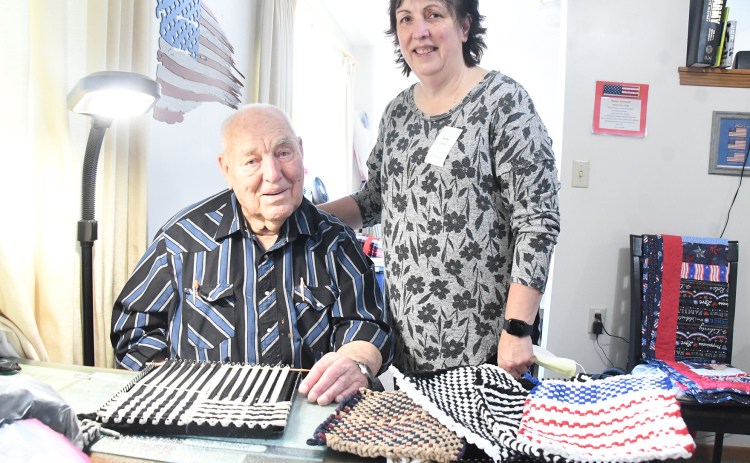
Edging close to 100, 98-year-old Ramer Fassnacht weaves hot pad holders in a variety of colorful and distinctive patterns, to pass the time. In an added bonus, Fassnacht’s three daughters have joined his cause, selling his creations in the last year since he’s mastered his craft.
The veteran moved to East Park Villa about three years ago. 
“It’s something to do,” Fassnacht said. “If it gets tiresome after a bit (I can say,) ‘Gee, do I want to put that one together today? Nah, we’ll wait until tomorrow.’”
Daughter Teresa Elder-Smith described her father as a jack-of-all-trades. He worked as a quality inspector at New Holland, at a lumberyard in Hampton and drove with a forklift at a DMC warehouse. He also served as a tank driver during the Korean War outside of being a father to three girls.
“(Raising three daughters was) not necessarily (hard), I was working,” Fassnacht stated. “It was the mother’s job to take care of them.”
Fassnacht moved to Hamilton County five years ago and soon moved into the East Park Villa apartments, where family got him involved in the craft of weaving hot pad holders with a small loom frame. The family ordered several loom frames of various sizes and loops to be placed on the loom’s hooks. Soon Fassnacht was able to start learning how to craft the square shaped hot pad holders.
“This wasn’t (hard) so much,” he said. “I made a lot of mistakes and I still make a mistake every once in a while. I take the time and it turns out pretty good. I have been able to have my daughter fix my mistakes.”
The materials are made in the United States and the pot holders are made of cotton loops. 
“(They are) made of cotton,” Fassnacht elaborated. “We found they had some nylon ones, they are no good. They will melt.”
Fassnacht first attaches horizontal lines of differing colors of loops, typically a light and dark color due to his colorblindness. The loops can also be at differing depths, with one color high on the hook and one down low. 
Afterwards, he turns the loom to where the loops are vertical, putting a needle through at the far end from himself, threading a long hook at the other and putting a loop on the emerging hook on the other side. 
He further explained that he then pulls the loop under and over the vertical loops depending on what kind of pattern he wants. Some can be checkerboards, have four quadrants that change directions (by laying a double thread of same color in the middle) and even a pattern with the American colors of red, white and blue.
“I said, ‘By gosh, by golly, I’d like a red, white and blue one,’” he recounted. “So (I) started out and I had a heck of a time figuring out which way to go. But I finally figured out that there are 27 strands there. (I first used) seven blue ones and four or five white ones, and that didn’t work out very good at all. So finally I started with seven blue, two white and two red (loops).”
Between placing each loop with the hook at this stage, he pulls them tight against one another with a metal or his more preferred plastic tool. 
Though he can get them on, it is a bit difficult for him to take the hot pad holder off the loom frame, which he leaves to Elder-Smith. 
“She can take them off, I can’t take them off,” he said. “I never got that. I can put them on there... and (taking them off) takes her 7 to 8 minutes. It takes me 45 minutes to put one on if I put my mind to it.” 
His family, including his two other daughters, Joleen Gustafson and Glenell Ratzlaff, have also been involved in sharing his creations with others by helping to sell them to individuals and at craft shows like the Health Fair Saturday. 
“When we started out doing this we gave them away,” Elder-Smith said. “And then there were people that were like, ‘Well, how much do you want for them?’ So we sold the big ones for $10. My sister that lives up at Wakefield, she sold several hundred just by word of mouth.”
All funds go to an account for the family as a whole, which sits right with Fassnacht.
“As far as I’m concerned, if they can sell them that’s more power to them,” he said. “Because they (the hot pads) don’t mean nothing to me as far as money, because I don’t need the money yet.” 
Elder-Smith stated that working with her father in finishing the hot pad holders and selling them has been a bonding experience, especially during the COVID-19 pandemic.
“I think it’s probably reconfirmed the bond,” she said. “We’ve always been close. It gave him something to do. There were times during COVID when they (East Park Villa) were locked down, he would get them down to me in one of the bags and I (removed them) and sent the stuff back up to him. So yeah, it kept us in contact when COVID hit.”
Fassnacht is a hot pad holder assembling machine, churning out about 20 a week. He estimated he has made 2,000 since starting.
“I put those three together Wednesday afternoon and last night,” he explained, pointing to some of the hot pad holders. “And I put the last half of them this morning and that silver and white one. After I get halfway, it seems to go fast.”
Fassnacht stated that he has no plans on slowing down anytime soon and will continue his craft regardless of if anyone buys them or not.
“I don’t care whether they like them or not,” he concluded. “I haven’t had anybody who said, ‘Oh, I wouldn’t have any of them at all.’ How many people have hot pad holders in their house? Most everyone has one or two. You get more than one or two, you get saturated.”