
All measures taken: a local’s voyage for peace

Subhead

Aurora native Dr. du Preez shares Navy, personal life
Dec. 7 is National Pearl Harbor Remembrance Day, a day that lives in infamy, when the Japanese Empire attacked the U.S. Navy at its Hawaiian naval base. 
In that moment, more than 2,000 U.S. personnel died, with ships to this day lying broken in the harbor, memorials dedicated to a day when America did not feel safe even with the vastness of two oceans to protect her from war.
Dr. Anton du Preez who grew up in Aurora and served in the U.S. Navy as a musician at Naval Station Pearl Harbor from 2009-2012, participated in the naval humanitarian mission Pacific Partnership and continues to help others through his doctorate in physical therapy and composing music for TV/film productions. He has experience in preparing for a surprise attack, whether it’s to help countries prepare for natural disaster events or an attack against his own happiness.
“It’s an individual journey, and for me it was a long one,” du Preez said. “And during that time, I still had a great external life with things but just internally I still have a lot of things to reckon with. At this point I’m just kind of comfortable, happy and confident.”
Du Preez started out in Aurora as the son of Maurice and Jana du Preez, which Anton described as a good community to grow up in. As he grew there were a few painful growth spurts that required treatment. It was through sessions with Howard Holland that he discovered the benefits of physical therapy. 
“I went to him for my knee issues that I’ve had for like four or five years at this point, where I pretty much had to wear braces for everything,” du Preez explained. “And just in a couple months of seeing him to resolve the musculature in the knee...I never had to wear a brace again.”
Another was his empathy for people who suffered from neurological conditions such as his fellow church member Glenn Berthelsen, who had Parkinson’s disease. 
“I just remember kind of watching the progression of that disease and being, hopefully he felt the same way, one of his besties as he was aging,” du Preez recalled. “And I just loved talking with him, learning about him and his life experiences. When he got to the phase of slurring speech and a difficult time with movement and whatnot, just sitting with him and being a person that he could spend some time with, who was patient and allowed him to do what he needed to do at a slower pace. I feel like that shaped the neurological physical therapy that I specialize in nowadays.”
A participant in cross country running, speech, drama, musicals, science and math clubs; du Preez’s other ambition was and continues to be music. Vocal professor and choir director Monte Burger’s tutelage and high school band director Richard Drees’ private trumpet lessons developed those talents.
“Between the two of them, I really got to craft my love for music, my skills as a performer and kind of helped lead towards the composition stuff that I do nowadays,” he credited to the two music teachers.
Du Preez graduated high school in 2002 and started a vocal performance major at Nebraska Wesleyan University before switching to exercise science and wellness with a minor in music due to what du Preez expressed as doubts about a music career. 
“I wanted to, but, you know, to be honest, I was scared,” he said. “In medicine, I felt like the things that I could do there would have a more lasting impact.” 
He graduated with his bachelor’s in 2007 when he heard the news that Berthelsen had died, leading to a mix of emotions as he started the next leg of his journey.
“I was thankful and very morose at the same time,” he stated.

Lost at sea
There are many reasons why people dedicate themselves to the armed forces. For du Preez it was the post-9/11 atmosphere, an event he remembers clearly, seeing others join and wanting a productive direction for his life that he said lead him to enlist.
Yet, there was also an even deeper reason, one du Preez stated he had been struggling with his whole life: being a closeted gay man.
“I was gay. I knew that like around maybe 10 or 11 years old, and that was the one thing that felt different, but I just ignored it until it kind of got to the point where I just couldn’t do it anymore,” he said. “And that was in college, where we kind of get into the physical and mental development stage, where we’re fully realizing who we are and trying to understand what that means.”
The influence on his decision for joining the military was, in part, to avoid the issue during the “don’t ask, don’t tell” policy and to prove himself as someone who was gay.
“It was something where I don’t have to address it, and I can try and be the toughest person I could be,” he said.
He signed up for the Navy with interest in Naval aviation and the Navy SEALs special operations forces. The Navy candidate wanted to be an aviator instead of a flight officer, but the results did not support that.
“I was picked up for the SEALs and for flight school, my eyesight wasn’t good enough,” he elaborated. “The results came back from the flight school application and it was a yes for flight officer and a no for aviator. I was kind of disgruntled with that, so I turned down the officer’s route and lifted into the SEALs package. Part of it was just wanting to do the toughest challenge I could think of.”
Du Preez went to train with the Navy SEALs, but soon, he said he realized there an internal conflict inside him on whether or not he could kill for his country, which lead to soul-searching about that path. 
“Okay, we can do all this badass stuff, but when it comes down to it, at the end of the day, I don’t want to kill anybody and I don’t know if I can,” he described of his thoughts at the time. “I don’t want to put myself in a position to jeopardize my future psyche or to jeopardize the team. You know, thankfully, there’s people who can do that, but I’m not one of them.”
He talked about his decision with close friends and family before making the decision to quit Navy SEALs training. 
He applied to the hospital corpsman to be a medic, but a successful audition for a vocalist position sent him to the Navy Music School in Little Creek, Va., and then off to Hawaii.

Singing across the Seven Seas
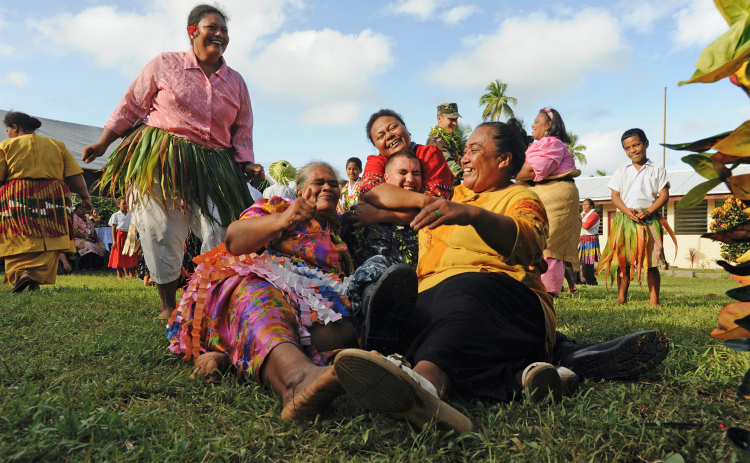
After music school, he went to Pearl Harbor and participated in Pacific Partnership, a humanitarian mission to prepare Pacific-bordering countries for natural disasters and provide medical assistance, an annual tour that started after the 2004 Indian Ocean earthquake and tsunami. 
“It was very inspiring, and...humbling,” he said. “It’s very humbling and just wonderful to be a part of something like that.”
In 2009, he went on the USNS Richard E. Bird to the Marshall Islands, Guam, Tonga and the Solomon Islands. In 2010 he was on the USNS Mercy to Guam, Vietnam, Cambodia, Singapore, Indonesia, Timor Leste and Papua New Guinea. Finally, in 2011 he was on the USS Cleveland’s final mission, before being decommissioned, to Tonga, Vanuatu, New Caledonia, Timor Leste and Micronesia. He was also in Australia in 2010 and 2011, though the stops were not part of the preparedness mission.
“It’s multinational, helping a whole bunch of other different nations, and just meeting all different types of people across the world, you know, granted, just in the Pacific region, but really stunning places to visit,” he described. “Incredible people to get to know a little bit and spend a week or two with.”
His duties included performing for classical patriotic tunes for ceremonies, jazz for VIP cocktail parties and for communities throughout these Pacific nations, incorporating American contemporary tunes as well as the local hits during the long line natives had to wait in to receive medical care.
He also assisted people with physical therapy, shadowing and helping medics with patients. 
One of the most memorable visits was the Pacific Partnership’s second trip to Qui Nhon, Vietnam, where Navy personnel were allowed to state their affiliation while in Vietnam for the first time since the 1960s-1970s conflict that left at least a million total estimated dead, according to the National Archives, the British Medical Journal and Population and Development Review. 
“Some of the time, when we just go out for hikes or just interacting with people, time heals, not everything,” he recollected. “I don’t think that is going to be 100 percent accurate, but there’s definitely some truth to it because, you know, here we are, at that time, 40 years later, and we’re just hanging out with people as people from different nations.”
When he was not stationed throughout the Pacific, du Preez was at the base in Pearl Harbor, a place that still serves as a memorial for the people who died in the infamous 1941 attack. 
“It’s still a sacred place,” he commented. “Some of the buildings there still have bullet holes in it from the attack and a lot of the ships are still under water in the harbor there.”
He also participated in the Remembrance Day ceremonies, playing music to honor the fallen and those who survived.
“We would take part in the Pearl Harbor Remembrance Day every year, and so that was really neat to be able to spend some time with the vets that were there at that time,” he said.