Highway 34 history -- Project was years in making

Subhead

With upgrade pending, ANR looks back on 1980s-90 decision

It’s a part of daily life for many Hamilton County residents. Highway 34, running east to west throughout the area, is an essential to commuters between Aurora and Grand Island or York. 
With recent talk of renovations to the roadway being done in the coming years, the News-Register took a look back -- circa 1984 and on -- to uncover what went down the last time big changes were made on that stretch of roadway through Aurora.
“The Nebraska Highway Commission and Department of Roads will hold a public hearing Wednesday, Nov. 7 at 7:30 p.m. on the proposed improvement of U.S. Highway 34 in Aurora,” reads an article from the Oct. 3, 1984 Aurora News-Register. “The project on ‘Q’ Street begins about 1/2 mile west of Aurora, at a point about 500 feet west of the Burlington Northern Railroad crossing and extends easterly about two miles, to a point about 500 feet east of the Lincoln Creek Bridge.”
The project was set to begin on the west side as a two-lane roadway with surfaced shoulders, the article continued. This would continue until almost 1st Street, where the roadway would then “transition into an urban-type roadway 52 feet wide.”
Also news at this time, two bridges were proposed to be widened, as well as the railroad crossing. 
About a month later, according to past editions of the ANR found at the Plainsman Museum, the Aurora City Council met in a special meeting Nov. 5 (just two days before the public hearing) and approved a resolution “re-enforcing a previous resolution to suppose a four-lane concept for the widening of Highway 34 in Aurora.”
“Following discussion that included the need to improve the present two-lane street that serves as Highway 34 and the three-lane and four-lane concepts, the council gave four-to-one support of the four-lane proposal…,” a Nov. 7, 1984 ANR article reports. “It was noted that there is ‘very little’ difference in the cost of three-lane and four-lane improvements to the City of Aurora and that the four-lane concept will provide for additional growth in the traffic pattern for both local and intra-state commerce use.” 
Just a week later the Aurora News-Register reported on the events of the public hearing. 
“Four lanes, yes! Raised medians, no! That was the consensus of opinion from the 75 Aurorans attending the Nebraska State Roads Department Highway 34 Improvement Hearing Wednesday night,” the Nov. 14, 1984 article reads. “The $2.38 million project is scheduled to start in the spring of 1988 and be completed that fall, according to engineers. Bids on the project will be taken in 1987.” 
At said meeting the Roads Department outlined four different proposals, all calling for the widened roadway to be extended from (approximately) the Lincoln Creek bridge to the railroad crossing spur on the west edge of the community.
“The widening will, if no changes are made, remove two structures near Highway 34,” the article continues. “One will be a duplex adjacent to Streeter Park on the north side of the roadway and the other would be the northeast unit at Crossroads Court.”
Many concerns were voiced on the topic of raised medians at the Highway 34 and 14 junction. Almost all of those in attendance testified to preferring a painted median. 
“While the state contended the raised medians were safer in preventing rear-end collisions and turning accidents, local individuals sought to make other points,” the article notes. “Objections were based on turning lane problems, impact on businesses in the Highway 14-34 junction area and the possibility of vehicles striking the curbs of raised medians. Other concerns about the project were aired.”
Sidewalks were slated to be installed along with the project, as well as new storm sewers and street lighting.

Work begins
Preliminary work for the Highway 34 improvement project began in 1989, with reports on the first steps appearing in the Oct. 4, 1989 edition of the Aurora News-Register.
“...Utility work has gotten underway along Highway 34 in Aurora and a tentative bid-letting date has been set for the widening and beautification project to follow,” the article notes. “That’s the good news for city residents who have long wanted to see the busy highway improved. The project has been planned for several years.”
The work in question was being done by Ruthjens Construction Company of Tilden and involved relocating some water and sanitary sewer lines before the larger project could begin. 
A good portion of Streeter Park was adjusted (and taken away) to allow for the widening.
Discussion continued throughout the next few months as work trickled by.
“Improving Highway 34 west from Aurora should come before improvements on Highway 34 east, Aurora officials will tell the Nebraska Department of Roads at a hearing next week in Grand Island,” reads the Oct. 18, 1889 edition of the Aurora News-Register. “The reason? Traffic counts taken by the Roads Department show that more than twice the number of vehicles are using Highway 34 west of the city than east and the total is growing.”
The traffic flow study reported in the article showed an average of 4,000 vehicles (including 360 heavy commercial vehicles) were recorded in a 24-hour period just west of Aurora. The numbers reported for the east end were 1,710 vehicles and only 185 heavy commercial vehicles in the same 24-hour period. 
By the Dec. 13, 1989, edition of the Aurora News-Register a start date of April 30, 1990 had been decided upon. 
“The project consists of 1.343 miles of grading, concrete pavement, culverts, bridges, guardrail and electrical work on Highway 34 through Aurora,” the article noted. 
The low bid of $1,848,970 was submitted by GLC Inc. of Columbus and accepted. 
As the main part of the project loomed closer, meetings for business owners or representatives for those located along Highway 34 were hosted.
“The first portion of the widening and beautification project will be the shoefly, which must be in place so the bridge contractor can start work on removing the bridge on Highway 14 just north of the intersection, and relocation of the entrance into the east side of Streeter Park, also on Highway 14,” the March 28, 1990 edition of the Aurora News-Register reads. 
Articles in the following weeks detailed ways that contractors planned to work to ease the burden of construction-restricted traffic on Highway businesses.

Make way for the highway
“The entire project is expected to take 105 working days, which will take it probably into October at least,” announced the April 25, 1990 edition of the News-Register. “One of the first moves will be for the Department of Roads to set up a detour around the city.” 
Initial work was to be done at the intersection of First Street and the highway and was to proceed east. 
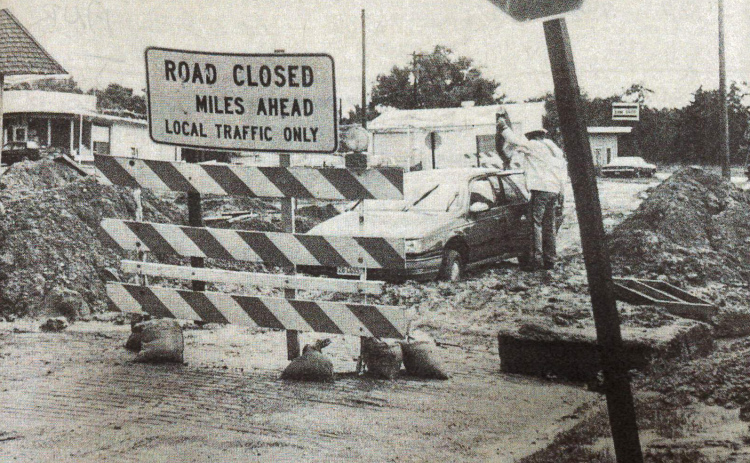
As of May 9, 1990, the first week of the project was going well, though delays due to rain were experienced. Rainfall totals had surpassed 2-1/2 inches by the 19th of the same month.
“The Highway 34 widening and beautification project is 20 percent completed, according to the project manager for the Nebraska Department of Roads in Grand Island and work is actually ahead of schedule on working days,” reads the June 6, 1990 ANR. “But the more than 4 inches of rain in Aurora during May did have an affect. Without it, construction crews could be even farther ahead.”  
All the old paving had been removed, except that which was part of the detour. News of the upcoming paving of the newly widened highway broke in the July 11, 1990 edition of the ANR. 
“In 30 days, again with cooperation of the weather, the length of the widened thoroughfare could be finished,” the article reads. 
This would leave the finish-up work to be done, like intersections and sidewalks 
“The first pavement will be poured in an area north of where the new bridge is going in on Highway 34 and at the west end of the highway near First Street,” it adds. “Once the paving begins on Highway 34, the north side will be poured all the way to Highway 14. When that has cured, traffic will be allowed on while the south side of the street is being paved.” 
Local traffic was officially allowed use of “most of the highway” by Aug. 22, 1990, though work was not completed.