
Aurora first responders climb in memory of 911 heroes

Subhead

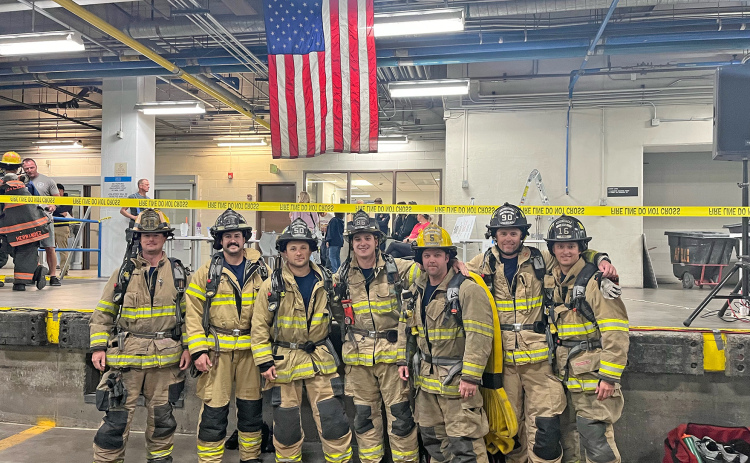
Greenough, Hyde participate in 9/11 Memorial Climb 
There are a number of documentaries and television specials about Sept. 11, 2001, and there is scarcely a person over a certain age that doesn’t know about it at all. 
Perspectives are often shared and people remember, some in different ways than others.
A pair of Aurora Ambulance Department members took on a special challenge in remembrance of those first responders lost on 9/11. 
Together, Tanner Greenough and Chris Hyde, alongside 341 other men and women from across the country, took to climbing the 55 flights of the Transamerica Tower in Denver, Colo. -- twice. 
“Every year they hold (this event) on September 11th and they have 343 spots. They don’t allow any more than that,” Greenough began, explaining the event. “If you get it when they register in July, you then go and literally represent one of these people (first responders).”
Each individual participating is given a plastic badge with the name and photo of a fallen first responder on it. 
“And that’s who you were representing when you climbed,” Greenough noted.
Hyde climbed for firefighter Thomas M. Butler. Greenough climbed for firefighter George C. Cain.
According to the 9/11 Memorial Stair Climb website, “the primary purpose of the annual Denver metro Firefighter’s 9/11 Memorial Stair Climb is to remember those 343 firefighters who selflessly gave their lives, so that others could live.”
The event is also a demonstration of the physical and mental preparation it takes to protect others from harm.
“This event is not a race,” the website reads. “It is a gathering of firefighters, who solemnly climb 110 flights of stairs, each firefighter carrying one of the 343 with them.” 
The climb started in Denver in 2005, growing from five total participants to several hundred. 
The morning starts on the ground level of the tower, where the teams of participants gather together and listen to a recording of radio or news traffic from that day, 21 years ago.
“Just to really kind of set the tone,” Greenough said. “It was either a radio or it was a news station, but you can tell it was the news. It was clearly from that day.”
It started with how nice of a day it was weather-wise and continued on all the way through the planes making impact, until the towers fell. 
“It made the hairs… I mean it’s making the hairs on the back of my neck stand up now,” Greenough voiced. “It really sets the tone for what you’re doing. Like, you kind of go in selfish, being nervous… but then once you listen to that, and once you get (your) guy, you’re like, ‘This is bigger than me.’” 
After that, they climb. 
“You do 110 flights and that represents how tall one of the towers was,” Greenough said. “The Transamerica building in Denver is 55 flights, coincidentally, so you do it twice. You go up, take the elevator down and go up again.” 
Hyde noted that there were 50 teams of various sizes, all adding up to the 343 cap. The Aurora duo was in team nine, alongside members from Grand Island Fire. 
“There are two sets (of stairs) per story, and on every floor there was a bunch of pictures of everyone, like six to eight people hanging on the wall,” Hyde voiced. 
“My understanding is that they try to, based on radio traffic and everything from September 11th, they try to put them on the floor that they were on when they died,” Greenough added. 
And of course, this climb was no easy feat.
“Especially the first 20 to 25 flights,” Hyde expressed. “That was pretty rough the first go. But your tanked by the end of it. There is a lot of energy going into that.” 
Not to mention, the climb was done in full bunker gear.
“And we carried an air pack on our back,” Hyde said. 
The group Hyde and Greenough was in also carried a hose pack, which is what firefighters from that day would have also carried to help fight the blaze they were going after. These heavy additions were swapped amongst members to the group every so many flights to help shoulder the burden. 
Asked to estimate how much weight, total, they carried up 110 flights, Greenough reported it was about 50-60 extra pounds. 
“The worst part was probably that the air movement there was zero in that stairwell,” Greenough noted.
“Floor 15 was nice,” Hyde said with a laugh. “They put one fan on floor 15.” 
Despite the light-hearted nature amongst the pair, and the overall good feeling about climbing in remembrance of others, the day still stuck with the pair.
“I can’t imagine doing what we did and then having to actually fight fire,” Greenough said. “And then on top of that die.” 
And in the real situation, firefighters likely couldn’t see either. 
“They wouldn’t be able to see, especially the closer they go to it,” Hyde said. “You’re not going to see squat.” 
One of the individuals Hyde ran into had a sticker over his mask that shields the vision a little, simulating the conditions of that day even more. 

Personal motivation
So why did they want to go?
“Me personally, I mean I remember September 11th,” Greenough said. “I was in middle school. I remember where I was, just like everybody can kind of remember that. It’s a big part of who I am today. I mean, I joined the military as soon as I got out of high school. I then went straight into the fire service. So, September 11th, that had a lot to do with that.” 
Never forget, Greenough recited. 
“I don’t want to forget,” he said. “And I don’t want anybody else to.” 
Though Hyde didn’t have the same type of motivation, he said, he did it for the cause too. 
“I (knew) it was going towards a really good cause and I thought I would enjoy it, that I’d be good at it,” he said. “It’s something that I can definitely represent.” 
If anything, the events of Sept. 11, 2001, mean more to him now, he agreed. 
“I can’t imagine (if) you were going into that, initially, as they did, your adrenalin is going to be pumping and you’re just going to be hauling butt up those first however many stairs until they get gassed,” Hyde said. “I can only imagine the pain that they went through when they finally hit those certain floors of just like, ‘I’m not going to even make it.’ I can’t even think about how hard that would be.” 
The day of the remembrance climb, those inside the Transamerica Tower knew they were okay, he added. They were moving at a steady, slow pace. They knew how hard it was going to be.
“And we definitely knew we were coming out of it,” he said. “But nobody goes into a fire, or I’ve never been to a fire where I’m just like, ‘I can die.’ I always think, oh, we’re going to get in there and kick some can and go home. You never think that this is the last one.”