
Monarch butterfly population dropping, locals help out

Subhead

Anderson, Miller speak to what can be done to aid insects
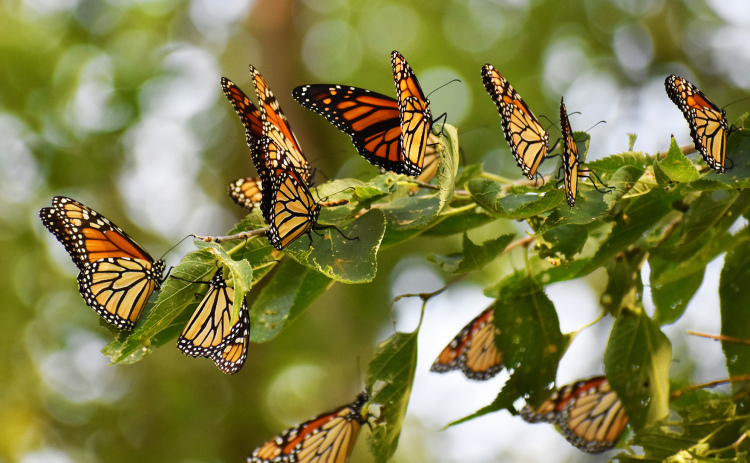
The Monarch butterfly is as popular as it is beautiful, with large, colorful wings complete with dark spots to both blend in and warn off predators. 
Despite all the positives surrounding the Monarch butterfly, the species is in danger.
According to an article posted by the The International Union for Conservation of Nature (IUCN), the migratory Monarch should be considered endangered. This organization, based in Switzerland, considers itself “now the world’s largest and most diverse environmental network.” 
To be noted, the United States and other organizations have yet to declare the species endangered, though scientists agree that populations are on the decline.
“Their population has greatly diminished,” agreed local butterfly expert Dottie Anderson. 
Anderson, now retired, spends a good deal of her time dedicated to learning more about the Monarch, as well as raising Monarch eggs to maturity before releasing the grown butterfly.
“In the wild, only like 5 percent of the eggs laid will become an adult butterfly,” she said. “In my house, it’s like 75 to 80 percent of the eggs I take in become mature butterflies that I release.”
She stressed that she does not keep the butterfly past that point and does not breed them. Though other areas in and around her home are dedicated to keeping them safe and letting them grow until they’re ready to be released. 
Also in the know when it comes to the migrating Monarch is fellow butterfly fan and Edgerton scientist Deb Miller. Miller often hosts yearly Monarch educational classes for youth and offers the chance to tag them before migration. 
“(The Monarch population) has been on the decline over the years due to habitat fragmentation and loss,” Miller reported. “As an agricultural area there is lots of use of herbicides and pesticides on crops and roadside ditches. The effect of drought is also a concern.”
Though presented with a relatively short lifespan in most Monarch generations, they still find themselves an essential part of the ecosystem.
“They are definitely part of the food chain,” Anderson said. “However, there are very few predators that eat them.”
Because of the makeup of milkweed the Monarch isn’t quite a tasty snack for most birds, she added. 
“But to me their greatest importance is beauty,” she added. “They’re fascinating and the whole process from egg to mature butterflies is so fascinating to watch.”
Asked about why she got started in her mission to help the Monarch population, Anderson reported that she’s liked them since she was a little girl.
“I’ve liked butterflies and caterpillars since I was a little kid,” she said. “But when our girls were (old enough) for 4-H, we got them involved in the entomology project. So we collected insects, butterflies and everything for years because all three girls did it and kept display boxes and all that. And then when we moved here to the house we bought and had some milkweed in the yard and I saw some caterpillars on it. So then I got started with the monarchs and I’ve been doing that ever since.” 
“They are an important pollinator of plants,” Miller added. “We are an agricultural community which depends on pollination for the crops. Many bees and butterflies are pollinators also. Monarchs can be an indicator of what the future will be, as certain species die off due to human interference (we keep building and developing the land).” 
The main food source of the Monarch butterfly is the milkweed. Female Monarchs only lay eggs on milkweeds and very few other plants in the same plant family. Though the common milkweed is native to Nebraska, it is viewed as that -- a weed -- and often removed, thus leading to the decline in population. 
Asked what exactly goes in to doing her part to help the Monarch population, Anderson noted that she starts by scouting around for eggs or small caterpillars (sometimes in her garden of milkweed plants, sometimes in one of Hamilton County’s prairies). 
“I don’t really take in the big ones, for several reasons, but I try to find the eggs and then I keep them in a safe environment, feed them and make sure their habitat is very clean,” she said. “There’s five stages in a caterpillar and I watch them through that process. And then when they are ready to go into their chrysalis, I keep them separate.”
When the chrysalis has formed Anderson moves them outside into a small screened-in area on her patio and she hangs them there. 
“The temperature has a lot to do with the speed that this whole thing happens,” she said. “The warmer, the faster, so right now it’s moving pretty fast.”
If the weather is bad she will move them indoors, she added.
Eventually the adult butterfly emerges, Anderson allows their wings to dry enough to fly and then they’re released. 
As October approaches, so too does the generation of Monarch butterflies that make their massive migration toward Mexico for the winter. Once this generation gets close enough, Anderson will tag the wing with an identification sticker before release.

A helping hand
Those interested in helping the Monarch population can do so in many ways. The first, Anderson noted, is planting and letting milkweed grow in the garden or yard. 
Though common milkweed is less “pretty” there are many other species native to Nebraska that flower and offer some beauty to the space. 
Another way, if one doesn’t want to raise and release, to aid the butterfly is to have a small butterfly garden with nectar plants, a shallow pool of water with rocks for resting and other aid to traveling butterflies.
“Planting milkweed or protecting areas that have milkweed growing is important,” Miller agreed. “The Monarchs only use milkweed to lay their eggs on. Have a flowering garden providing native flowering plants which is a good source of food (as well as) maintaining natural habitats for them.”

Tagging and migration
Nothing can quite compare to the sight of the Monarch butterfly migration, Anderson agreed, where there are so many of the same butterflies resting in a tree that the tree itself often looks orange. Hundreds of thousands of the Monarch butterfly population will eventually make a pitstop right here in Hamilton County on their way to Mexico after the start in mid-September to October.
Part of this adventure for people like Anderson and Miller is the chance to catch and tag some of the butterflies for scientific purposes later on. Individuals in Mexico later retrieve the butterflies and record their tag information to see where they’ve been.
“Monarchs have a very unique life cycle,” Miller explained. “Four generations through the year and only the fourth generation is the migrating one. The fourth (generation) travels the farthest of any butterfly, roosting in central Mexico for the winter.”
Unable to survive the freezing temperatures, they migrate and roost in mass, she added. 
“This fourth generation needs enough food sources along the migration to provide enough fuel to fly and also have enough stored to sustain them through the winter months in Mexico till spring when they mate and start the next generation ready to migrate north.”
Those interested in learning more about the Monarch butterfly, how and why to tag or help in any way are invited to contact Miller at the Edgerton, or Anderson, for further information.