
Pivot problems continue to plague local producers
Editor’s note: This is the fifth in a series of articles focused on supply chain shortages and delays and how they are impacting local business and industry. This report highlights feedback from Hamilton County-based ag companies.
Supply chain issues have plagued a variety of industries in more than one way and level of disruption. Unfortunately the agriculture industry is no exception, though it seems to be lesser -- for some.
“I would say there was the potential to have issues,” said Andrew Willis, owner of Diamond J Custom Services in Aurora. “We started getting warnings about products that may be a concern early last fall.”
This came in as a problem for certain products Diamond J is used to using, like RoundUp.
“They said RoundUp was going to be tight and the price was going to be a lot higher,” Willis continued. “It’s actually four times higher than it has been in the past. So we started looking at, as we’re making plans with our customers, how we could work around that.”
Finding a way to not have to use that product, or others that might be experiencing the same issues, was the plan.
“And then there were a couple of other (products), and we just kind of found ways to get around it, or use substitute products,” he said.
A lot of other products or items that could have been a problem, Diamond J has been lucky enough to get in time.
“We’ve never had to not spray a field because I couldn’t get a hold of a chemical or a fertilizer product that I needed,” he added.
More than anything, Willis said, ag supply chain issues are affecting the farmers.
“I will say it’s impacted the farmers a lot more, just in the prices of inputs,” he explained. “I would say that growers are probably seeing the impact of it a lot more than we are, just mainly because, with the issues in the supply chain, everything is inflated.”
This means that something like RoundUp is selling for four times the price it was last year -- and that issue isn’t exclusive to the brand.
“Any of your nitrogen fertilizers are three times more than they were last year,” Willis reported. “Now granted, the commodity market is quite a bit higher than it was last year. In the grand scheme of things, I guess, it’s the same decision as far as it takes 27 bushels of corn at the current price today to buy 180 pounds of $650 per ton fertilizer. Well, it took 27 bushels at $3 corn to buy the $250 per ton fertilizer. So it’s the same decision, just bigger numbers.”
In his position, Willis aims to help producers utilizing his services understand that concept.
“(With) fertilizer, I just don’t have a good feeling on what’s going to happen there yet,” he added. “I do see prices coming down on it, but I also then see the potential for the grain market coming down with it as well.”
All of these changes made on an operations level at Diamond J were not, at the beginning, due to supply chain issues. Though intended to make the business run more smoothly, there is never not a curveball, Willis voiced.
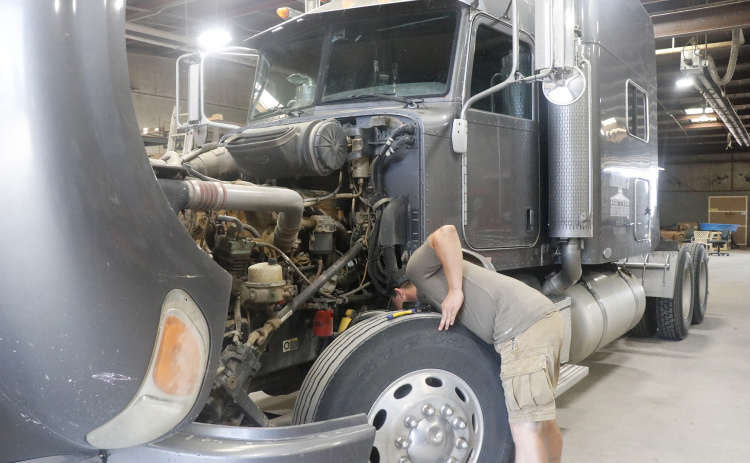
“From an equipment standpoint, as far as (the) supply chain goes, in the last three years I’ve made a conscious effort to get all of my sprayers, all of my semis, to one platform, so that I can have an inventory of parts,” he said. “And that’s really paid off this year. We are to that point now where we’ve got all the same engines in our semis. We’ve got all the same sprayers. And I can have an inventory of filters and common parts and things like that.”
He’s never had the problem of being broken down in a field, unable to fix the issue, he added, though he’s heard of others having that problem.
“And we’ve got good partners, like AKRS here in town,” he said. “They’ve taken really good care of us as far as they set us up with a parts cabinet and they got us some extra things to have in there. Some of the things that they knew were going to be tight, we went ahead and just bought a spare to have in the shop. Luckily we haven’t had to use it, but it’s one of those things I’d rather have and not need than need it and not have it.”
This sort of unintentional planning ahead also came in handy for things like supply of chemicals.
“They just put together a multimillion dollar chemical plant that can store all their year’s need worth of chemicals,” Willis said of CPI, whom Diamond J has had a partnership with for the last three years. “We’re utilizing that. Had I not made that decision three years ago, I would have probably been in a world of hurt because the guys that are having the biggest issues right now are the guys that are relying on the supply chain to refill their chemicals in-season.”
Being diligent about how much of each chemical they would need as spray season approached was also important, allowing the team to again plan ahead about how to obtain the needed amount in time.
“It’s just taken a lot more planning than we’ve ever (done), but in the end it’s made us better,” he said. “It’s going to make us better businesses, more efficient. I can’t say where it’s affected my bottom line and just really disrupted our business, but it’s definitely added another level of management to it.”
Besides needing to plan around which chemicals to use, and the rise in price for most nitrogen fertilizers, one of the biggest things affecting Willis’ business is that this year would have been the one scheduled to upgrade sprayers.
“On June 1st I had to make a decision,” he said. “We wanted sprayers, but our sprayer dealer was allotted half the sprayers that they were in the past… (So) they had to know by June 1st (to) speak for those sprayers.”
Willis ordered said sprayers June 1, but they have a build date of next June.
“I won’t really even be able to use the new sprayers until then, so that’s what’s going to affect me probably the most is that part of the supply chain -- our new equipment,” he said. “The equipment we were planning on getting rid of after this season is going to have to come to the shop and get worked over.”
This will mean spending extra money he wasn’t originally planning to spend, he said, because the sprayers he currently have will need to be used at the start of next season.
“We have a goal of 1,500 hours and the thing is out the door,” he concluded. “We’re going to end up putting 1,800 hours on these machines and that’s more than I’ve ever done.”
Pivot problems
Not every industry in the ag world has been as lucky, in fact some may argue that producers and those related to the growing season, like pivot companies, are in a rut.
Corbin Fagan, owner of Fagan Irrigation, has been more than busy over the last several weeks -- thanks to a plethora of unwanted hail storms, alongside supply chain issues -- and is still running and full-steam ahead.
“As far as the supply chain, I guess it affects me, but really it boils down to it ending up affecting that customer more than anybody,” Fagan said. “It’s not getting parts and not having parts, and it’s having to make do with what we have and fixing things that we have.”
Sure, it affects him, he agreed, because he can’t always accomplish everything that his customers want done the way they want it done. But he and his team are doing everything they can with what they have “to make due for now”, he said.
“It affects everybody,” Fagan added. “But it affects (the farmers) the most because of the situation that it puts them in.”
Thanks to a handful of recent hail storms in the area, as previously mentioned, crops and pivots took a major hit and sustained challenging damage. This, coupled with the prolonged amount of time it’s taking for suppliers like Fagan to obtain the pieces and parts they need, is challenging.
“My friend over in Waco just got hit really hard with that last hail storm,” said Willis, aside from speaking about Diamond J’s supply chain issues. “He lost all of his pivots (and) ordered them all… they said it’d be eight weeks. That puts him towards the tail end of irrigation season. So, as he’s replanted all this stuff, it’s almost a dryland crop.”
“We knew we were going to have a little bit of a supply chain issue coming into this year,” Fagan explained. “(The storms have made) it that much worse when it’s exacerbated like it has been.”
Asked if there were any specific parts or pieces that he had a more difficult time obtaining, he explained that it’s changed a little bit over the year.
“It was steel when we started,” he said. “Now that’s kind of somewhat leveled out a little bit. Now it’s more the electronic components for pivots and panels, little stuff that you didn’t ever really think would ever be an issue and it’s become an issue.”
He had more than enough work for the year before the season started, now he only has more, he said.
In terms of what types of delays farmers are expecting, Fagan said it “just depends on what it is.”
“I’ve got a couple of corner arms laying on the ground right now and we’re just waiting on parts,” he said. “Then it’s people to build stuff for me. It’s build crews. It’s workforce and labor. Right now, labor is probably our biggest downfall, not having enough people to do that.”
Sometimes it’s a week, sometimes a month, he added.
“New stuff right now for me is two months (out) to get the stuff, just to get the pivot, and then it goes back to you’re waiting on a crew to get it built or put it up for you,” Fagan explained. “And we’re all pinned down like broken stuff, trying to get it moved out of the way so guys can replant or do what they need to do. It’s just nuts.”
All the negatives aside, Fagan reported that his clients have been fairly understanding of the situation.
“Anything that we’re waiting on, if we can figure out how to MacGyver it together to get it to go around (it’s good),” he said lightly. “We’ve had some timely rain here, avoided some hail, which was nice.”
Any rain without hail is good rain, he agreed.
“We’re just hoping for rain so we can just keep rolling,” he concluded. “We’re getting closer. We’re getting more caught up every day. It just takes time. Everybody here in our community and who I do stuff for, has all been fairly understanding of the situation. That’s been a blessing in itself because it can be the total opposite.”