
Youth Nebraska Ecologists venture out to Niobrara Valley
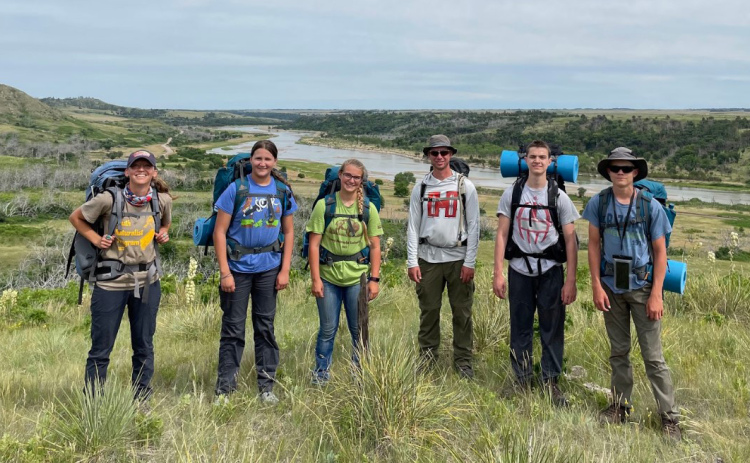
A group of area students took their understanding of nature to a higher level last week with a four-day Young Nebraska Ecologist program designed to help youth study and compare how habitat and ecosystems vary by region.
Program coordinator Sarah Bailey, greenhouse manager/naturalist educator with the Prairie Plains Resource Institute, was still buzzing with excitement herself a day later while sharing the group’s experiences on a three-day trip to the Niobrara Valley Preserve northwest of Ainsworth.
“We heard a little bit about the different habitat types there and about the natural history and geology along the Niobrara River,” she said. “Later we set out on a backpacking trip across the north side of the Niobrara Valley and after hiking into camp had the most beautiful evening of all time. It was a beautiful sunset and the kids had an absolute blast.”
Four high-school-age students participated in this year’s program, which is offered as a more extensive look at topics introduced during the popular Summer Orientation About Rivers (SOAR) program scheduled to begin next week. Kim Evans of Phillips, who will be a junior this fall at Aurora High School, enjoyed her Young Nebraska Ecologist experience so much last year she signed up for another year.
“I had so much fun last week,” she shared. “There were moments where you just got to enjoy the scenery and how if was different from the Gjerloff Prairie, which we looked at earlier in the week. Everyone who was there was really interested in what we were doing, and if they weren’t we found something that we did find interesting.”
Evans said she hopes to one day get into a field related to animal behavioralism or ecology, thus she was soaking up a lot of valuable information.
“To be exposed to stuff like this and get to see the different biomes and how the insects and plants interact and how we as people interact with them was really neat to see,” she said.
As for the campout on the Niobrara River, Evans agreed with Bailey that it was indeed memorable.
“There were so many different shades of blue and purple and the stars stood out so well up there,” she described. “It was really nice and quiet so you could hear all the animals, even two groups of coyotes that were howling back and forth, so that was really cool.”
Bailey said her goal for the program is to share presentations by people with extensive knowledge about Nebraska ecosystems, perhaps inspiring students interested in those topics and helping them find new ways to enjoy the outdoors.
“One of the main goals since a lot of the kids have been through our series of programs and are familiar with the ecology of our area and the Platte River, river bluffs and meadow prairies, is to give them a chance to explore and learn about other ecosystems that are in Nebraska,” she explained. “It exceeded all our expectations with the awesome presenters that we had, who shared a lot of information with the kids and hopefully inspired some of them who are thinking about potential careers in conservation or ecology. So, we were very happy with it and very excited to get the kids out. They were a fantastic group to work with.”
The adventure began June 20 in familiar territory on the Gjerloff Prairie, where Dakota Altman showed students how photography can be used both as data and as an educational tool to teach people about ecosystems in Nebraska. Using PPRI’s new education center on the edge of Gjerloff Prairie, Altman shared how time-lapse photography can trace changes over time and what happens along the watershed from Colorado and Wyoming then through Nebraska before dumping into the Missouri River.
“His role with that is to show how photography tells a story, both for educational purposes so people can see how awesome that whole watershed is, and so people understand where their water comes from and how it’s so important for both conservation and agriculture,” Bailey said.
That lesson in Hamilton County set the stage for a road trip west to the Niobrara Nature Preserve, where students heard several other presenters talk about the ecology and different habitat types in that area.
Among the many presenters was Amanda Hefner with the Nature Conservancy.
“She talked about the fire ecology of the area because up on that north side in 2012 they had a wildfire go through that area, which had a lot of ponderosa pine,” Bailey noted. “She talked about that ecosystem, what happened with the fire and how it’s transitioning.”
After a five-mile hiking excursion, which included the picturesque overnight stay high up on the bluffs overlooking the Niobrara Valley, the group met with again with Hefner, who explained how the Nature Conservancy utilizes a bison herd to help manage the land. The agenda also included time aqua netting at Smith Falls, as well as a bird hike with wildlife biologist Jen Corman and presentations by Alex Briner (backpacking instructor), Jayne Jonas-Bratten (UNK professor) and Ashley Oblander (Nature Conservancy at Niobrara Valley Preserve).
“We looked at all the habitat types there and saw a lot of different birds, certain species that only occur in abundance kind of along that nice stretch of the Niobrara,” Bailey said. “We saw some really interesting birds, as well as an eastern hognose snake, which was really cool.”
Evans said her only disappointment with the Young Nebraska Ecologist outing is that more people didn’t get to experience it.
“It was an awesome experience,” she concluded. “I’m kind of disappointed that there aren’t more people in it. I would like to see a lot more people getting involved because I know there are people who are interested.”
Bailey is exploring the great outdoors again this week with the Youth Naturalist Program. Watch for a story and photos from that four-day program in next week’s edition.