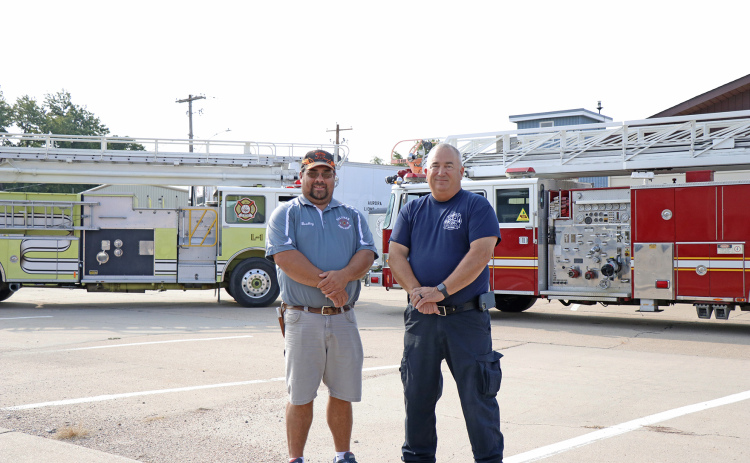
Departments receive rigs thanks to fed program
Thanks to conversation between friends and a special program offered by the Nebraska (and U.S) Forest Service, both the Aurora and Giltner volunteer fire departments received new pieces to their firefighting fleet.
The exchange took place Aug. 18, much to the appreciation of both departments. Aurora’s previous ladder truck, with yellow-green paint and a 65-foot ladder, will now call the Giltner Volunteer Fire Department home. Similarly, the Aurora Volunteer Fire Department took possession of a rescue-red truck, complete with a 100-foot ladder and elevated master stream capabilities.
“We were looking for an elevated master stream (capable truck),” said Aurora Fire Chief Tom Cox. “That was the biggest thing. And what I mean by that is it’s got a nozzle on the top of the ladder.”
This would allow firefighters to spray water on a fire from above, a useful technique in many instances.
“Several years ago when we had a fire on the square, when the Fidelity Building burned down, what stopped that fire was when we got aerial devices in and were able to get water in from the top,” Cox added. “That’s what we were looking for, not just for on the square.”
The department’s previous ladder truck (the green one) had been effectively utilized in home and structure fires, allowing firefighters to pinpoint where they wanted water to go more exactly. There is also an added benefit of use for public safety, should the need arise where citizens need to be evacuated from taller buildings or grain bins.
“The only problem with that green truck was it was only a 65-foot stick,” he said. “Which a lot of the time works, but it just wasn’t tall enough to really do what we wanted to do.”
Cox found the Nebraska Forest Service while in Grand Island at State Fire School this past year, he noted. He struck up a conversation with Lew Sieber (the local rep) and asked him to keep Aurora in mind should he come upon a 100-foot ladder truck.
Luckily for the AVFD, Sieber had one in mind. There was a unit perfect for the job sitting in Sutton.
“Sutton had an aerial truck that they had purchased several years ago and it broke down and was going to be down for like three months,” Cox explained. “So basically they borrowed this one from the forestry service while it was being fixed.”
Sutton’s truck has since been repaired and the 100-foot ladder truck Aurora had been looking for was sitting in Sutton waiting to be transported back to the Nebraska Forest Service.
After local firefighters made a brief trip to take a look at the rig, it made its way back to its new home in Aurora.
“(It’s) just what we needed,” Cox noted. “And now with Giltner (taking the other one) there will be two in the county.”
The crew has since been training with the new truck and getting it in the best shape for service. This included replacing a few tires and fuel lines. Though 30 years old, Cox agreed the 1991 Pierce rig is in great shape.
Along with the added 35 feet of ladder length, the truck itself is slightly larger than the previous one, he added. This allows for more compartment space and an extra axle in the back. The truck only holds about 100 gallons of water, but can be fed by another fire truck or a nearby hydrant.
“It’s something to train on,” Cox added, speaking to the benefits. “And the guys have a lot more buy-in and they see, you know, this was for them too. I mean this is to help protect them. If we need to cut a hole in the roof, instead of a guy crawling up on a roof and cutting a hole he could work off this ladder and be so much safer.”
FEPP program
The Nebraska Forest Service, through a cooperative program with the U.S. Forest Service, offers the FEPP, or Federal Excess Personal Property, “fire shop.”
According to the Nebraska Forest Service website, the organization acquires and reconditions “vehicles which have become excess to the needs of the federal government” as part of the program.
The vehicles are then assigned to rural fire districts who participate in the program, the website reports. They remain federal property, but are on loan to the department for as long as needed or wanted.
“Both of these (ladder trucks) came from VA hospitals,” Cox voiced. “Because at one time it was required by the federal government that they have a ladder truck at every VA facility. That’s been dropped, so a lot of that equipment became excess inventory that we can (use).”
If a department has something in particular that they’re searching for they simply put a request in. Sieber will then keep a look out for the desired equipment, or assign it if they have it at the shop.
“They charge us a flat fee (for the truck) and then whatever it takes to get it shipped here,” he reported.
When the green ladder truck came to Aurora a handful of years ago it cost the department between $2,500-2,600 total to “lease” it and have it shipped from New York.
For the department’s new 100-foot ladder truck, Cox explained, AVFD owed $4,500. Brand new, he said, a truck like that would cost $1 million or more.
“It’s great, because little departments like ours that don’t have a lot of money, we’re able to get the equipment that some of the bigger departments have,” he said. “We still need it, just because we’re not a big department doesn’t mean we don’t need the equipment.”
After the fire department is finished with the vehicle it simply needs to be in good enough shape to be returned to the Forest Service.
“Through the Forest Service you can get other things (too),” Cox added. “We’ve got a Suburban that we use to carry guys to fire school or to training and for carrying equipment to fires -- that’s from the Forest Service.”
Tankers and other equipment -- like generators and hand tools -- can also be obtained through the program.
A truck for Giltner
Aurora’s previous ladder truck, also a 1991 Pierce rig, was transferred into the hands of the Giltner Volunteer Fire Department officially last week.
Because GVFD Fire Chief Brad Consbruck and department member Perry Hosier were on hand to drive the truck back to its new home in Giltner, the department only had to pay the flat fee to the Nebraska Forest Service to transfer the truck into their name. This amounted to only $525, Consbruck reported.
Cox noted that the idea for the transfer of the ladder truck over to Giltner first took shape when Hosier approached him at state fire school.
“Actually, Perry saw me at fire school and he goes, ‘Hey, so you’re gonna get rid of it. Well, if it works out, we want it,’” Cox recalled. “So I called Brad Consbruck, talked to him and he was in.”
Conbruck talked to the rural fire board and it was a done deal. With the added bonus of having a new fire station with more room for trucks and equipment, this move of department growth was a no-brainer.
“Having the new station and being able to grow our fleet and grow our department is just… it’s awesome,” Consbruck said.
Besides physical growth for the department, the opportunities the crew can now face are limitless, he said.
“The opportunities are kind of a skies-the-limit (situation) on that because we can use it on grain bins, we can use it at the co-op grain dryer, even structure fires to just (have) something from above coming down, hay bale fires,” he noted. “Just really if there’s a need for it we have that option now.”
Speaking again to now having a ladder truck, Consbruck was confident that if the need arises, the department would -- and could -- be there.
“I mean, just being able to have that truck if the need arises, that’s what people do, they call us if they need help,” he said. “Previously we didn’t have that option without having to call another department, such as Aurora, but now we have that, and two in the county for that matter.”
The GVFD now has claim to one engine, the ladder truck, one tanker, two grass rigs, a rescue truck and an ambulance.
“We appreciate that opportunity to have that because if it wasn’t for the Forestry (Service) a lot of departments, including us, wouldn’t have some of these trucks that we have,” Consbruck concluded. “We’re just excited. We’re excited to grow and learn and be able to benefit the surrounding area.”