
Action committee working to enhance church ministries
A century-old church in Aurora revised its name within the past year as part of a two-fold mission reflecting both physical and spiritual changes not only in the church itself, but in the world as a whole.
What was known for years as Aurora Evangelical Covenant Church officially became Westside Covenant Church in March of 2020. More than a year later, after working through a number of COVID-related challenges, church leaders explained the change and the reasons behind it.
“We started out a couple of years ago at a leadership retreat and we implemented an action team,” explained Suzanne Rauert, who chairs the action committee. “We wanted to enhance the ministries of our church, but we also wanted to reach out and be ministering to the community and the world.”
While talking through some initial goals and objectives, the committee came up with the idea of changing the church’s name, which was ultimately decided by a vote of the congregation.
“The action team narrowed it down and the congregation voted and they felt like Westside kind of said where we are,” Rauert recalled. “When we got it down to three names it was close, but I think people were very supportive.”
Pastor Karl Larson noted that this isn’t the first time the church has changed its name. Founded locally in 1904, many immigrant members spoke Swedish, thus services were offered in that native tongue. In the 1930s, the language was changed to English, reflecting a changing membership, and ultimately a new name.
“The world was changing, as well as the congregation, as well as the world around us,” Larson said. “So over the years as the world has changed we keep changing. I felt that was important now, especially given that people tend to equate us or associate us with the church on the west side (of Aurora).”
The Westside Covenant Church remains a member of the Midwest Covenant Conference, which includes parishes in Nebraska, Kansas, Missouri, Colorado and Iowa. The Aurora congregation currently has approximately 100 members.
Online presence
Though initial response to the name change within the congregation was overwhelmingly positive, Larson said the reaction outside the church doors was difficult to judge, primarily because of the pandemic.
“It’s been difficult to invite people to services when we couldn’t hold them,” he noted, sharing that services were suspended twice due to the pandemic in March of 2020 and again in the fall. “We did not feel that a name change in and of itself will do a great deal unless we really worked to figure out how to change and modify our ministries to meet the needs around us, and to speak in a way that people hear.”
With Sunday services shut down due to the pandemic, church leaders saw a need, and an opportunity, to upgrade online resources. Larson said the church previously had a website and an online presence, though it was minor.
“It’s not that we’re an online powerhouse now, but we had to figure out how to put our services online,” he explained. “We have audio online services now, not video, because we felt that fit our personality and our worship style best. We did that initially because we couldn’t meet in person and we wanted people to be able to listen, but we also decided that needed to be a continuing emphasis to have a quality online service posted each week.”
“I think we have a really nice-looking website now and our online ministry touches more than just the people who were in church or when we couldn’t come to church reaching the membership,” Rauert added. “You know, we can also check to see that people around the country are listening.”
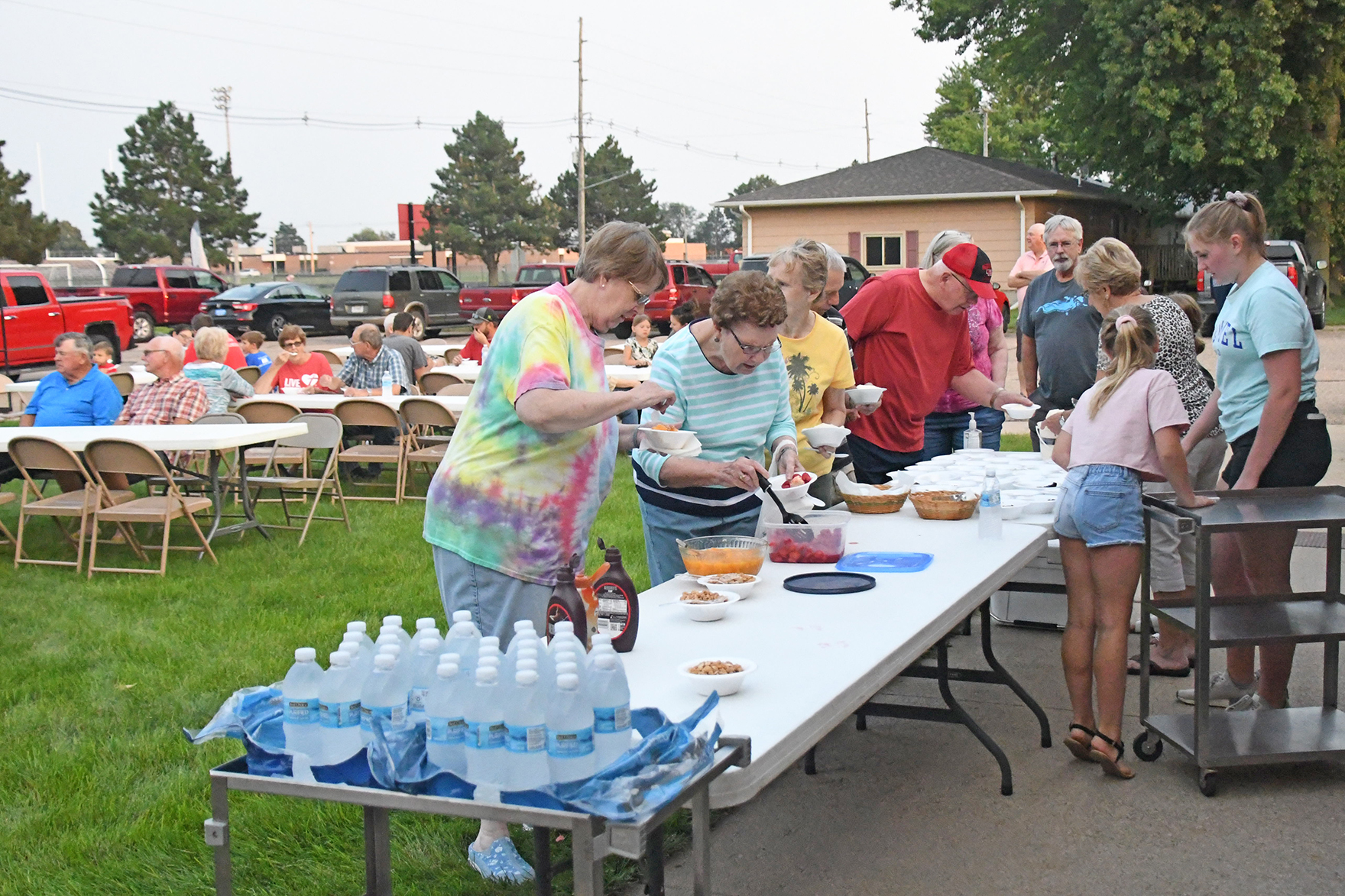
Last week’s National Night Out event is one of the church’s outreach opportunities, with members volunteering to serve brownies and ice cream to the community at large. The Hamilton Community Band provided background music during an evening which drew a large crowd of both members and guests.
“So for us it’s very simple,” Larson said. “For National Night Out we’ll take some pictures and we’ll put them up on our website and just try to let people know what’s going on. For me, personally, that’s been a big challenge is how to do that online. I do online devotions each weekday and that’s a time commitment, as well as a creativity issue.”
Having served the Aurora congregation for the past 18 years, Larson views the name change as a major step forward in the church’s history.
“I think it’s a significant milestone and we’ve had a number of those this year,” he said. “Again, how do we minister to people who have been much more isolated, whether it’s someone in a care facility or at home? The online aspect is really great, so we’re trying to figure out how as a church do we respond and change.
“Again, the big change for this congregation 100 years ago was the literal change of language,” he continued. “And that’s kind of still the issue, though not in the same way. There is quite a bit of Christian lingo that maybe 100 years ago people would have some concept of what it meant … and now just biblical literacy is much less than it was 100 years ago due to people’s time. They are just pulled in all kinds of different directions. The name change is part, I guess, of our ongoing efforts to figure that out. It’s just one piece, but we feel it’s an important piece.”
One point Larson wanted to emphasize is that changes in the name of “progress” are not intended as a criticism of what the church or its members have done in the past.
“It’s an acknowledgement that the world has changed,” he voiced. “So therefore the message that we bring is the same salvation through Christ, but the way that we do that has to change and that goes again to language. We want to honor the traditions of the congregation while we move beyond them in some sense, and in some ways, in order to engage people.”
Music
One noticeable example of change involves music. Rauert said many older members are comfortable with the old, traditional hymnals, while some want to sing and hear new songs, with words and images projected on a screen.
“We want to do things that are inviting to younger people,” she said. “Some people like to read music and some people like to see the words up on the wall, so finding a balance is challenging.”
“That’s like the online, it’s an ongoing challenge,” Larson added. “We have people for whom the old hymns are tremendously meaningful, so we’re not just going to jettison those in favor of something else, but also as Suzanne said there is a lot of great new music and some of it is within our competency. And that’s another piece of it is we don’t want to try to do things that we’re not going to do well. We have a lot of skills and abilities and gifts and talents and we want to utilize those, always asking, how should that look in this environment?”
Rauert noted that the action committee, which is made up of one person from each of the church’s committees plus two at-large members, continues to change and evolve itself.
“It’s really an idea-building board or committee,” she explained. “If we come up with ideas… we assign it to maybe three or four so that a lot of people are included in the ministries of the church. The team generates ideas but also provides, I guess, advocacy and support so that the ideas have someone behind them, encouraging, so they don’t just get dropped or forgotten.”
For more information about Westside Covenant Church, go to www.westsidecovenant.org.