
Forty-nine states allow assisted home births, not Nebraska
Kirsten Johnson was sitting at home on Christmas Eve when a sharp wave of pain stole her next breath. More than a week past her due date, the first-time mother immediately recognized the first sign of labor.
Johnson and her husband left their rural home near Dunning and sped off on the two-hour trek to the hospital in Kearney, a trip Johnson had reluctantly made for dozens of appointments.
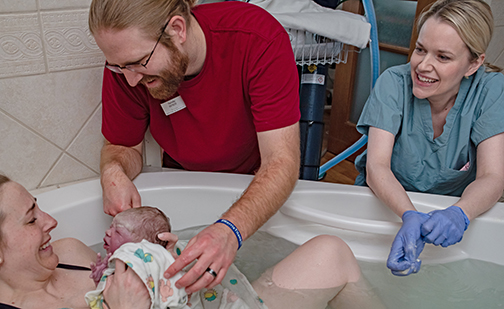
Hours later, Johnson held her wailing baby boy after delivering him in a natural water birth on Christmas Day 2024. While successful, it solidified Johnson’s desire for a different avenue for birth: midwifery.
“Being a first-time mom, you don’t know what to expect … it’s a lot all at once,” she said. Had a midwife been present “I would have felt a lot more empowered.”
Mothers like Johnson interested in alternative forms of birth run headlong into existing Nebraska law.
State law prohibits nurse midwives, the most qualified group of midwives, from assisting in home births even as mothers continue to seek such care from less-educated midwives and doulas.
The supervision barrier
Nebraska is the only state in the nation where certified nurse midwives — registered nurses with advanced training — can’t assist with home births. Nebraska is also one of only two states that requires physician supervision of nurse midwives.
A 1984 state law licensed and regulated nurse midwives, but a last-minute addition requested by the Nebraska Medical Association prohibited them from assisting in home births.
The measure also failed to address forms of unlicensed midwifery in the state. This allowed less-educated midwives to assist in home births until two years ago, when the Nebraska Supreme Court ruled that all midwives must hold a license to practice.
In 2024, about five planned home births occurred in Nebraska per 1,000 live births, up slightly from a decade ago, according to the Nebraska Department of Health and Human Services.
Nurse midwives have been practicing in Nebraska hospitals, birth centers and clinics for more than 40 years — under the supervision of a physician.
Beyond their specialization in primary, sexual and reproductive care, nurse midwives can conduct exams, order tests, prescribe medications, do procedures such as pap smears and address gynecological concerns.
The provision in the 1984 law banning them from overseeing home births came at the request of the Nebraska Medical Association, which raised safety concerns.
Now more than 40 years later, the Nebraska Medical Association and the Nebraska Hospital Association have expressed openness to supporting and advancing the profession with certain guardrails.
“If (home birth) should occur, it should be with a highly trained person in a low-risk identified patient with collaborative arrangements made,” said Robert Wergin, president of the medical association.
A 2024 analysis from the Journal of Clinical Medicine found that midwife care often reduces medical interventions during childbirth with favorable maternal and neonatal outcomes in most cases. Additionally, a researcher at the Boston University School of Public Health found that states with larger proportions of their births attended by midwives tend to have lower infant and pregnancy-related mortality rates.
Elizabeth Mollard, president of the Nebraska affiliate of the American College of Nurse Midwives, said the state’s regulations have made it difficult for nurse midwives to function “from the get-go.”
Under the 1984 law, nurse midwives must practice under a licensed physician who is readily available for consultation.
Mollard said many midwives have struggled to find physicians willing to sign a supervisory agreement because of possible liability risks. This has caused some nurse midwives to switch to non-birth-related roles or to leave the state altogether.
As of June, 113 people had active nurse midwife licenses in Nebraska. Approximately 87 were practicing in some capacity, while only 44 were providing birth services.
The supervision requirement has also been the “primary barrier” to opening and sustaining freestanding birth centers in Nebraska, Mollard said. Such centers in other states are run by midwives, exist separately from hospitals and handle low-risk pregnancies.
Maternal care deserts
Nebraska has seen three separate freestanding birth centers fail over the years, with the latest closing in Lincoln in 2024.
“It’s just silly when we see these statistics about maternal care deserts and that there’s no obstetric care provider in that community, and it’s like, ‘Oh, wait, actually there is.’ It’s just our laws don’t allow them to actually care for patients,” Mollard said.
In April, a nurse midwife legally assisted with a home birth in Hastings after a pregnant mother sued the state, arguing the home birth ban on nurse midwives violated her 14th Amendment rights and religious freedom. The state settled and allowed the birth to proceed.
The case has given nurse midwives across the state hope for change to the current system, which drives home births “underground,” involving individuals with varying levels of experience, Mollard said.
“Right now, we have a really ugly system where you have a choice of a hospital or giving birth alone or giving birth with somebody who is practicing illegally,” Mollard said.
Because of Nebraska’s 1984 law, nurse midwives are the only type of midwife recognized under Nebraska statute. That lone recognition created an avenue for the less-educated midwives in the state, including certified professional midwives and traditional midwives, to practice unregulated.
The loophole was addressed by the Nebraska Supreme Court in 2024 after it ruled that the state’s Uniform Credentialing Act restricts unlicensed persons from presenting themselves to the public as individuals qualified to treat any physical condition.
The cases that triggered the Supreme Court decision involve Judy Jones, a now 78-year-old professional midwife. She attended home births in 2021 and 2022 in Madison and Douglas counties. In the Douglas County case, the baby died because the umbilical cord wrapped around her neck.
Jones is charged with unlawfully practicing as a nurse midwife after receiving a cease-and-desist order, a felony punishable by up to four years in prison. Trial dates have been set for this summer.
Both nurse midwives and professional midwives are now engaged in separate legislative efforts trying to remove barriers to their work — efforts they intend to continue in the 2027 legislative session.
Wergin, president of the Nebraska Medical Association, said nurse midwives could be important collaborators in both urban and rural communities. But the medical association, he said, does not believe professional midwives are equipped to “ensure patient safety” during home births.
“They don’t really have the formal medical training that a certified nurse midwife has,” Wergin said, “and their standards fall far short of what we felt was a safe maternity situation, especially in obstetrical emergencies.”
Written by Kaitlyn Kelly for the Flatwater Free Press, Nebraska’s first independent, nonprofit newsroom focused on investigations and feature stories that matter.