
Early motorized wheelchairs back on display at Plainsman after years in storage
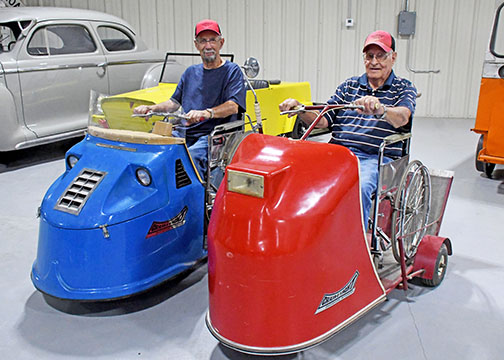
Two sporty looking precursors to today’s battery-powered wheel chairs are back on display and up and running at the Plainsman Museum after having been stored away for the past few years, thanks to the help of some museum volunteers. The gasoline-powered “Chair-E-Yachts” built by a Wyoming company in the 1970s are now on permanent display in the Plainsman’s Wesley Huenefeld Agriculture Museum. One of the unique vehicles is a red 1974 model and the other one, which is blue was built in 1976.
“Many, many years ago, they were over in the (main) building, but then they went into storage,” museum director Tina Larson explained.
Originally brought to the Plainsman in 1998, the motorized scooters were on display up until 2018 when they were moved over to Huenefeld.
“For me, I never saw them before a couple of months ago,” volunteer Dale Saddler commented.
However, late this summer he and fellow volunteer Don Bish went to work on them to get them running again.
“We didn’t have to do a whole lot, just put gas in the carburetor just to get them running,” Saddler said.
Taking a ride around the exhibits at Huenefeld, Saddler displayed the speed and maneuverability of the ‘76 model chair.
That unit has a 5-horsepower Briggs & Stratton engine with a forward and reverse gearbox. The 1974 model has a 5 HP electric start Briggs with a serial number of 02.
“They made that motor for thousands of things,” said Bish.
The engines are started by placing a key into the ignition and turning it, similar to a car.
“We actually had a key,” Larson commented. “After all these years, we actually had the key.”
Drivers control the forward and reverse functions of the chairs by rotating the handlebars.
The controls for the accelerator and brakes are located on the Yachts’ handlebars as with a bicycle or motorcycle.
Larson said she had driven one of the chairs at a speed of 8 mph, but estimated they could go as fast as 15-20 mph.
“The self-propelled was enough to knock me off, I tell you,” Larson said. “Holy smokes!”
Larson explained the ‘Chair-E-Yachts’ were early versions of today’s motorized wheelchairs.
“This was an early version of how somebody could get around in a wheelchair, which we now have automated ones in Walmart and that kind of thing,” Larson said. “The back drops down as a ramp... and then they can drive themselves sitting in their chair.”
The Chair-E-Yachts were created in Shoshoni, Wyo. in the 1970s, two decades before electric wheelchairs came on the scene.
“There’s a little history of it, but of the history of these particularly was 1976 in Wyoming, by this company ‘Chair-E-Yacht,’ a play on the word (Chariot),” she commented.
According to Larson, 1,200 of the ‘76 model were manufactured, but only 50 1974 Chair-E-Yachts were made. She said records of remaining vehicles are very limited.
“Who knows what happened to them all,” Saddler commented. “They probably got scrapped out... but it was a good idea at the time.”
The museum’s ‘74 model came from a shed in Lincoln where it had been stored for 17 years, while the ‘76 was found in a airplane hanger in Lander, Wyo. The ‘Chair-E-Yachts’ were brought to the Plainsman by Lincoln residents Chuck Robinson and Roger Gustafson in 1998.
“They were in Lander and brought them back, refurbished them and they ended up here,” Larson explained.
“Now that this building’s completely redone, we brought them over here,” Larson said of the scooters. “So things are coming out of storage and it’s kind of fun. The volunteers and staff have worked very hard to get everything out on display and we are proud of how it turned out.”
After bringing the motorized scooters out of storage, Bish and Saddler had to make some changes in order for them to run properly.
“The carburetors, they didn’t want to run very good,” Saddler explained. “I’m surprised they ran when they brought them in... so we’re just cleaning them up basically.”
“They’re in pretty good shape,” Bish commented.
It only took two weeks for the volunteers to make the repairs needed for the vehicles.
While the museum doesn’t plan to drive the scooters regularly, a video of Saddler driving the scooter can be found on the museum’s Facebook page.