
Tallgrass announces $98M project

Subhead

Energy infrastructure company to convert natural gas pipeline into CO2 transport line
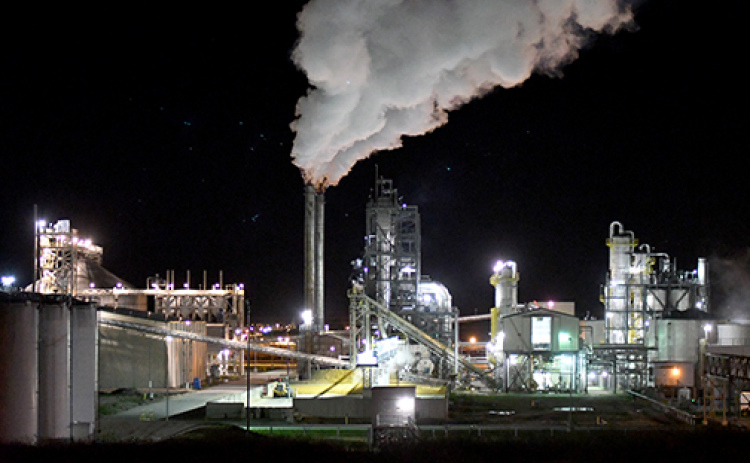
A large energy infrastructure company has announced plans to invest an estimated $98 million in Hamilton County over the next two years, converting its existing Trailblazer natural gas pipeline south of Aurora into a carbon dioxide (CO2) transportation service based in part on a new partnership with the KAAPA Ethanol plant in Aurora.
Tallgrass is active in 14 states and has been operating in Nebraska since 2012, with a focused mission of moving natural gas from where it exists to where it’s needed. John Hladik, the company’s manager of state and local public affairs, shared some background information on Tallgrass in a presentation last month to the Aurora Rotary Club, while also explaining the new venture with KAAPA.
“The ethanol industry is facing some headwinds right now as there are a lot of electric vehicles out there, far more than there were two years ago,” Hladik began. “Several states have also passed laws that make it more difficult to sell the traditional ethanol produced here in Nebraska into those states, so you have an industry that employs around 6,000 Nebraskans, does $4 billion of business in the state every year and gives a 22 percent-per-bushel premium on every bushel of corn that a farmer sells to them. 
“That industry is looking in the mirror and realizing that it needs to adapt,” he continued. “It needs to recognize the changing market. It needs to produce a product that is in higher demand than what traditional ethanol is right now and we can get there if we can capture and store and transport the CO2 that’s produced during the ethanol fermentation process.”
As it operates today, the ethanol plant on the west edge of town, as do similar plants across the state and nation, releases carbon dioxide into the atmosphere. At one point there was a carbon capturing facility on the site owned by EPCO which distributed small amounts of CO2 by truck, though that facility was discontinued and removed years ago. 
Tallgrass, according to information posted on its website, is now advancing a project to convert its Trailblazer natural gas pipeline to CO2 transportation service, establishing an approximately 400-mile CO2 pipeline to serve as the backbone of a regional CO2 transportation system. This project will allow the company to capture, transport and permanently sequester more than 10 million tons of CO2 per year from industries in Nebraska, Colorado, and Wyoming. In support of this investment, Tallgrass is developing a commercial-scale CO2 sequestration hub in southeastern Wyoming, partially funded by a grant from the Wyoming Energy Authority.
“When you create ethanol, the fermentation process releases 99.2 percent pure CO2,” Hladik explained. “That’s food grade, medical grade, and right now it’s going up in the air. That’s fine, but if you can capture that and move it, then you’re not just producing ethanol, you’re producing low-carbon fuels and that’s where the market is right now.”
Hladik noted that Tallgrass has been talking with companies all over the world which reflects a growing demand for using CO2 as a feedstock for various products.
“So all across the board we know demand for traditional ethanol is going down while demand for low-carbon fuels is going up,” Hladik said. “We can produce these low-carbon fuels in the same places in the same infrastructure as we’re producing the traditional ethanol, as long as we can capture and transport that CO2. That’s what this project is all about.”
Tallgrass has been approached by a number of different firms that are looking to utilize CO2 as a feedstock, added Kyle Quackenbush, the company’s segment president.
“We have companies that are looking at making synthetic diamonds by using this,” he said in a later ANR interview. “The food grade companies that utilize CO2 for drinks or things like that are looking at it. There are also firms that can use CO2 to create other kinds of fuels as an example, so our vision for Trailblazer is to have this backbone system. No matter what happens, the CO2 is no longer going into the atmosphere and that’s what sequestration makes available.”

Trailblazer CO2 Project
Known internally at Tallgrass as the Trailblazer CO2 Project, the concept to convert an existing pipeline to transport carbon dioxide from ethanol producers has been brewing for a couple of years. That plan, company officials report, began to crystallize toward the end of 2023. 
“We’re very big into repurposing infrastructure at Tallgrass,” Quackenbush explained. “We had heard from a number of ethanol plants that we serve and we are physically connected to, including some of the KAAPA facilities, that they were looking for solutions for CO2 and that is something that we could be helpful with. They’d heard about some of the other products that were out there, and so that’s really when the dialogue started.”
Quackenbush noted that both companies began researching all aspects of the plan to make sure the project would be viable. Those efforts focused on confirming that moving CO2 into what was built as a natural gas pipeline would be safe, that all the natural gas infrastructure could be replicated, and that the process would lead to a commercial agreement that worked for all parties involved.
“At some point last year all those things started to come together and then right before the end of the year one of the last pieces came together as we expected,” he said.
The overall Trailblazer CO2 Project is estimated to cost $2 billion in Nebraska, creating 4,500 construction jobs as well as 60 permanent jobs, which would be in addition to the 60-100 Tallgrass employees already working in the state. 
“I looked at the numbers and I think it’s a $98 million investment in Hamilton County, and that’s because we need to put a capture facility on the Aurora ethanol plant,” Hladik said. “We’re also going to have to be able to connect that facility down to Trailblazer (pipeline) in other places in the county, so we’re excited about the investment here. We’re excited to work here and we’ve been getting really good feedback.”
The route for connecting the ethanol plant to the Trailblazer pipeline is in the process of being determined now.
“That’s one area where we are actively working with landowners,” Quackenbush reported. “We work hard and try to route the pipeline to work with landowners that are excited about the opportunity, versus those who are opposed to it from the beginning, or just from the perspective of their property. Maybe it’s not an ideal location, so it’s just a little bit of a process that is still coming together.”
One of the benefits to the Trailblazer project, Quackenbush reported, is that instead of having to build hundreds of miles of main line, Tallgrass can build smaller lateral lines that connect into an existing pipeline system, all buried four or more feet underground.
“That creates a lot less total mileage that we would need to build to still connect some Nebraska facilities,” he explained. 
Depending on various factors, including routing, Quackenbush said the earliest potential targeted start date could be a year or so away.
“Right now we’re looking in the middle of 2025 for our potential in-service,” he said. “That was an important element for the ethanol facilities themselves as far as incentives that they have in place or their ability to do incremental investments on their facilities. Having carbon capture supports their development efforts. It also means you’re able to start capturing earlier, so you’re reducing the carbon intensity all very quickly. That was a very important element for these facilities as they were thinking what their options were.”

Safety factor
Quackenbush also pointed out that though large-scale CO2 storage pipelines may be unheard of in Nebraska, they are not new to the United States.
“It’s important to note that these CO2 pipelines are not new,” he said. “We’ve got decades of great experience operating CO2 pipelines across the country. As we interact with the community, sometimes just because you haven’t had a CO2 pipeline in Nebraska yet there’s an assumption that these are a new feature, and sometimes people will try to make it sound as if this is something that’s either novel and untested, or something that hasn’t been proven. Neither of those are true. What is true is that there wasn’t a reason to have a CO2 pipeline in Nebraska until this point … What we are doing is expanding the services that we provide today to all of our customers in the area with a very known and established operating pipeline.”
Tallgrass touts safety as a top priority, utilizing a 24/7 sensor system which automatically shuts valves down if any decrease in pressure is detected throughout the line.
“We’ve had Trailblazer since 2012 and there have been no leaks or major accidents,” Hladik said. “CO2 is not flammable, it’s not toxic, it’s not corrosive, it’s not poisonous and it’s a gas that the federal government classifies next to nitrogen.”
On a related note, Dist. 47 Sen. Steve Erdman introduced a bill in the Nebraska Legislature Jan. 11, LB 1140, that would prohibit the transportation or storage of CO2 on a natural gas pipeline. That bill was withdrawn eight days later by unanimous vote.