
State Fair revolves around people in yellow shirts

Subhead

Local volunteers enjoy contributing to annual G.I. event
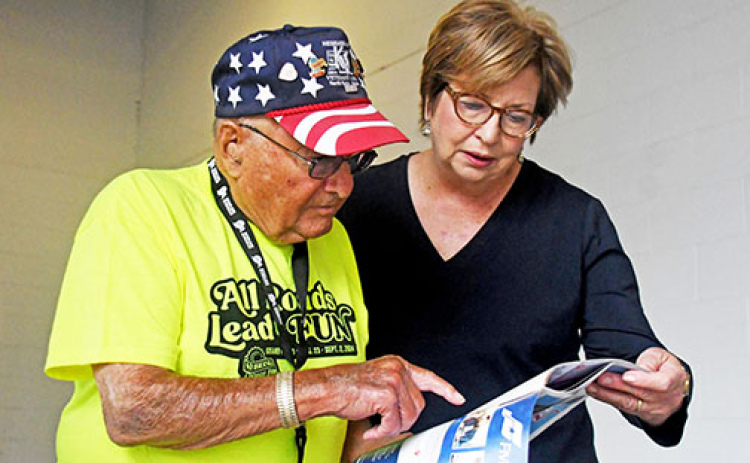
While the state fair features a variety of performances and events that bring people from all across the state together, volunteers adorned with yellow t-shirts have established themselves as being essential cogs in the fair’s machine.
According state fair volunteer Claire Frevert, a former teacher from Aurora, there are hundreds of volunteers who help make the 11-day long fair a success.
“There’s no way they could have a lot of things that they have at the state fair without the volunteers,” Frevert said.
After the fair relocated from Lincoln to Grand Island in 2010, Aurora resident Glen Beran was one of many folks from surrounding counties who were eager to help it thrive.
“I was very glad when it moved from Lincoln,” Beran commented. “When it was there, I was very disappointed in what they had. When they moved here, I just figured, ‘Hey, in order to make it go, it takes a lot of volunteers.’ I’m glad to see it support central Nebraska.”
This year Beran was one of the first faces visitors saw when they entered the fairgrounds. Working at the north gate, he said there’s never a dull moment with new visitors arriving by shuttle or by bus.
“There’s kids that come in and I get to wave to them,” he commented. “You’ve got shuttle buses all the time and so on.”
Throughout the park, volunteers can be found welcoming fair-goers to the fair’s countless exhibits and attractions.
Aurora’s Dave Oswald, 92, who has been a volunteer since 2011, has greeted thousands of fair-goers all over the fairgrounds.
“I’ve ran the courtesy cart that hauled people around several years,” Oswald stated. “I’ve been in different areas, down at the cattle barn and then down at the hog barn.” 
When signing up for roles, state fair volunteers are presented with options and choose where they want to work according to Oswald. This year, he chose to be a greeter at the sheep barn.
“It’s a nice greeting place,” he commented. “A lot of people come and go. This changes from different days of the week with different products in here.”
Oswald said seeing the thousands of fair-goers this year has been an ongoing motivation for his work as a volunteer.
“It’s been real interesting to greet different people from all over the country,” Oswald said.
Since 2013, Frevert has also volunteered throughout different parts of the fairgrounds.
“(On Wednesday), I was just driving the courtesy cart,” Frevert said. “One day, I was on ground shuttle. I’ve done the busses that go back and forth to Sam’s Club or (Central) Community College.”
Frevert has also volunteered at the information kiosks, open class photography and later helped in the low-sensory room, where visitors can visit if they become overwhelmed with the weather or the crowds.
While the streets can be filled to the brim with fair-goers, volunteers and staff, Frevert commended visitors for being courteous to courtesy carts.
“If I have to go down a part where there’s people there, if they hear you coming or see you coming, they’re very good about it,” she commented. “We’re very cognizant of them and they’re very cooperative with us.”
Having a lifelong passion for helping others, Frevert uses the skills she has gained as an educator to help make the fair welcoming to everyone.
“I wouldn’t keep doing it if I didn’t like it,” Frevert commented. “I’m a teacher, it’s kind of what teaching is, helping people in a way to pass that on and continue to do that and help people.”

Volunteers behind the scenes
Even though they didn’t volunteer during the open hours of the state fair, Doris and Steve Vetter have also  been playing a crucial role in volunteering since they started four years ago.
“It was something we had thought about doing, but the opportunity didn’t pop up,” Doris said. “Then one of our friends, (Sue Kemling) is in charge of photography and she said what she was doing and we volunteered to help.”
During the week prior to the fair, the Vetters assisted judges for the photography competition in prepping over 1,000 photos that were submitted in 50 different categories.
“They lay out the pictures and there are three judges and they come along and pick first through fifth places,” Doris explained. “Then there is a table of us where we record that, there’s a picture taken of the picture, it’s written down and then there’s a ribbon put on in a certain process.”
Along with the challenge of making sure every photo is accounted for, volunteers had to relocate from the usual location of the photography exhibit into a smaller space due to construction.
“It used to be in the grandstand and there was quite a lot of room,” Steve explained. “Now it’s moved over to the agricultural building, because of the casino and everything’s a little more pushed together.”
Despite the change of scenery, the couple was happy to continue being part of the event.
“We like being part of the process and we feel like we’re part of the state fair that way,” Doris commented.
While she has not worked as a yellow-shirt every year since she started in 2010,  Beth Andrews has also dedicated several years as a 4-H volunteer helping out contestants in the style and horticulture competitions.
“I just like being there to help the girls and I try to be the mom that can’t be there, because they don’t let moms back in the dressing rooms,” Andrews said. “I check bows, I check necklaces, I check to see that everything looks good before they before they model... I like to help make things run smoothly.” 
Having been highly involved in the 4-H program in Hamilton County, Andrews spoke on the pride she feels in seeing contestants grow over the years.
“It’s fun to see the progression,” she commented. “Because these high school girls, the ones that have graduated, this is their last year and just to see... the accessories and you see the well put- together outfits.”
Frevert said the volunteers who are easily identified by their bright yellow t-shirts feels like a big family. 
“When you’ve got a yellow shirt on and you see another volunteer, you wave and there’s an instant camaraderie,” she said.
Frevert encourages others in the area to consider volunteering at the fair and noted how much the fair gives back to the smaller communities around it, including Aurora.
“People stay here, people camp, people stay at the motel,” she commented. “Aurora gets business from the state fair. It’s good for us and we just want to help make this fair successful in central Nebraska.”
On Friday state fair officials paid tribute to the more than 700 volunteers they called the “heartbeat of the Nebraska State Fair year in and year out.”  
Volunteer Coordinator Haley Roush said she was beyond thankful. 
“When I took this job, I didn’t realize the family-friendly environment these volunteers would become,” Roush said. “It’s not just 11 days with these people. They become family to you, and they check on you even when the fair’s not going on.”
“It’s a new side of the fair that people haven’t seen before,” Roush added.