
GPSHO relocates from Kearney; Dunn serves as local mgr.
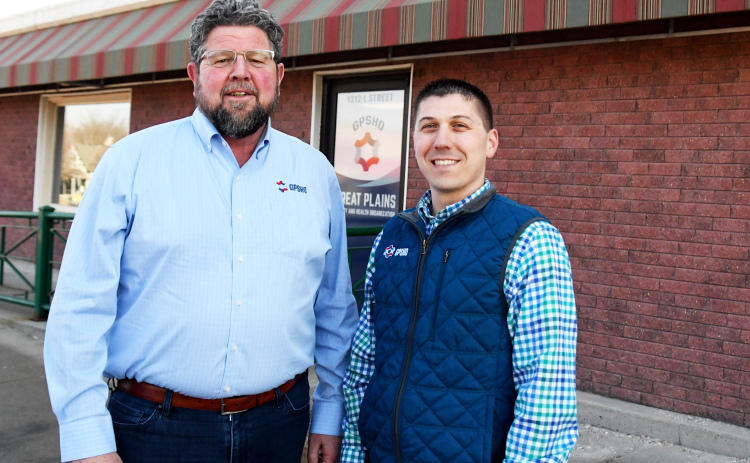
The Great Plains Safety and Health Organization has planted a flag in Aurora, moving its headquarters from Kearney to just off the downtown square hoping to expand its safety training mission with a location more central to its clientele.
Company founder and executive director Mick Anderson explained the reason and timing for the move, reporting that he is excited with opportunities created by the location change.
“We were kind of looking for a spot and then this came open,” Anderson said of the offices at 1312 L St., the former State Farm Insurance building. “We’ve had a long partnership with the university there in Kearney, but their space (on the west campus) was getting more challenging for us to get people on campus to train, so it just wasn’t as convenient. There was a lot of opportunity here and the timing was good.”
The Great Plains Safety and Health Organization (GPSHO) provides training to a wide range of businesses and industries large and small, helping them to comply with or exceed OSHA, community and company safety and health requirements. For more than 20 years, the 501(c)3 company has provided customized, on-site training, job site audits, safety and risk management assessment, and OSHA abatement assistance, all with a goal of keeping employees safe.
The new offices in Aurora provide space for larger on-site training seminars, though much of the company’s work is done on site with clients throughout central and eastern Nebraska.
“As we continue to move east a little bit more this gives us a better location to some of our clients,” Anderson said, listing clientele from Lexington to Omaha. “Not everybody comes here for the training. Some do, but we have a lot of folks in the Grand Island, Aurora, York, Hastings area we train and represent so the move to Aurora gives us a central location. Geography had a little bit to do with it.”
Another reason Aurora stood out in the site search is the fact that safety specialist Mark Dunn, a Falls City native who joined the company after graduating from UNK, has lived here since 2010. Dunn, who was recently elected to serve on the Aurora City Council, was commuting to Kearney, but also spent time on the road driving to clients throughout GPSHO’s trade territory. As of Dec. 1, 2020, Dunn now anchors the home office in Aurora, though continuing to travel as needed.
“My wife (Micayla) teaches middle school so that prompted the move here,” Dunn recalled. “We’ll go anywhere and do all kinds of training, which is still the case, so I’m not in the office here every day. This was available and the timing just worked out perfect for us to be here.”
A growing need for safety training
In addition to excitement with the change of location, Anderson said he is encouraged by what he calls a growth trend in the training industry.
“I’ve done safety training at the manufacturing facility (in Kearney) for many years,” he noted. “I’ve just seen growth in the industry as more and more companies begin to understand the value to do safety because you can reduce injuries and they start seeing that their insurance and workman’s comp rates are better.
“There are some companies, like Cargill or ADM, where you can’t work for them if you don’t have a safety program,” he added. “We’re seeing that, and also the workforce continues to roll over, so businesses have to retrain their people. Some businesses are also getting people in the workforce now that maybe don’t have those skill sets to operate equipment. We’re just seeing more training opportunities, so I see continued growth.”
Though GPSHO works with some very large clients, Anderson said some of the growing need for employee safety training is coming from smaller businesses, including the retail sector.
“Everybody has risk and liability, whether it’s preventing personal injury or lawsuits,” he explained. “One of the things we do is try to help reduce that. And then most people are under OSHA, though a lot of times they don’t know that. Our role is training, but sometimes a bigger component of it is kind of consulting, making sure they have written programs in place, and making sure they are looking at things that potentially could cause somebody to get hurt.”
The consequences for violating safety guidelines, even if unknowingly, can be costly, Anderson advised.
“From a compliance standpoint, one violation can be $13,000 for just having a blocked exit or fire extinguisher requirement that some people may not have even known they were under,” he said. “I think that more of the general public and businesses are finding out that they have to follow OSHA regs.”
Dunn noted that GPSHO has added classes in recent years, some aimed at very specific industries, while others apply to a broader audience.
“Some of the stuff involves skill development, with things like mobile equipment, skid steers, tele-handlers and forklifts,” he explained. “So for some we have to have hands-on training with skill-based things. You just can’t do that through a computer.”
Adding to the challenge of providing timely training out in the field has been a year-long pandemic. More training sessions were offered online in 2020 than ever before, which Dunn said worked, but wasn’t ideal.
“It’s a little bit tougher, trying to do it virtually or remotely, just to engage people to make sure that they kind of do get the message,” he said. “Again, it can be done, though it’s definitely just an easier process when it is done in person. Most of the places that we’ve been we’ve been able to do training by finding a big enough space that we can still keep everybody socially distant, keeping within the health guidelines.”
The GPSHO staff includes Anderson, Dunn, as well as another trainer and membership development coordinator, both based in Kearney.
“We have about 200 companies that are members, though you don’t have to be a member to be part of our organization,” Anderson said. “We put out what we call Safety Speaks, which are a weekly sample. One week, for example, there may be a focus on ladder safety and we’ll go over with your company or your crew safety tips on that.”
On a final note, Anderson reported that GPSHO is a 501(c)3 nonprofit company, and as such has a mission to try and give back to its host community.
“Whether it’s school safety, bike safety or something to do with kids we do try to give back by promoting things outside of occupational safety,” he said. “That’s another reason we’re kind of excited to get involved more with the Aurora community. I think this is a great size town and just a good fit for us to be here in the community doing more of those safety outreach things. We are really looking forward to that.”
For more information on the company, go to its website at www.gpsho.org.