
UNMC scientist says farmers not to blame, urges private well testing as studies examine possible connections to cancer
Concerns about nitrate contamination in Nebraska’s groundwater extend well beyond drinking water quality, reaching into questions about infant health, cancer research and the long-term health of rural communities, according to University of Nebraska Medical Center researcher Dr. Jesse Bell.
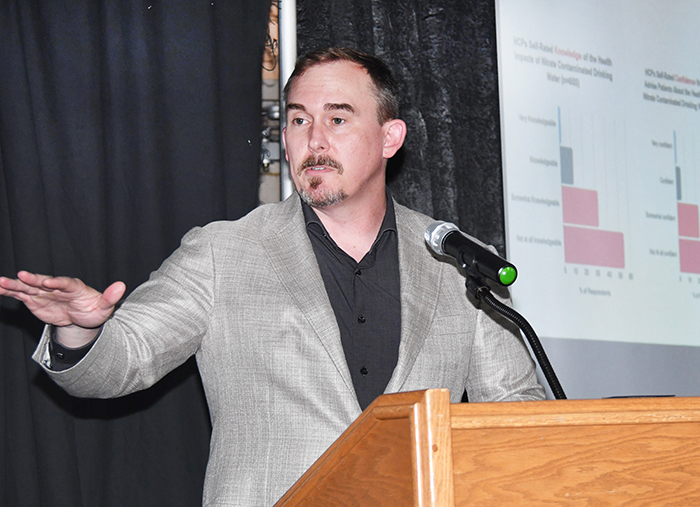
Speaking July 18 at the Grain Place Foundation’s Field Day in Aurora, Bell said scientific studies have identified associations between elevated nitrate concentrations in drinking water and a variety of health concerns, while stressing that researchers have not established nitrates as the cause.
“High concentrations of nitrate in drinking water have been linked to adverse health outcomes,” Bell told a crowd of approximately 100 attending the event at The Leadership Center. “I know that this is a heavy topic, but I want you to know what there are pathways forward for addressing a lot of these issues.”
Bell said Nebraska has one of the nation’s highest rates of pediatric cancer, but cautioned against assuming nitrates are responsible.
“Is that because of nitrates? We can’t say that,” he said. “We don’t know. There are a lot of factors that could potentially be interplaying here. But could it be a contributor? Potentially.”
Bell said UNMC researchers found that counties with higher nitrate and atrazine levels also tend to have some of Nebraska’s highest cancer rates, while reporting that the levels vary significantly from county to county across the state.
“These are correlations. It’s not causation,” he emphasized. “It’s just saying that there’s an association there between the two of them. But again, that’s not the only thing that we’re talking about in Nebraska. We’re not just talking about nitrates.”
Farmers not to blame
Bell, a Ph.D who serves as the University of Nebraska’s director of Water, Climate and Health, sent a clear message to the ag-focused audience attending the Grain Place event.
“This is not because of farmers,” he said. “Nothing upsets me more than to say it’s the farming population. Thirty to 40 years ago a lot of these associations weren’t known so we’re building up an understanding of a lot of these things. Farming is generational, (involving) handed down land and practices, so they were given a bill and now they have to deal with it.”
Bell said his goal now is to be a resource for farmers and others in Nebraska working together to address concerns with nitrates in the water supply.
“We should be making heroes out of the ones who are willing to take the risk,” he said, referring to producers now pursuing regenerative agriculture practices. “Let’s not be pointing fingers. The person who is out there putting their livelihood on the line to make a change because it could potentially change their children’s health and the environment, we should be treating those people as the heroes.”
Extensive research
Bell summarized research that has found associations between elevated nitrate exposure and colorectal, thyroid, kidney and bladder cancers, as well as several pregnancy and childhood health concerns. He noted that some studies have reported increased risks even below the federal drinking water standard, while other studies have found no association for certain cancers.
“The complexity behind it is that a lot of times we only look at one exposure in the environment, but we’re not a one-exposure world,” he said. “We’re exposed to a lot of different things in our environment on a regular basis. Nitrate may be just the canary in the coal mine of trying to understand some of these associations, because we’re not potentially measuring and monitoring all these other potential exposures as well.”
Bell said Nebraska is particularly affected by nitrate exposure because about 85 percent of homes rely on groundwater and an estimated 360,000 residents use private wells, which are not regulated under the Safe Drinking Water Act. He explained that the federal drinking water standard for nitrate is 10 milligrams per liter, a limit originally established to protect infants from methemoglobinemia, commonly called “Blue Baby Syndrome.”
Indiana study
Having devoted a great deal of time and attention to his research, Bell said there are several main points he wants to drive home in terms of what is being done to address the nitrate issue.
“One, we need to identify at-risk areas and people who are at risk, and then we need to communicate to them and help them understand what their risks are,” he said. “Those individuals, especially those on private wells, we need to encourage them to test their well so that they know what’s there and what’s present so they can make informed decisions on what to do.”
“Then we need to help these individuals find low-cost to no-cost solutions, because the financial burden obviously could be great for them to try to address these issues,” he continued, noting that the risk of bankruptcy in the United States is twice as high if somebody in a household has cancer. “Then, especially in some of these locations, we need to make sure that they’re maintaining these (private well) systems as well.”
Bell cited one specific study conducted in Indiana, where a number of women were having spontaneous abortions, also known as miscarriages.
“The CDC (Centers for Disease Control and Prevention) came in and did a study within that area to try to understand what was potentially going on,” he reported. “The only thing they could find was that in the wells where these women were located, which were all private wells, the nitrate levels were between 19 and 26 milligrams per liter. Anecdotally, I heard afterward that some of those women had a healthy birth when they found them a new source of water.”
From a pure prevention perspective, Bell said, if those steps are taken consistently, especially in areas with high nitrates and a heavy reliance on private wells, health risks could be reduced within Nebraska communities.
Expertise, engagement needed
Bell reported that he and others across the University of Nebraska system need help and support from other sectors to have the greatest potential impact.
“To be able to do this we need expertise from people that are working in agriculture, working on the environment, and those who understand the physical science side,” he said. “We need the public health side and we need sociology and a variety of other areas to be able to talk about these complex issues.”
On the education front, Bell said there are trainings available for high school teachers to help individuals go out and test their wells, as well as an effort to involve health officials in the process.
“We’re working with the State of Nebraska through the Nebraska DHHS (Department of Health and Human Services) to provide the information to local health departments so that they can help communicate,” he said. “We did a survey of healthcare providers in the state and most of them said they’re not really knowledgeable about the nitrate issue in Nebraska and what it means for health.”
“That was a fail on us,” Bell said.
However, he believes it can and should be addressed.
“One of the things I took away from that is that even though they’re not very knowledgeable on probably the biggest environmental issue that we face in the state of Nebraska, most of them (healthcare workers) were willing to talk to their patients and learn about this,” he said. “That was a gap, so we’re working on that and trying to address some of these issues.”
Bell commended the Grain Place Foundation for hosting an event which shared a variety of perspectives on the topic. In addition to speaking at the event in Aurora, Bell said he has given a number of presentations to Natural Resource Districts, farmers and various farm groups about the nitrate issue.
“A number of my colleagues have also been engaged with this as well, because this is a challenge that isn’t going to be solved overnight,” he said.
Bell said solving the nitrate challenge will require partnerships, expanded well testing, continued research and better public education.
“I’ve talked to 200 to 300 farmers in Nebraska because of the interest, and now the governor is talking about water quality,” he said. “We have seen huge changes in Nebraska in a short period of time.”
“I would love to see Nebraska be a leader in trying to solve this problem,” he concluded. “I love having these conversations. They are not always fun conversations, but they are important, so I’m hopeful.”