
Museum plans to preserve today’s history as well
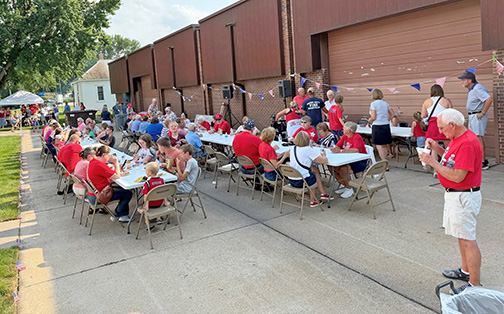
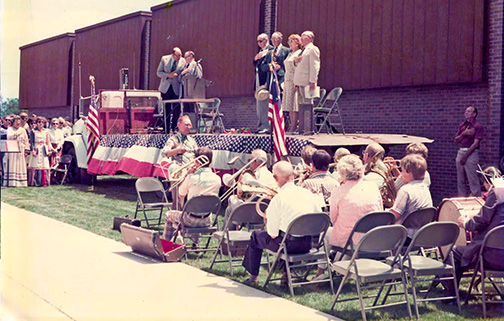
Turnout was large for the Plainsman Museum’s 50th Anniversary celebration on Friday, with approximately 275 people in attendance for the golden anniversary party.
While the Plainsman and Hamilton County Historical Society traces its origins back to 1935, first inside the courthouse, the Plainsman was located at the Otto House from 1944, with the Historical Society buying a site where the current facility is located in 1969.
“You couldn’t move around in there and they started storing things in out buildings,” Larson said. “Things were getting moldy and you just couldn’t do much, and they felt that the knowledge our history was as important as the knowledge you can get in the library and people agreed.”
The project was led by Wesley Huenefeld, who, along with several volunteers, approached the city and county to raise money to build a new facility.
Paul Huenefeld, a nephew of Wesley, recalled how he and his family had to help manage their farm south of Aurora while his uncle had overseen the construction.
“I was kind of managing most of the decisions on the farm at that time and he was gone a lot, but it didn’t hamper the farm,” Paul said.
He recalled watching his uncle’s determination for people to see artifacts from Hamilton County for years to come.
“He always, as long as I remember, had a keen interest in preserving the history and the museum was the avenue that he took to do what he felt was his part in preserving the past to show for the future generations,” he said.
One of the major features the volunteers worked on was the main facility’s rotunda, which features murals along the walls and on the floor, capturing Hamilton County’s landscape and history.
“Wesley started seeking out artists and ideas on storytelling,” Larson said. “‘How are we going to tell our story with pictures and text? And the rotunda cases became like huge dioramas, like we used to do when we were kids in school... They... told the story of the beginnings of humankind and everything, going through the story, bringing them up to growing corn here and the Native Americans and all of that.”
The floor murals made of Italian marble were designed by Wesley.
“When you think it’s been on the floor for 50 years and how many people walk all over it and it still looks as good as it does, it’s an amazing testament to that,” Larson said.
According to Paul, several artifacts that are now on display at the Plainsman and Ag Building were once stored on his family’s farm.
“I can’t say that I had that moment of seeing it for the first time, because a lot of the furnishings or the articles that are in it today, he stored on the farm, in buildings, sheds, garages and his basement,” he said. “I was aware of the majority of the items that went in there. In fact, some of them were equipment I drove as a kid.”
Among the artifacts from the family farm was the sod house.
“The sod house was dug just three-quarters of a mile out of here, less than a mile south of here, out of a native pasture and I helped a little bit on that project,” Paul said.
Another was the blacksmith shop outside of the Plainsman.
“I know my dad (Charles) and the family were glad to contribute towards that,” Paul said. “The blacksmith shop actually sat out here for quite a few years before it got relocated again. It was not original to the farm. I think it came from the Hampton area, but it was moved here until the museum had a place to relocate it back there.”
When the collection outgrew the main building, the Wesley Huenefeld Agriculture Museum was created and dedicated on July 4, 1986, the same day as the celebration of the museum’s 40th anniversary. The Ag Building hosts antique cars, historical ag equipment, a homestead and even a watercraft commissioned by the Nebraska State Navy.
“I don’t think that he envisioned that building in the beginning, but when they finally built the main museum, he realized there was a lot more to tell,” Paul said. “They needed space to tell that story as well.”
Larson noted that the Plainsman’s current facility now hosts over 60,000 items as well as 10,000 photos of Hamilton County’s history. All of it was donated by people who were residents of the county.
“For a small county to be able to house this much knowledge, this much research, this much in artifacts and items, and all that kind of stuff is extraordinary,” Larson said.
“I’ve had people go through here, just walk super quiet; they don’t say much,” she said. “Then they get over there and all of a sudden, you can hear laughing, and people are talking, and they’re pointing, and say, ‘Can you believe we did this? We did that!’ and ‘Do you remember this? Do you remember that?’ That’s fun.”
Recently, volunteers have built and opened exhibits filled with artifacts from the 1950s, ‘60s and ‘70s.
“That’s generating a lot of conversation, because most of those folks are grandparents now and they’re bringing their kids, and people are remembering all of these interesting things that we have,” Larson said. “That’s really fun to continue that story, so we’re not just stopping in 1940, we decided we go to push through. We’ve got to bring it up to the 1990s if we can, because all that stuff’s just being thrown away and I do not do future directors any justice if I don’t start capturing this history now, because time is marching on and this is what we need to do, is advance our history.”
As a private museum not on the tax rolls, the Plainsman has continued to grow thanks to the Hamilton County Historical Society board of directors and the volunteers who maintain the facilities.
“We have 43 volunteers that help us in so many ways, either with tours, cleaning, repairs, building, filling, cataloging and then serving on committees that help make decisions and put on programs,” Larson said. “We can’t do it without them. It is impossible. That has always been the backbone of the museum: the people volunteering.”
Paul is also pleased to see the memories of his childhood and his family live on in the museum.
“It was satisfying to know that the history of our county, of our people here, was being preserved in a way that future generations could learn from them,” Paul said. “I enjoy going through the museum and just rolling back through the memories of using some of the pieces I see up there on our farm in the early years.”
As people rely on digital technology to store photos and memories, Larson encourages people to create physical copies so that no matter what happens to their cloud storage, they will always have them to cherish.
“I tell the students, even though people of the past dressed differently and they had different interests, we are still human,” Larson said. “We like to hear and experience stories. We like to touch things, to see them, to hold them, we like personal contact and connection with things. That’s who we are and that’s what connects us through centuries.”
“We appreciate everyone who turned out to join our celebration,” Larson said. “And thank you to the Hamilton County Historical Society Board for all their work in putting on the event, as well as the participation by the Aurora High School cheerleading squad and the Hamilton County Band. We also thank all our volunteers who helped get us ready for the event.”