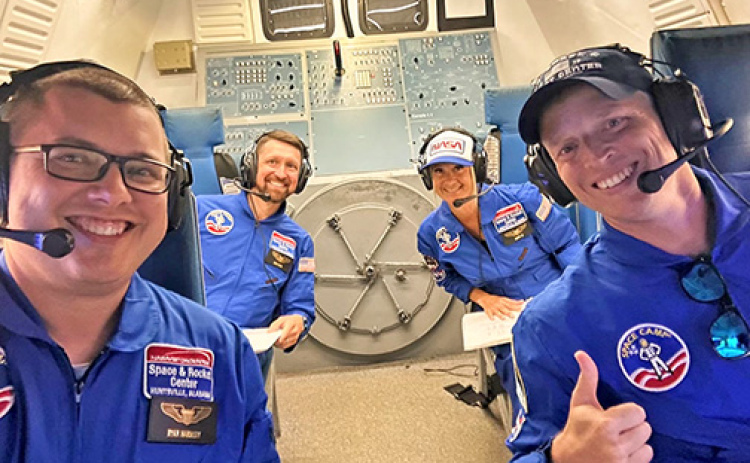
Phillips travels to space ... camp

Subhead

Nebraska Teacher of Year shares NASA camp experience

The role of Teacher of the Year continues to be an eye-opening experience for Aurora math teacher and Nebraska Teacher of the Year Scott Phillips. 
Alongside his cohort of 55 others who were selected as Teachers of the Year throughout the United States and its territories, Phillips recently participated in the Space Academy for Educators at the U.S. Space and Rocket Center in Huntsville, Ala. 
The camp commenced on Wednesday, July 17 and ended with the teachers’ graduation from the Space Academy on Monday, July 22.
“When we went there, we were actually campers,” Phillips said. “It’s for educators and for teachers, but it’s as if you’re reliving your days of high school and elementary school a little bit because they literally sit there and have you do all the activities that kids and families would do.”
Not only were the teachers encouraged to live like campers during their stay at Space Academy, but to share the same learning mindset.
“They started off the camp telling us that we had to kind of shift our mindset and be willing to fail and be willing to sit and listen and work as a team and support each other,” he stated.
During the week, Phillips was placed in a team of 12 teachers to work on NASA activities from building a small rocket they would launch to participating in a simulated mission to take a space shuttle around the world.
“We had an hour training session, where they trained us on how to do the missions and then we had the actual mission later that day,” he explained. “The first mission, I was the commander and I was actually in charge of flying the space shuttle. Then the second mission we were taking a group from Mars and I was in mission control.”
When taking on different missions, Phillips was able to use the training equipment used by astronauts as they train and prepare for potential obstacles in space.
“They had put us all into different responsibilities and roles and it really required that we communicated,” he shared. “When we’re in the space shuttle, we couldn’t see any of the other people (outside of the shuttle) and they would tell us what buttons to hit because we had a few times where the alert light will go off. I was able to say, ‘Houston, we have a problem,’ which was really cool.”
Another activity Phillips and his fellow educators got to experience first hand was a gimbal designed to simulate spacecraft and air tumbling.
“It’s called MAT (Multi-Axis Trainer) and they had you sit in that and then it spins around in all different directions for about 45 seconds,” Phillips explained. “They say that if you just stare at the (top) bar and you don’t look anywhere else, you’re not suppose to get dizzy. Well, that wasn’t the case for me.”
Phillips also shared about the camp’s Water Day, where the campers had to learn how to exit their aircraft should their mission end with a splashdown.
“If you have to emergency land... in the ocean, you have to be able to swim out and save yourself,” he stated.
While wearing safety equipment, the teachers were taken out in a tube with openings on the side for the trainees to escape from.
“Without warning they drop (the tube) in the water,” Phillips said. “Then you got to put your head below and brace for impact and then you all had to swim out of it. If I just stood up I could touch the bottom... so it wasn’t super scary, because we were in four or five foot water.”
In addition to training simulations, Phillips and the other teachers were able to witness the ribbon-cutting of Rocket Park, which showcases artifacts from previously constructed rockets that made the journey to space possible.
“There’s (a metal electrical strip) that’s the brains of the spaceship, of the rocket. They said that all the stuff that makes it fly is all in this one little strip,” he said.
Another item on display was a rocket that was originally launched into space and then was dispersed and retrieved from the ocean.
“They put it on display, but’s hard to even describe how big this is, but it’s at least 150-200 yards going down the building,” Phillips commented.
A major highlight for the teachers was meeting astronauts and others who have worked on previous NASA missions.
“I was surprised, but also excited to actually to meet people who were astronauts or they had a bunch of people on site that they’re called docents,” Phillips explained.
Among those Phillips met and had lunch with were Craig Sumner and Luke Talley.
“Craig was an engineer and worked on the lunar rover that they drove around on the moon,” Phillips explained. 
Talley was an engineer who worked on the Saturn program from 1967 to 1975 as ground support and later worked on the Skylab Program.
Teachers were also given presentations by astronauts and scientists from NASA, such as Michael Foreman.
“He spoke to us on the first night and he said that he was in NASA for 17 years. He had to apply eight times before he was accepted,” Phillips stated. “He only went to space twice. It’s crazy, because the 17 year career and everything that he did was pretty much training in order to go to space.”
After graduating and having his group recognized as the team that won the Commander’s Cup for the most completed missions at Space Academy for Educators, the Aurora teacher’s appreciation for learning grew. 
“My biggest takeaway is to never stop learning,” Phillips said. “I feel like sometimes as adults, we try to act like we know everything and I don’t know everything. Every time I leave one of these experiences, I just leave learning a lot whether it’s about space or about the NASA program or how to work with other people and how to become a better teacher or a better father.
“I just appreciate the opportunity, I feel like this has been one of the best parts of it,” he continued. “I just sit in this moment realizing I’m never going to experience this again and just trying to soak it all in as much as I can.”
It’s an experience that Phillips encourages teachers to pursue should they ever receive a nomination.
“I would just encourage people to have the opportunity to do it, because it is rewarding,” he commented.
During the upcoming semester, Phillips will serve out the rest of term as Nebraska Teacher of the Year traveling the state to participate in local programs and workshops. Near the end of his term, he will be joining the rest of the Teachers of the Year to be recognized during the NCAA National Championship Football Game in Atlanta, Ga.
While he will be passing the torch to the next Nebraska Teacher of the Year in January, he is looking forward to returning to his routine in seventh grade math, with the hopes of showcasing his memorabilia and the space jumpsuit he was gifted as part of his time at the Space Academy.
“My plan right now is still kind of in the planning stages, but it is to have a unit based on space,” Phillips said. “Then towards the end of the last week I’ll wear my spacesuit to school. I’m excited, it will be a lot of fun.”
Phillips said he also hopes share what he learned from his time being Teacher of the Year with the broader community.
“I’m excited to hopefully pay it back to the community, all these things I’ve learned,” he said.
Video of Phillips’s time at Space Academy for Educators can be found on his YouTube Channel.