
‘Space for Ag’ program Aug. 22 features a local perspective
A long-standing lecture series through the University of Nebraska-Lincoln, and the Institute of Agriculture and Natural Resources) was brought to life long ago through a gift from Phillips native Keith and Norma Heuermann.
In the Aug. 22 Heuermann Lecture, guests were treated to “Space for Ag: NASA Satellites and Science to Support Food and Water Security.” This lecture featured keynote speaker Karen St. Germain, director of the earth science division at NASA; Mark Svoboda, climatologist and director of the National Drought Mitigation Center; Jackson Stansell, CEO and founder of Sentinel Fertigation; and Hamilton County’s own Brandon Hunnicutt, owner and partner in Hunnicutt Farms, vice chair of the Nebraska Corn Board and member of the National Corn Growers Association Board of Directors.
“From a farmer’s perspective, it’s really great to be here, especially (being) one from Hamilton County,” Hunnicutt began. “It’s great to have Keith Heuermann sponsor this just for the great work he did not just for Nebraska, but in our county as well.”
All that aside, there are a number of challenges faced on the farm, he added.
“There are a lot of things we obviously can control, like what seed we’re planting, the amount of fertilizer, what herbicides we’re going to use, etcetera,” he said. “But when it comes down to water, that’s the key element that becomes the massive challenge to having a great year versus a poor year.”
His farm, Hunnicutt noted, is “blessed” to be fully irrigated. This means that when droughts do come in, evident in today’s climate, the conditions to raise crops are ideal.
“Strangely, it becomes one of probably the best times for us to utilize, because it means we probably have a lot of sunshine, a lot of heat and that we can pump water,” he said.
But that wasn’t always the case. When Hunnicutt returned to the farm in 1999 things were still being done the “old-fashioned” way. At that time they were monitoring their soil moisture via the Handfield Test, using the radio and other ways that turned out to “not be very accurate.”
“We got more involved with that working with UNL on the beginning stage of using soil moisture monitoring systems. Just little soil probes that we were putting out there. And they worked well because they gave us the initial look at what’s going on in the soil and what’s going on in the water.”
From that Hunnicutt Farms has moved through that to try to figure out efficiency in timing and placement of its water, though additional challenges arose in the form of the singular soil probes being a static point in the field.
“Well, is that your best area or your worst area, the average area?” Hunnicutt noted. “So we upgrade to the next platform, which is more data points as a pivot goes around. But that’s still becomes a challenge because you’re still in a really small area trying to figure out what’s going on.”
Looking at next steps to more accurately monitor field conditions, Hunnicutt noted, maybe it would be through satellite imagery that the farm can get a bigger picture -- without turning the pivot.
“We’ve realized over the years that we were way over-watering,” he said. “We talked about the overall aquifer, you know, without that in Nebraska, we won’t have the production we currently have. So what is it we can do to protect that?”
From his perspective of looking ahead, producers can start making some decisions about water.
“Those become real decisions on whether it’s water, whether it’s fertilizer, whether it’s a fungicide, whatever the case might be,” he said. “But we’re looking at it going, ‘Okay, what is it that we can do to impact the farm in a positive way?’ Because we’re always trying to figure out what is the next big thing for yield. What is the next big thing to bring more value back to the farm.”
There should be a partnership out there, somewhere, that utilizes the satellite data farms are already getting to helping producers understand the measurements and use the tools to better manage farm practices.
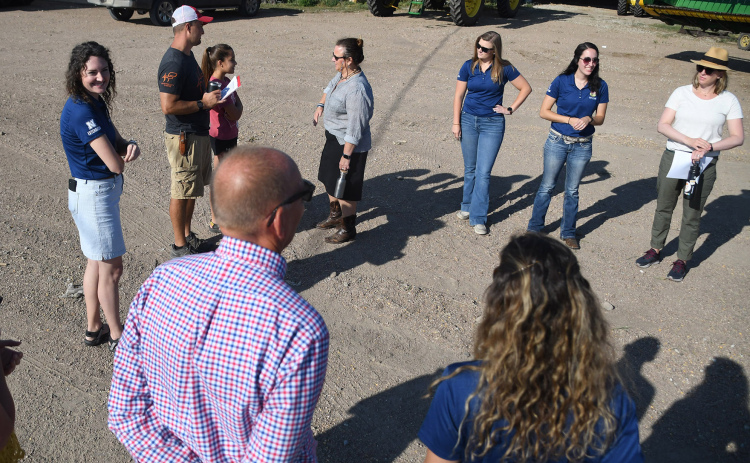
The panel discussion held in Lincoln on Aug. 22 was followed up by a few different farm tours around Nebraska, including one to Hunnicutt farms near Giltner. This tour featured St. Germain, a few others from NASA and Zach Hunnicutt.
NASA studying the Earth
“How many of you are wondering why someone from NASA would be here?” asked St. Germain to begin her presentation. “Most people when they think of NASA, they think of rovers landing on Mars, or they think of the Webb Space Telescope, or the return to the moon. What most people don’t know is that the planet NASA studies the most is our home planet.”
This is because, according to St. Germain, NASA’s mission is about the betterment of mankind.
“So understanding how this planet works and helping people make better decisions, informed decisions, science-informed decisions, is really what we’re about in earth science,” she added.
Today’s Earth science program at NASA has approximately 25 different satellite missions looking back down at Earth. These measure everything from precipitation in the atmosphere to soil moisture and more.
St. Germain further explained that there are about 10 more missions in the works and many more planned after that.
“And that’s part of the reason that I’m here to talk with you today,” she said. “It takes a while to build and launch a new capability. So one of the things we want to do is make sure that we’re building the most impactful systems for the future. So we’re all smarter 10 years from now than we are today.”
Changes are being seen in the water cycle, she said, and that is leading to changes in the carbon cycle and challenges in agriculture such as drought or flooding and severe weather.
“So one of the ways that we try to bring utility from the observations we make from space is to integrate them with crop models,” St. Germain reported.
Crop models factor in genotype and what’s being planted where, as well as management practices and environmental conditions.
“And that’s really where we come in,” she said.
These different satellites range in size from a coach bus to a carry-on suitcase and a shoebox.
“We also have instruments on the International Space Station and these are measuring things like temperature, water content,” she said. “They’re measuring different attributes of vegetation, pollutants in the atmosphere, all kinds of things.”
So what has this told scientists?
“We know because we measure it, that the difference between the energy coming into the Earth system and the energy leaving the Earth system -- that’s called the imbalance -- (is) growing,” St. Germain said. “That number has about doubled in the last 15 years. So where does all that energy go? It’s mostly being absorbed by our oceans, over 90 percent of it is being absorbed in the ocean.”
Said energy is being absorbed and then transported all over the world by ocean currents, changing weather patterns.
“And all that extra energy in the system is what is intensifying the water cycle,” she continued. “As you all know, better than most, the water cycle is mostly the water that we need to live on land. (It) originates in the oceans and it gets delivered to us by the atmosphere. That cycle is intensifying. That’s what’s leading to more drought in some regions, drier areas getting drier.”
This has spurred scientists and producers to think about how to prepare for challenges this might create in the future.
“I’m just going to talk to you about some of the capabilities we have today that can help inform real time decisions as people need to make them today,” she noted.
For example, a hail model showing monthly damage swaths across the Great Plains from 2000-20 can help to understand the patterns, the magnitude, the frequency and the intensity of the events. Similarly, a pair of satellites flying in formation are giving measurements on root zone soil moisture and shallow groundwater. Together these allow scientists to see minute changes in Earth’s gravitational pull.
Measurements about Earth’s gravitational pull can help showcase water coming and going (think tides and the moon).
“So as a demonstration product we’re looking to have folks give this a try and let us know if it’s useful to them in terms of their their planning,” St. Germain voiced. “The Ogallala Aquifer… so the same instrument, the same system that I mentioned, this gravitational system, can also see changes in aquifer status.”
Looking even farther into the future, St. Germain brought a new slide in her presentation to the attention of the attendees. This one, a map covered in brilliant green and yellow pixels, was representative of corn and soybean yields.
“The intensity, the brightness of each pixel is proportional to our predicted yield,” she said. “And what we did was we developed a crop model again that that integrates information about what got planted, how it was managed, and then uses our environmental information to predict the yield.”
This helped predict what happened at the county level “pretty well,” she said.
“So why might that be useful?” St. Germain asked. “Well, it might be useful if you want to look ahead. So that’s what we’re doing here for corn and wheat. We take our climate models, which give us a statistical forecast of temperature and rainfall and so forth into the future, and we use that as the input to the crop model.”
The NASA Earth science director made it clear that these are not predictions.
“Producers are already adapting what they plant, where they plant it, how they manage it, so it’s not a predictive tool,” she said. “But it is a projection tool. That allows you to now start running if-then scenarios against what we think are going to be the growing conditions in the future.”
These tools, developed with help from individuals in the agriculture community, are ready to start being tested, she added. This will help tackle local challenges and make a visible impact in individual communities.
St. Germain continued her discussion briefly before welcoming the panelists to the stage to partake in localized conversation in each of their expertise fields.
Editor’s Note: To hear more about questions and answers posed to Zach Hunnicutt during the farm tour, as well as a reflection on the opportunity from Brandon, please see next week’s ANR.