
Hampton board OKs plans for new subdivision

Subhead

Chairman signs water restriction resolution
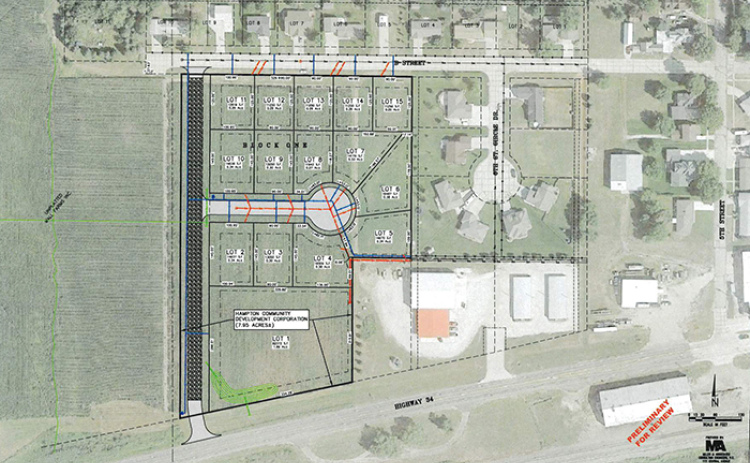
In an 11-minute session that was almost the complete opposite of last week’s regular Hampton Village Board meeting, the board took action Monday night on the agreement with the Hampton Community Development Corporation (HCDC) to put in a new subdivision on the town’s western edge. 
Board chairman James Parsley was back to chair the special meeting and the other four members of the board were also present, along with village clerk Tammy VanHousen, village attorney Drew Graham and utility superintendent Chris Friesen. However, in contrast to the crowded room at last Monday’s meeting, only HCDC representative Karen Bamesberger was in the audience for this week’s meeting. 
The only item on the agenda was consideration of the agreement for the 15-lot subdivision which was to go before the county’s Joint Planning Commission Tuesday night for review. At last week’s meeting, which had focused mostly on the town’s tenuous water situation with only one working well, board members had expressed concern about the deadline stated in the agreement for completing the infrastructure improvements in light of the possibility of having to dig a new well in the near future. The agreement called for the village’s portion of the project to be completed as soon as possible or by Dec. 31, 2024 at the latest. 
At the June 12 meeting, the board delayed a decision on approving the agreement while Graham researched alternative wording that would give the village an out if other spending priorities suddenly arose. The board also set the Monday meeting to make a final decision before the planning commission was to meet the next night. 
Shortly after the meeting was called to order, Bamesberger was asked to address the board. She reported the HCDC board had met on Thursday and decided on one of three options proposed by Graham for changing the wording of Item 9 on the agreement, which is the section that deals with the deadline for completion of the village’s portion of the project. 
“We’re all on the same page so I don’t really have anything to report,” Bamesberger told the board. 
Then it was Graham’s turn to speak. He told the board he had drafted three different recommended changes in the wording of the document. The first recommendation was to end the section in question after the words “as soon as possible” and remove any reference to a date for completion. Secondly, he said the board could “change the date to something a couple of years further out.” 
However, it was the third recommended change that had been adopted by HCDC and which the village board ultimately approved. 
“There was already some language to say that there may be circumstances where this needs to change,” said Graham, adding, “Go ahead and just leave that anticipated date of Dec. 31, 2024, but make it a little more explicit that the anticipated date is based on what is known today.”
Graham said that wording would take into account “any unforeseen circumstances” such as “nature, labor disputes, material, equipment, or availability to get bonds” which are beyond the control of the parties would make the anticipated completion date “subject to change and the parties shall make reasonable efforts to adjust the schedule accordingly.”
“If something comes up in the next two to three months and that well needs to take precedence,” said Graham, “then it’s really just important that you communicate that to the corporation to say we need to address this time (constraint).” 
“So that’s the recommended language that I think addresses both sides of it, specific enough that there is still an end in mind – it’s not open-ended – but with enough openness that it can be changed as necessary if the circumstances change,” Graham concluded.
After a brief time of discussion, the board took a roll call vote and approved the agreement with only board member Jared Rojewski voting no. 
Graham told the board the special meeting was necessary because the agreement needed to be changed before it went to the planning commission. He said if it was changed after the commission’s meeting it would have to go back to them for reconsideration and at that point the commission would make a new recommendation. 
Graham said the planning commission operates only in an advisory capacity and would make a recommendation to approve the plan, deny it or make no recommendation at all. 
“They have to take some action before it can come to you,” he said. However, he noted the final decision would be in the hands of the village board. It is anticipated that after going to the county’s planning and zoning commission, the agreement will come back to the village board for a public hearing and final decision at the next regular meeting on July 10.


Voluntary water restrictions
While Parsley was at city hall, he took the opportunity to sign Resolution 2023-5, approved by the board last week, which calls for voluntary water conservation by the residents of Hampton. 
Section 1 of the two-page document calls for daytime watering restrictions for yards and gardens which were to begin June 12 and will be in effect until repealed by resolution. It states that watering of yards and gardens will not be allowed between the hours of 9 a.m. and 6 p.m. and further states that even numbered street addresses are to water on even numbered days and odd numbered addresses should water on odd numbered days. The resolution also says “In months where there are 31 calendar days, no watering will be allowed on the 31st day of the month. 
The second section of the resolution prohibits water wasting activities such as watering on the incorrect date, allowing water to escape from any premises onto public property, “such as alleys or streets, or upon any other person’s property.” 
Washing vehicles, structures, driveways, sidewalks, parking areas or other impervious surface areas with an open hose is also prohibited. 
The resolution also addresses the wasting of water through a broken sprinkler head or failing to repair a controllable leak as violations of the resolution.  
Section 3 of the resolution specifically exempts commercial businesses from the watering restrictions and Section 4 deals with noncompliance. It states: “If the voluntary water restrictions outlined in this resolution are not complied with, the Village Board of Trustees may impose mandatory water use restrictions to be codified. If so codified, violation of the mandatory water use restrictions would be a crime, and could be punishable as a misdemeanor.”