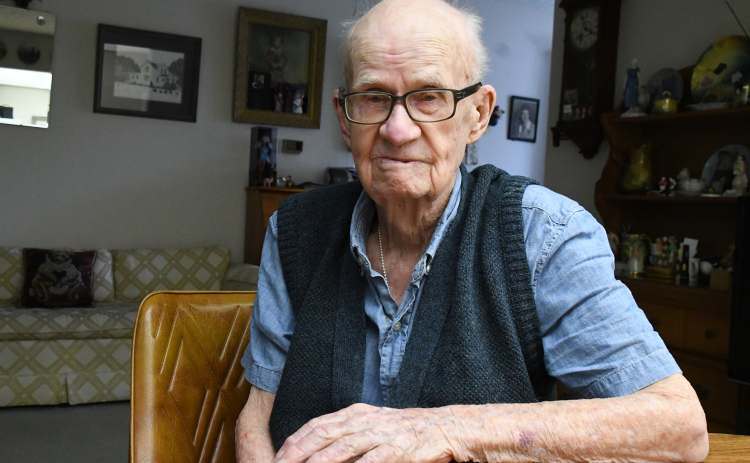
East Park Villa resident Lester Williamsen turned 100 on April 4, having been born in a hospital in York, but ever since remaining a lifelong Hamilton County resident with few exceptions.
Williamsen grew up on a farm between Hampton and Hordville in what he called the “Dirty 30’s.” He described the environment as hot, dry, with no crops and grasshoppers to eat what was left.
“People survived,” he said. “I was young then. Didn’t know no different.”
The farm subsided on chickens and cream made from the cows with the occasional wheat crop every other year.
Williamsen went to a rural elementary school with the same teacher for eight years before going to high school in Marquette.
“It was because there was family living there in case of bad roads or a snowstorm,” he explained. “There was no gravel then and we were 10 miles from Marquette.”
His father had an automobile in which three to four carpooled with him on the way there. The pastime he devoted himself to was baseball in the neighborhood.
“There was a lot of families in the neighborhood,” he remembered. “Not anymore. You have to go about three miles to find another family.”
After graduation he would work with his father and older brother on the corn that they had been developing. Then when World War II broke out, his brother went into the Air Corps in a B-52 bomber that flew over Europe. Lester would follow soon after, joining the Army in 1945.
Before he entered the service, Williamsen recalled playing against an African American team on the Air Force base in Grand Island.
“Oh my gosh, did they make us look like pansies,” he recalled. “They was so quick and fast. It didn’t take me long to get acquainted with one of the short stops. I say, ‘Really, how do you throw it that fast?’ He said you pick it up and zip!’ You’d only get about half way from third base to the pitcher’s mound.”
Though he was trained for combat against Japan, an end to the war prevented that from happening.
“I was fortunate,” he stated. “We were out in Seattle about to get ready to go to Japan when Truman dropped the bomb. We left from San Francisco and two days out they told us that the war was over. We just accepted it.”
Williamsen ended up in postwar Korea, with the occupational force taking over the administration from the Japanese Empire and beginning reconstruction of bridges and roads for the southern part of the country.
The Soviet Union occupied the northern part and Williamsen recalled an episode with a Russian emigrant who went by the name Yahoo. Yahoo went missing for five days and Williamsen, who was a platoon sergeant, covered for the soldier.
“He comes back, I said, ‘Yahoo, where the hell you been?’” Williamsen recalled. “He says, ‘Oh visiting some of my friends and relatives.’ He said, ‘Oh did we ever drink vodka and do a lot of dancing.’ I finally explained to him that I could have been in Dutch. From that day on, if I ever got any static from the big guys, I would just say Yahoo.”
Williamsen was discharged in 1946 and returned to the family farm his father was running. Lester took over after Christmas, meeting his wife Fay Lewis Williamsen at 4-H club.
“I had a wonderful wife and partner,” he said. “We had five children. We’ve gotten all of those graduated from college and they’re doing fine.”
He recalled that in talking with her father Fred, who had five daughters, that of all his four son-in-laws “there wasn’t a stinker in the bunch.”
“After we got married, I never heard him say he got five,” he said with a chuckle. “Maybe with my sense of humor, I’m the stinker.”
Williamsen remained involved in his community outside of 4-H. He was on the county fair board for a number of years as well as numerous other organizations.
“My wife had a theory: if there was a job, and the organization didn’t pay anything, they’d point to me,” he said.
He was also involved at St. John’s Lutheran Church near Marquette, where he was part of the softball and volleyball socials.
“The No. 1 thing was a social for all that came out of the service,” he recalled. “We had three teams of volleyball players and we’d play on Tuesday nights. You never seen a freer or happier bunch of men. It was out of the service, no more pressure, and we’d play volleyball and have fun.”
He also was part of an irrigation association that in his words would keep track of the water supply allocation.
He noted the change in farming with the mechanization and the replacing of horses.
“I still can harness a horse,” he said. “It was all that when the changeover was coming and my father had bought two tractors so I kind of grew up on them anyway.”
Williamsen retired from farming the 1980’s and lived with Fay for 16 years in Aurora.
“It was the best thing I ever did for her,” he said. “We enjoyed 16 years together.”
Williamsen eventually moved into East Park Villa and has grown to know 10 grandchildren, 10 great-grandchildren and his first great-great-grandchild was born last week.
“It’s a happy day,” Williamsen said.