
Discussion during Monday hearing focuses on rising cost of ambulance service
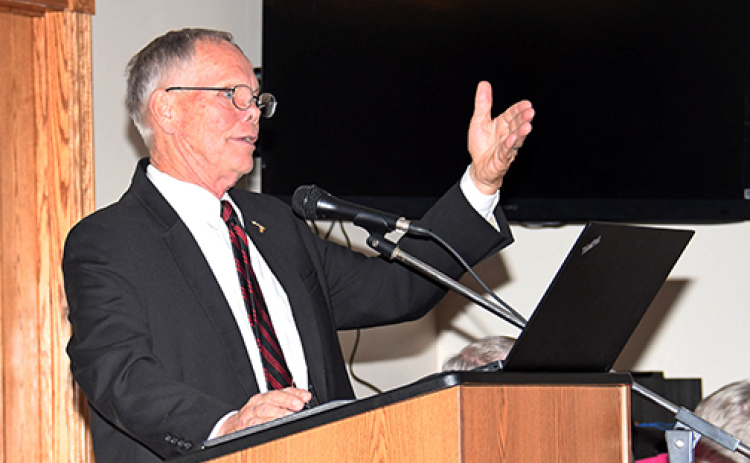
City leaders sharpened their pencils after Thursday’s “pink postcard” meeting drew criticism of a budget proposing a 38 percent increase. Four days later, Mayor Marlin Seeman presented a revised budget during a special public hearing at the Fire Hall reflecting a reduction in the proposed tax increase from $751,816 to $334,805.
“We have reduced services significantly and provided what we believe is a bare-bones, balanced budget,” Seeman said at the beginning of a 2-1/2 hour meeting which drew a crowd of approximately 100 people. “It would be my conclusion that there is very little meat left on the bone in this budget.”
Seeman opened Monday’s hearing with a moment of silence honoring former mayor Ken Harter, who died last week in Texas. He then shared that he and other members of the city staff worked over the weekend and on Monday revising numbers throughout the budget, ending up with a document which was printed out just minutes before the meeting began.
“There is an element of risk in this budget and I want you to be aware of that,” he said. “We have not placed in this budget items I would refer to as cushion. When you build a budget you start from the top and work down and I believe we have never proposed or supported a more risky budget than we have here.”
The document shared with the public Monday listed proposed 2024-25 totals by department, along with a comparison to actual spending the previous three years. It was also noted that the budget reflects the city’s budget authority, which does not necessarily mean the money will be spent.
Total budgeted general fund expenditures for 2024-25 were listed at $5,069,686, an increase of just over $1.5 million. Of that total, general administration expenses went up from $970,825 to $2.02 million, though City Clerk Barb Mikkelsen explained that $1 million of that increase was for a transfer to help cover ambulance expenses and another $431,000 was for grants flowing through the city which helped fund economic development projects.
According to the proposal which council members were scheduled to consider for adoption Tuesday night, the police department total, including an equipment fund of $85,000, increased from $1,458,366 to $1,757,444; fire department expenses went up from $182,210 to $201,320; cemetery department expenses increased from $109,628 to $134,532; parks and recreation department total expenses increased from $301,270 to $318,970; swimming pool department expenses increased from $167,486 to $239,797; and library department expenses increased from $254,950 to $314,695.
“The budget number doesn’t mean it’s going to be spent,” Mikkelsen said, at one point frustrated with the tone of the questions being asked. “Governmental budgets are different than a budget at home. We budget for the authority to spend it. The city is not trying to make money. What services do you want us to cut?”
Seeman also noted that a significant portion of the overall increase was related to personnel.
“Bear in mind, as citizens we appreciate the desire for safety, security from our police, fire and EMS and you’ll notice that those are significant portions of every budget,” he explained. “We have a very dedicated staff that I do not want to see pushed to leave or be recruited by other businesses. We need to pay them a competitive wage to retain their services to the citizens of Aurora and the citizens deserve nothing less than these types of services we have and will continue to invest in training for the staff to develop their ability to perform necessary tasks.”
EMS discussion
One focal point of the presentation was the city’s dwindling reserves, which Seeman explained have been impacted significantly since the city took over the local ambulance service in 2019. The EMS budget has doubled since that time, thus it was pointed out that ambulance operations required transfers from the general budget of $400,000 to $600,000 per year, increasing this year to a transfer totaling just over $1 million.
Seeman noted that since the city took over EMS operations the cost of labor has gone up significantly, partly because they have added staff members, and partly because the city prefers to hire paramedics now rather than EMTs because they are more skilled and proficient at their trade. The cost of equipment has also skyrocketed, he said, with a new ambulance nearly doubling to more than $400,000.
“The hourly wages that they can garner by driving an hour east or a half hour west significantly influences the price we pay,” he said. “It costs money and I don’t know what to say.”
Some in the audience questioned the level of EMS service the city is providing, with one man saying “It looks like we’re trying to buy a Mercedes on a Chevrolet budget. Will the city readdress taking the ambulance service private?”
“That’s not been a conversation we’ve had at City Hall,” Seeman responded, sharing the history of how the city took over the ambulance service from the county in 2019 after a community discussion which included proposals to take the service private.
“It costs money, but that’s what we do in Aurora, Nebraska,” he said. “I know it costs money and I hate it, but I don’t know what the alternative is except to deny you the right to have a safe and productive place to do business, to live, to work, to drive through.”
Seeman recalled an accident scene on Interstate 80 recently where the Aurora EMS responded to the scene and transferred the patient to the hospital in what he believed to be the most efficient way possible.
“You would accept nothing less if you were standing up there, but when you write a check for your taxes you probably have a difference of opinion, and I honor that,” he said. “That’s fine, but that’s what motivates me.”
There was considerable discussion throughout the evening on the EMS budget, with several in the audience raising questions about the level of service and number of employees, the amount of downtime for staff members on call, and especially on the rising level of costs and the impact on the city’s budget. Some also questioned how the city will address that challenge going forward, with no reserves to utilize next year and the cost of labor and equipment continuing to rise.
“I do think it’s a necessary service, but the expenses have gone out of control,” one man said, with another suggesting that a cost analysis of all transfer calls be conducted to insure that those calls are in fact generating enough revenue to cover the cost.
Sales tax question
Asked to clarify a point raised during Thursday’s public hearing, Seeman said the proposed budget was not a response to the sales tax proposal failing in May.
“The sales tax was simply an opportunity for the citizens to make a choice between two types of taxes,” he said. “So it’s not an issue. It has nothing to do with anything because we have no sales tax.”
Long-time Aurora resident and community leader Gary Warren was one of the last people to speak, commending city leaders for listening and responding to citizen concerns.
“Thank you for the work you’ve done on this,” Warren said. “It gets a little credibility back with the audience and 6 cents (the amount of the proposed levy decrease from the original budget) is significant. It’s not what everybody wants. You went from 40 to a 20 percent increase, or whatever, but it’s a sign you’re trying to make something work.
“I think the next step, in my view, is you’ve got to engage some of these citizens in some discussions about these issues,” Warren continued. “We aren’t going to solve them all here tonight, that’s obvious, but you’ve got to engage them in the meat of it. That’s going to be more work, that’s going to be more meetings, that’s going to be more interface with the public, but I think that’s what’s got to happen if we’re going to rebuild the trust and credibility.
“I would encourage you to find some other citizens to engage with,” Warren concluded. “I know you’re elected, but you aren’t the only people who care about the community. You know that, and they will work with you.”
“I think there is a lot of room for conversation between community members and we want to have that conversation,” Seeman responded.
Council member Nancy Lohrmeyer also encouraged citizens to run for city council, adding that people who want to engage in conversations with city leaders should run for elected office.
Monday’s hearing set the stage for Tuesday’s regular city council meeting, which will include an item to consider approving the budget and tax levy for the coming year. Watch for coverage of that meeting in next week’s ANR.