
Fiscal plan for 2024-25 reduced by $316,000 in response to public input
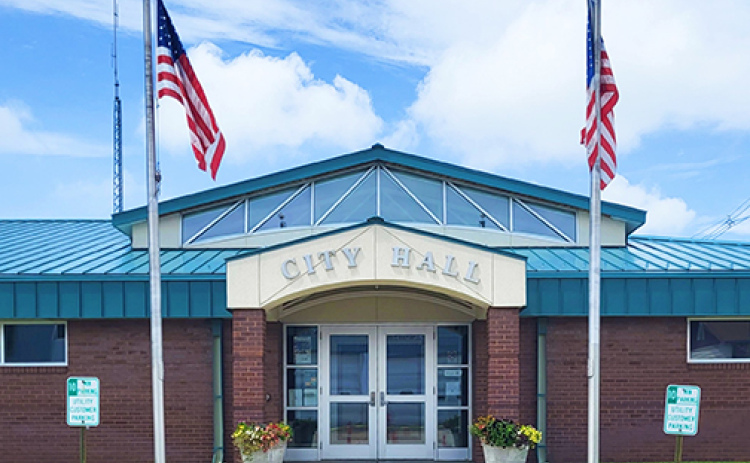
After two public hearings which drew considerable public interest last week on the city’s proposed 2024-25 budget, the Aurora City Council approved a revised plan for the coming fiscal year at its Sept. 24 meeting requesting $316,355 less in tax asking than the original proposal, cutting the total increase from 38 to 22.2 percent.
For the record, the budget approved last week lists a general fund tax request of $1,953,113, plus a bond fund request of $445,371, which sets the total for tax asking at $2,398,484. That’s an increase from the previous year, when the council approved tax asking of $1,963,023, of which $1,618,307 was designated for the general fund.
Commenting on what he described the night before as a “bare-bones, balanced budget,” Mayor Marlin Seeman said he believes the public hearings helped provide clarity on the city’s spending plan.
“It is my understanding of the community members that were there to voice their frustration and support that they were willing to move forward,” Seeman said just before the council cast its unanimous vote. “I believe that the community understands the necessity of a quality provided budget, and there’s no lack of clarity.
“Everything that was asked last night was addressed,” he said of the Sept. 23 budget hearing which drew approximately 100 concerned citizens to the Fire Barn. “It’s our budget. We are not going to overspend. We don’t buy something at the end of the year just to spend out the budget. I know there are some businesses that do that. We don’t.”
Last week’s city council meeting drew a crowd of 10 people. One person asked to speak, noting that the city had provided the revised budget information the night before just as the public hearing began, though Seeman didn’t allow input saying the time for public input had passed.
“This budget gives the maximum that we can spend,” he continued to explain. “The budget gives some $10,000 left at the end of the year. If we were forced to go there, there is no capacity for services or good things. It’s identical to what was presented in the meeting last night.”
The council also approved a resolution setting the tax levy at 46.3 cents per $100 of assessed value. That compares to a levy from the previous year of 38.6 cents per $100 of assessed value. Based on that levy, taxes on a home valued at $100,000 increased from $386 to $463.
After the budget and levy were approved, council member Paul Lackore offered his thoughts when asked by the mayor for any observations from the public hearing.
“I think it’s worth hearing, Mayor, that there were concerns about the raise, that we do what we can in those areas where we may not need to spend,” Lackore said. “Part of the budget process in a city is if we think we may need to do a project, we need to put it into our budget in order to do that. If not, later we have to jump through a lot of hoops and go back to the state auditor to say, ‘Hey, we want to amend our budget to do this project.’ So some of the projects in the budget, originally, were trimmed down or changed so that we would lower our levy and there are still some projects in the budget that may not be expenditures in the coming year. We’ll do what we can to try to hold costs down, looking forward to next year, and what that may mean in terms of taxation.”
Street plan approved
In other action during last week’s meeting, the council approved a resolution adopting the one- and six-year street improvement plan, as was presented by JEO Consulting Group.
Among the items listed on the 1-year plan is the 1st Street renovation project, which the JEO report listed at $3.1 million for work on 1st Street from the railroad to Highway 34.
Council member Nancy Lohrmeyer asked how long the project had been included on the 1- and 6-year plan, noting that it was not a new project.
“JEO has gone through details on different options to improve 1st Street,” Andrew Wilshusen responded, adding that it has been discussed for at least three years.
Other projects on the 1-year plan included paving of Mission Avenue in the Mission Critical Subdivision (a project scheduled for completion later this month at the cost of the developer); concrete, grading and erosion control of a 1/2-mile portion of County Road 11 extending east from Highway 34 on the north edge of the Mission Critical Subdivision (a project listed at $1 million of city expense); concrete and grading on Adams Street from Grant Street to Jefferson Street (a project listed at $500,000); .6 miles worth of concrete, grading, storm sewer and erosion control in the Streeter Subdivision (at the cost of the developer); a .2-mile stretch in the Friesen Subdivision (at the cost of the developer); a .1-mile stretch of concrete on 9th Street from R Street to Jennifer Road, with an estimated cost of $250,000; a .2-mile stretch of concrete on Lincoln Avenue from Highway 34 south, with an estimated cost of $400,000; a .1-mile stretch of concrete on Craig Street from Jennifer Road to Terry Road, with an estimated cost of $200,000; a .5-mile stretch of concrete on Jennifer Road from 1st Street to 9th Street, with an estimated cost of $1.25 million; a .5-mile stretch of concrete on Terry Road from 1st Street to 9th Street, with an estimated cost of $1.25 million; a .1-mile stretch of concrete on 9th Street from Jennifer Road to Terry Road, with an estimated cost of $200,000; a .1-mile stretch of concrete on E Street from 8th to 9th Street, with an estimated cost of $150,000; a .1-mile stretch of concrete on C Street from 8th to 9th Street, with an estimated cost of $150,000; and a .3-mile stretch of concrete on 8th Street from A Street to Railroad Avenue, with an estimated cost of $500,000.
The final agenda item included a public hearing and approval of both the preliminary and final plats for a proposal requested by Casey Nunnenkamp, who is considering building an apartment complex on 12th Street. The council approved the final plat by unanimous vote.