
Cory and Clint Ohlson of Aurora have turned a life-long passion into a worldwide adventure, with their wives along for the ride
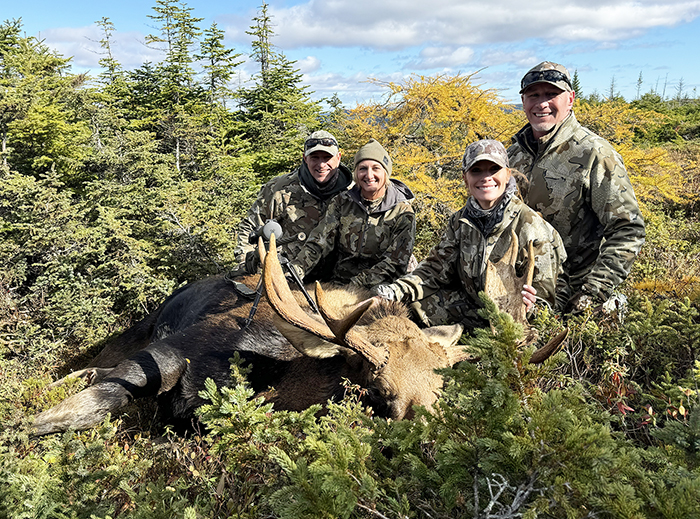
What began with two brothers hunting around home has grown into a tradition of taking their wives along on adventures around the world.
For Cory and Clint Ohlson, hunting has been part of their lives long before the destinations became exotic. There were no elaborate outfitters, expensive guided trips or far-flung hunting camps when the two brothers were growing up near Phillips. There were homemade decoys, the outdoors around home and whatever hunting opportunities two young boys could find with their friends.
Cory, the older brother, was hunting by the age of 5. Clint, who is four years younger, started joining him as soon as he was able.
“I had to drag him around as soon as he was old enough to come with us,” Cory recalled. “We just did outdoor stuff all the time.”
That childhood habit never really went away. The brothers grew up hunting pheasants and waterfowl around Nebraska, with waterfowl eventually becoming a particular passion. As they got older, their interests expanded into big game, archery and hunting trips that have taken them far beyond the places where they first learned to hunt.
And somewhere along the way, the Ohlson hunting tradition expanded from two brothers to a party of four. Cory and his wife, Tracy, and Clint and his wife, Megan, have discovered that the adventure is even better when they share it.
“We love the fact that our wives love to go,” Cory said. “It makes it a dynamic that’s so fun.”
Their 2024 Newfoundland moose hunt may have been the ultimate test of that theory.
Into the wilderness
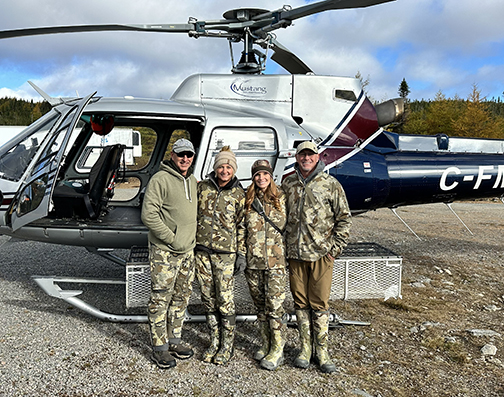
The group wasn’t looking for an easy hunt. They wanted remote. They wanted to walk. They wanted to get away from roads, motorized vehicles and the conveniences of everyday life, even without satellite phones as a communications safety net. So the four flew by helicopter roughly 25 miles into the Newfoundland wilderness for eight days of hunting.
Their accommodations were about as basic as it gets, featuring bunks in an unfinished building, a wood-burning stove and little else.
“They do have a generator that they fire up so they can cook in the main lodge or whatever,” said Cory, whose day job is director of emergency medicine at Grand Island Regional. “We like it rough, and we loved it, but it’s not for the feint of heart.”
“Shack,” Megan corrected Cory regarding his description of the lodge. “No shower. No toilet. No wi-fi. No telephone. Nothing.”
For Tracy, who admittedly doesn’t particularly enjoy the idea of killing animals, it wasn’t exactly her idea of a relaxing vacation. But she had married a hunter.
“There’s this saying,” she said. “Either you join them or you get left behind. I’d rather join than be left behind.”
And, more importantly, she had learned to embrace the adventure.
“There is so much more to see in this world than Nebraska, which is great,” Tracy added. “I’m always in for an adventure, for the sights, for the landscapes, for the stories.”
Megan had taken a different path into hunting. Growing up in York, she was the only girl among six brothers, and hunting simply wasn’t part of her childhood.
That changed when she met Clint, who works as a project director for Mead Lumber. Their second date was in a tree stand. She shot a deer that day, which hangs as one of many prized mounts in their Aurora home. Since then, she’s added a world-class bull and large caribou from the Arctic Circle to the collection. She started with a rifle before moving to a bow, eventually developing a particular love for the bow and arrow.
“I love archery hunting,” she said. “Just the close proximity of it.”
That love would be tested in Newfoundland, a large island in eastern Canada situated in the Atlantic Ocean off the coast of the North American mainland, south of Labrador.
Eight days in the bog
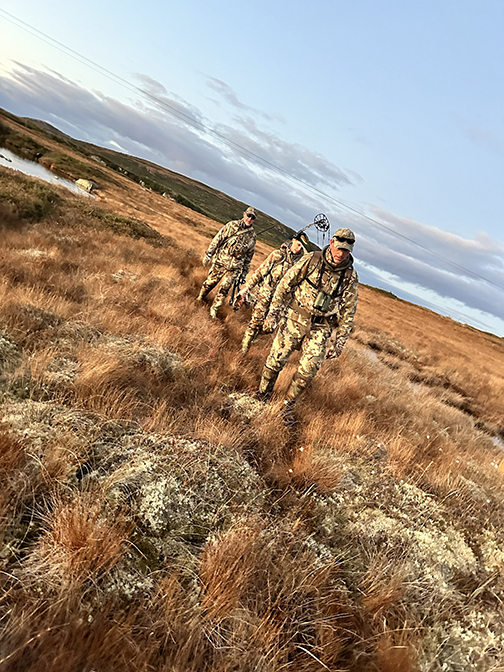
The Newfoundland hunt, which was two years ago this month, was physically demanding from the beginning. The terrain was a maze of hills and bogs, and a promising moose sighting didn’t mean a quick walk to a shooting position. A stalk could take hours.
Cory estimated that he and Clint each fell more than 20 times while negotiating the rough ground. They carried their bows and packs, climbed hills and slogged through bogs. Megan even became so physically exhausted at one point that she vomited.
“It was the hardest hunt I’ve ever been on,” Cory admitted.
The reward, the hunters agreed, was that every animal had to be earned.
Megan first to tag out
Megan was the first to punch her tag, taking a 10-point bull moose on the second day with a shot from approximately 140 yards.
“We sat on this bull for a few hours and once he stood up it was over so quick,” she shared. “The rush was indescribable and to experience it with my favorite people made it that much more memorable. It was a lot of work, but so rewarding too to be able to donate all of the meat to families in need or people who were no longer able to hunt themselves. It was so nice to be the first one to punch my tag and have the pressure off.”
Clint was quick to credit his wife for being ready when she had the opportunity.
“We saw it go in some trees and you couldn’t imagine a 1,200-pound animal just disappearing in a small pile of tees,” he said. “We were sitting right on him and we didn’t know it. We sat there for how many hours and then he stood up and Megan was ready.”
Clint’s bow shot
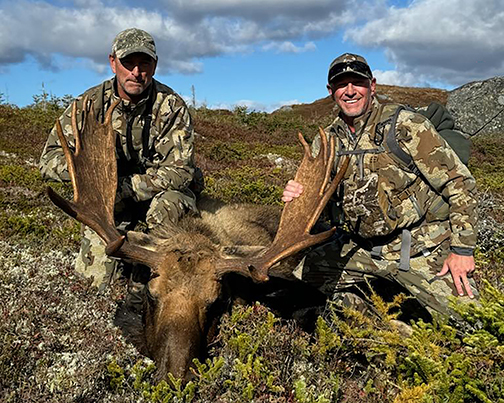
On the third day, Clint got his opportunity. The group had been working toward a moose for hours when the animal finally came into position. Cory had been the designated bowhunter on the stalk, but the distance wasn’t right. He wouldn’t take the 80-yard shot.
Then the guides, who advised the group that between the two men they’d only seen a hand-full of successful bow hunts in more than 40 combined years working this terrain, called again. The bull turned and moved toward the rest of the group, and Clint took the opportunity.
“There was a lot of luck involved,” he said of tagging a 9-point bull with a bow.
The shot was good, and the guide’s reaction said everything.
“He screamed when Clint got it, just out of sheer excitement and joy,” Megan said.
For the Ohlsons, that was part of what made the hunt memorable. There was no guarantee of success, and there certainly wasn’t a guarantee of comfort. But the challenge was exactly what they wanted.
“We don’t want it given to us,” Cory said. “We worked our butts off, so every critter we took was earned. Clint and I walked for eight days, and these guys each walked four, so it was a lot.”
The effort, in other words, was part of the trophy.
Then came Cory’s shot
By the final days of the hunt, Cory was still looking for his moose. He and Clint had spent the entire trip hunting with bows, but Cory eventually switched to a rifle.
“So we went to a spike camp (which was basically a 12x8 OSB building that black bears had damaged over the years) and the ladies stayed at the main camp,” he recalled. “It took us eight hours to get there and it was only about seven miles. You’d think, geez, and we were in great shape, but it’s just so different and we were so physically exhausted by then, to the point where Clint and I would say we had to take a break.”
On the final day, the group spotted two large moose on the opposite side of a deep cut, several hundred yards away. The guides weren’t convinced it was worth the effort, as it was getting late in the day and making a move to get in position would take several hours. The brothers decide to make one last push, so off they went.
Finally, they’re in range on two moose just lounging in the sun, unaware of the lurking danger. The guides suggested passing on the shot, due to the distance, the wind and fatigue factor.
“So the guides said we don’t think you should take that shot laying down, and Clint says, ‘Oh, I guarantee he can make that shot,” Cory said, still razzing his brother two years later for making the bold claim on his behalf.
The distance was roughly 370 yards, there was a 25-mph crosswind and Cory was using a rifle he’d never shot before — his sister-in-law’s Browning 7MM.
Still, Cory and Clint were willing to take the chance. Cory settled into position and began calculating the wind. He didn’t have an elaborate electronic system to compensate for the conditions, so he watched the wind, studied the animal and relied on his experience. Rather than aiming directly at the spot where he wanted the bullet to hit, he moved his scope far enough to compensate for the wind.
He remembered advice he’d heard over the years: “Never have your cross hairs not see fur.” So he aimed toward the back of the quartered-away moose. Then he fired and watched the bull drop.
“When I pulled the trigger, he just falls over dead,” Cory recalled.
When they reached the animal, a 14-point, 40-inch trophy bull, Cory realized just how much the wind had affected the shot. He estimated the wind had pushed the bullet roughly three feet from where it otherwise would have gone.
“If I’d have put it on where I wanted to shoot him, it would have hit rocks,” he said.
It was a shot that demanded confidence, judgment and a little good fortune, and it capped an already remarkable hunt.
The ride home
The adventure wasn’t over just yet. The following day, the first leg of the ride home turned into an adventure all its own.
Weather had moved in. Rain and wind were whipping through the mountains, making visibility difficult. Even the helicopter pilot was shaken by the conditions.
“That was the most terrifying ride,” Megan recalled. “Even the pilot was shaken up after that.”
Two years later, that’s part of what makes the trip so memorable. The four laugh about it now, because they made it home. And because, as hunters tend to do, the scary parts have become part of the story.
“We had our wills in order on that hunt, and then we almost died on that helicopter ride,” Clint said. “Since everything turned out okay, it adds to the story.”
From Newfoundland to Argentina
The next chapter took the four much farther south.
In August of this year, they traveled to Argentina for a dove hunt, which was a dramatically different experience than Newfoundland. Instead of an unfinished camp in the Canadian wilderness, they stayed in comfortable accommodations and the ladies even enjoyed massages.
Instead of spending hours stalking a single moose, they were surrounded by seemingly endless flights of doves. The shooting was fast and furious. Cory reportedly went through roughly 30 boxes of shells during one session, while eventually harvesting 39 pounds of dove meat.
And because they had traveled so far, the group decided the Argentina trip should be more than just a hunt. They added time in Buenos Aires, enjoying the food, drinks and nightlife before returning home.
It was different from Newfoundland in almost every way. But the important part was the same. The four were together.
“It’s always fun with these three,” Tracy said. “I mean, no matter where we go, no matter what we do, we always have fun. We’ll find the adventure.”
The next adventure. That’s becoming a new tradition for the Ohlsons.
The brothers who once hunted together as boys are now making a point of finding at least one adventure each year that includes their wives. The next destination may be Namibia, where they are considering an African plains-game hunt. It’s another long way from the fields and waterways where Cory and Clint first learned to hunt. But in some ways, nothing has changed. They still want the adventure. They still want the challenge. And they still want to experience it together.
For Megan, the choice is pretty simple. She admits she sometimes gets nervous when Clint proposes another wild hunting adventure — especially when the trip involves international travel, remote country and the kind of risks that require a conversation about wills before leaving home.
But she, like Tracy, doesn’t want to be left behind.
“Truly, I love the adventure,” she confided. “I love traveling with these guys. I love the hunt, the experience of it all. And sometimes we travel to sand and beach, with unlimited drinks, and we dive together. It’s a balance.”
For two brothers who have been hunting together since childhood, that’s probably the best description of the Ohlson family tradition.
The animals may change. The terrain may change. The continent may change.
But the adventure, and the people sharing it, remain the same.