
Aurora hosts intensive DARE training

Subhead

Graham says decision-making model a key element
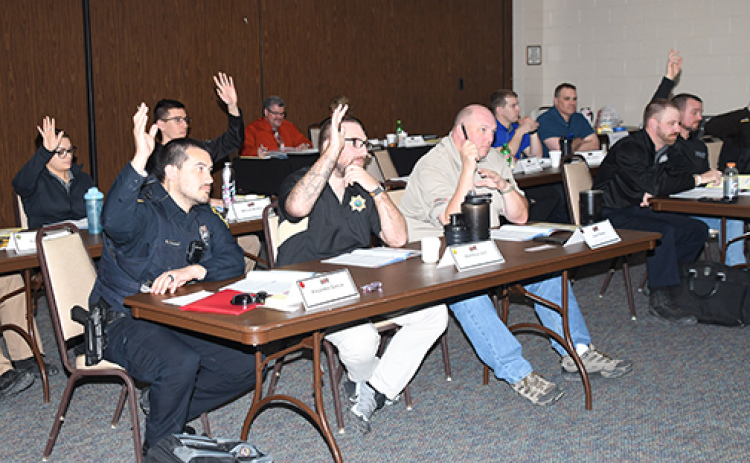
Fourteen law enforcement officers from throughout Nebraska and three Midwestern states completed an intensive 10-day training course in Aurora Friday, training them to help give today’s youth tools to make good life decisions.
Aurora Police Chief Paul Graham has been a certified DARE training officer for 26 years, serving as the program’s state coordinator since 2016. He helped host this year’s training program, the first in Nebraska in 15 years.
“The Leadership Center has a lot to offer and that was one of the things about doing it here,” he noted of the host site on the east edge of town. “Working with Maile (Ilac Boeder) and her staff and what I’m hearing from the group is that it’s been working out well here.”
Jolene Palmer of Lincoln, a former educator who now serves as part of a national DARE training team, agreed.
“We as a training staff love to be able to stay right on site because it saves a lot of time in the day,” Palmer said. “The class grows much closer together in this kind of situation than if everybody went out for lunch and did their own thing.”
On site from March 13 through March 24, the officers in training spent at least eight hours a day studying a science-based curriculum which covers a wide range of topics, including drugs, alcohol, social media use, bullying, “More than sad” suicide prevention, prescription drugs, opioids and vaping. The curriculum is updated every 10 years or so to reflect the changing times, and is currently in the revision process.
Graham said the curriculum has evolved over the years to reflect the changing times, yet is based on a timeless decision-making model.
“DARE isn’t just about drugs and alcohol, it’s about everyday life,” he explained. “I tell people all the time that we have a DARE decision-making model, which is the acronym for DARE,” noting that D is for define, A is for assess, R is for respond, and E is for evaluate.
“I tell the kids that if their mom and dad tell them to clean their room, do the dishes or take out the trash, you can use the DARE model to make sure you make the right choices,” he said. “If you don’t, then you have a negative consequence.”
Palmer pointed out that the DARE curriculum is updated periodically to reflect changing trends.
“They add a lesson here and there without changing the entire curriculum,” she said. “And as Paul mentioned, everything is centered around the DARE decision-making model so that no matter what choice in life they have they can apply it to that model. That’s a valuable skill set to look at, understanding that it’s not just about making that choice, it’s a matter of looking back and saying, ‘Okay, if I had that to do again is that really what I wanted to do.”’
Having worked with Aurora’s youth for more than 25 years now, Graham said he often refers to lessons learned through the DARE program when working with individuals later in life.
“At the end of the program, I always say that we may run into each other again down the road and it may be good or it may be bad,” he said. “You know what the first thing I’m going to ask you is what we talked about in DARE. They say these lessons are just common sense, but you know what the number one answer I get is: ‘I don’t remember.’ But if it’s common sense, the DARE decision-making model should hopefully jog you as much as we go through it. They should remember it.
“Like I said, later on in life I’ve got people that will talk to me about things now, or maybe they didn’t make the right choices,” Graham continued. “It’s one of those tools that they need to know and hopefully it will help them make the right choices.”
With a background in education, not law enforcement, Palmer said she brings a different perspective, observing that there is another aspect of DARE which in her view is equally important.
“I would add that the community policing aspect of it is probably as important as the education of what we do with students,” she said. “We’re at a time in our world where law enforcement isn’t as revered, or as appreciated, as it maybe once was and this is a fabulous way to get officers in the classroom to help students and to see them in a whole different light. They get to see them as a real person, bringing their own experiences into the classroom to teach them and help them. I love the fact that students and police officers have that time together because everybody’s busy and it’s a specific time when the officer comes into the classroom and spends time teaching them some pretty important concepts for life.”

Detailed training
As for the training itself, Graham and Palmer agreed that this year’s class was fully engaged, often reviewing material over lunch and dinner at The Leadership Center during their down time. The 10-day program began with two-minute presentations the officers would give to elementary students, then moved on to more detailed lessons to be shared with both elementary and middle school students. The officers practiced by giving presentations to each other, then had “a final exam” Thursday of presenting to students at Aurora Elementary.
“We take basic street officers (from both city police and county sheriff’s departments) and in two weeks we help them understand and learn how to be able to go into a classroom to deliver lessons to students over a period of 10 to 12 weeks,” Palmer said. “When they leave, they are actually certified to teach pre-K-12.”
Students participating in the DARE training program offered in Aurora included: Philip Turner, Saunders County Sheriff’s Office; Logan Lawson, Neligh Police Department; Sara Graham, Phelps County Sheriff’s Office; Jonathan May, Seward County Sheriff’s Office; Christopher Henderson, Broken Bow Police Department; Troy Skeens, Crook County (Wyoming) Sheriff’s Office; Matthew Veit, Jefferson County  Sheriff’s Office; Carson Dunlap, Franklin County (Kansas) Sheriff’s Office; Cheyne Terrell, Schuyler Police Department; Rosa Perez, Bennington Police Department; Alejandro Garcia, Seward Police Department; Jason Baker, Roosevelt County, (Montana) Sheriff’s Department; William Watkins, Bureau of Indian Affairs, Winnebago, Neb.; and Jayda Furtado, Johnson County Sheriff’s Office.