
Anderson excited about changing gears

Subhead

Former Case-IH manager adjusting to new part-time roles
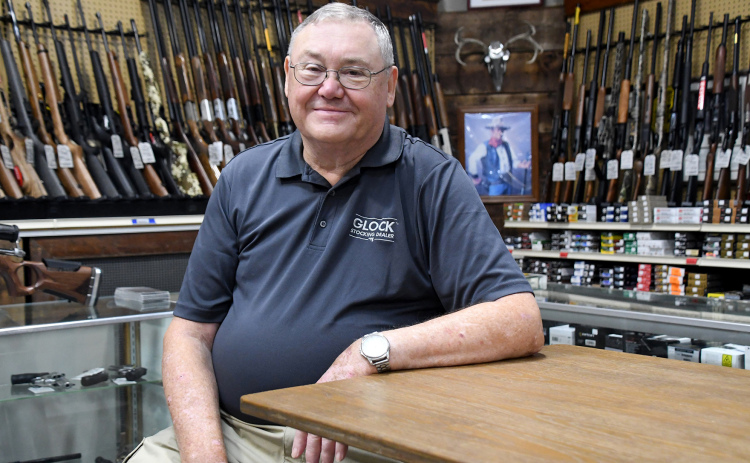
Alan Anderson has seen a lot of change in a career of selling and servicing equipment on the front lines of agriculture, and these days he’s experiencing change in a whole new light, up close and personal.
The Lexington native decided the time was right to retire as store manager at Grosshans International in Aurora on July 10, the same day his wife Dottie retired from her job in Grand Island. Always quick to invite customers to pull up a chair, have a cup of coffee and share a conversation, Anderson sat down to reflect on his own career and the process of what her perceives as not so much gearing down but changing gears.
“Things have progressed a lot since about 2010 and now it’s getting really sophisticated,” he said of the continuing evolution of computer-driver precision farming, which lets producers control multiple pieces of complex equipment all from a single monitor in the tractor cab. “For probably the last five years it’s just gotten better every year.”
Anderson thoroughly enjoyed the challenge of learning about and implementing new technology as a manager, having started out in 1972 as a salesman with Orthman Manufacturing in Garden City, Kan. A farm boy himself, he soaked up every opportunity to learn how to sell, fix and even assemble farm machinery, realizing early on he’d found his calling.
“At the time I entered the farm equipment business it was actually something I always wanted to do,” he recalled. “When I was a little kid we would go to the John Deere dealership in Lexington and I was just fascinated. I always thought I would like doing that so it was planted in the back of my mind if the opportunity ever presented itself.”
With a huge trade territory south of I-70 in Kansas extending down into Oklahoma and parts of Texas, Anderson spent a lot of time on the road in those early days, often in the fields with farmers.
“We did it totally different than how it’s done today, but that’s part of the progression of selling,” he said. “Back in those days, I would go out on a Monday morning and start calling on dealers. I’d get home at the end of the week and when I got back I helped put it together, spray painted it and did all that stuff. When it was all done we’d throw it on the back of a trailer that we had manufactured, deliver it back to the people who bought it and I would go out to the farmer that had bought that item with my wrenches and help put it together. 
“I spent a lot of midnights sitting in a corn field with pickup lights on the product, putting it together piece by piece,” he added with a reflective smile. “You couldn’t get anybody to do all that today, but I grew up a lot and learned a lot from people.”
Anderson progressed through his career, working first as a salesman, then as a sales manager, later as export manager or “whatever they needed at the time.” At one point in the early 1980s his versatile background landed him an opportunity to represent his company, still Orthman Manufacturing, down under in Australia.
“I was asked to put on a presentation for a row crop farm since that is what our equipment was made for,” he explained. “I gave examples from basically half of the world because I was there, so I saw it and helped set it up and could answer their questions. At the same time this was going on the agriculture equipment revolution was starting here (in the US). We had a major revolution in this country on what they wanted to do with equipment.”
That’s when electrohydraulics completely changed how the manufacturer made equipment, he described, which changed the agricultural landscape in many ways. 
“We went from four-row equipment to six-row equipment to 12-row equipment, which was a huge jump, then it went to 16-row equipment and now we’re up to 42 rows or whatever it is,” he said. “But they had to build the horsepower to handle it and they had to build a way for the equipment to operate that tractor.
“Everything was powered by hydraulics and it was monitored by electronics, which had been very primitive to that point,” he added. “It just exploded everything because we then had the horsepower, which we didn’t have before.”
At the time, Anderson said he felt like he was part of an innovative group that was leading the pack with changes in agriculture.
“Every morning that we went out to talk to people it was something that was brand new we were bringing to them,” he said. “Was everything successful? No. But you had to have your failures to learn what you were going to do, and we had the draftsmen and salesmen and engineers and whatnot listening to what we had to say. In a lot of cases, the farmers brought the solutions right to us.”

Back home in Lexington
Anderson and his family eventually returned to his native Lexington, where he worked as a salesman for the local John Deere dealership. He later made a career move to Bertrand, where he spent more than a year creating a sales catalog for a farm supply company, before returning to Lexington to work for the International dealership there. He took a break from the ag equipment business in the late 1990s, helping a friend who was trained as a certified Microsoft engineer install computer hardware and wiring. That knowledge would become useful when he got an invitation from Paul Grosshans to become the Aurora store manager at Grosshans International’s Case-IH dealership in 2000.
During his 22-year tenure here, Anderson watched that evolution continue, realizing that his role had evolved to one of listening, training and motivating as a manager, something he truly enjoyed.
“My job was to manage the people and keep them happy, because if I lost someone who had five years of experience that’s $150,000 in training to get somebody back, if you can find somebody that will stay with you long enough to learn all that stuff,” he said. “When I was hired I was asked by Case people to come down here and try to teach this and I think I did a pretty darn good job of doing that. When I look back on what we’ve done I think we’ve been very successful, winning two Pinnacle awards for a little tiny dealership. That wasn’t me. That was my employees.”
The technology evolution continues on, and as Anderson celebrated his 75th birthday he decided it was time to let someone else embrace that challenge.
“It’s a flood right now,” he said of the innovations in ag equipment, combined with the challenge of providing the equipment producers want and need. “Between COVID and not being able to order equipment since December (due to a supply chain related chip shortage) and not being able to get things in, it’s time to let someone else fight that battle. Do I love it? Yeah. But it’s time to move on.”
Now ready to shift gears, Anderson said he looked toward his future and decided he is not yet ready to “retire.”
“Retirement is not my future, okay,” he said. “It is not my wife’s future. We weren’t raised that way. We were raised to be involved and to be part of things. After a week I told Dottie I was going to join the Foreign Legion. I needed something to do.”
That “something,” it turned out, is mowing lawns part time for the city and helping sell guns in a second part-time gig at Schneider’s Hardware. Handling, shooting and talking about weapons is another long-time passion of Anderson’s, a former Army sharp shooter.
“I’m a good old farm boy so I have to be doing something,” he said. “The only decision I have to make mowing lawns is to turn right or left and I’m okay with that. At Schneider’s they want me to interact with people and I can certainly do that because I’m so full of BS. The other thing about this is that I have a great deal of appreciation for what people do. Now that I’m doing it I can see that it’s not so easy.”
One other thing on the Andersons’ to-do list is a return trip to Australia, this time to visit Regan and Janelle Bairstow, whom they befriended while hosting the couple on a 2015 honeymoon trip to America.