
Aurora resident to debut art exhibition at Flynn & Ivy
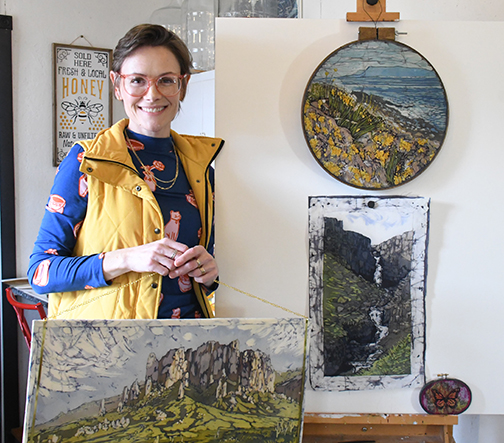
Megan Vetter will be debuting her first art exhibition, “Batiks of Nature” at the Flynn and & Ivy in Aurora on Friday from 5-9 p.m. The show will feature approximately 20 batik pieces made with a dyeing technique that uses wax resist.
Aurora resident Megan Vetter will be debuting her first art exhibition, “Batiks of Nature,” at the Flynn & Ivy on Friday, from 5-9 p.m.
The exhibit will feature approximately 20 art pieces by Vetter in the style of batik, which involves using wax and resin dye on fabrics.
“The resist can be from the beeswax that I use, people can use glue, it depends on the surface you’re putting on,” Vetter explained. “It’s porous and will absorb the dye and the wax helps resist where the dye goes. Then at the end of the process, you remove all the wax, and what’s left behind is the layers and layers of dye that you applied.”
For 10 years, Vetter’s batiks were inspired by the rocky structures and landscapes she has seen during her travels, such as in Iceland and Ireland.
“I started to experiment with how I could use the batik of landscapes and the process of dyeing,” she said. “I discovered it was really easy to create atmospheric distance using the lighter dyes in the background and building the color intensity in the foreground. Similar to watercolor painting, the dye will blend with the colors underneath, if it’s not been waxed and it will create new colors. I’m constantly experimenting with ‘What if I had this color? Is it going to turn brown or is it going to make it more vibrant?’”
A creative all her life, Vetter recently picked up traction in her artwork working in her studio on the family’s farm.
“Within the last six years, I have really pushed to try to make something and do something creative every day, more so now that my kids are a little bit older,” Vetter said. “I’ve got a little bit more freedom as far as the school day, so I can really jump right into a project.”
For her batik pieces, Vetter uses cotton as a canvas to create a tapestry with dye and wax.
“The thing about batik is it’s on fabric, so you can fold it up and roll it up,” Vetter said. “I use nice cotton and I use beeswax and batik wax, which is a combination of resin and beeswax, and I apply with brushes of all sorts, sizes and a Tjanting tool.”
After capturing the subject with her camera, she will draw the subject on the fabric before applying the wax, then the dye, then repeating the process. She collects the beeswax she uses from her beehives on the family’s farm.
“I used probably my tiniest brush, put down the wax, then the wax absorbs through the fabric so it seals on both sides,” Vetter said. “I have fabric dye that I mix with the water and then I will either brush it over the entire surface or submerse it in that dye, or I will paint it like I would with a watercolor.
“Once that dye dries, then I can set that color forever by putting hot wax back over the top and letting it seal within the fabric,” Vetter continued. “Then after I’ve covered the whole thing in wax, there’s no more dye that can be applied. I like to crinkle it up, crunch it up and I’ll either submerge it or brush on another color of dye to give it that very fun marble or crackling effect that is more of a traditional submerging batiks.”
Vetter has made her own dyes using water and different mixtures to create colors.
“I used these Procyon mixes and they’re good,” Vetter said. “I mix a little soda ash with the color, water and a little urea... it keeps the water from drying out too quickly. I have lots of colors. I do a lot of mixing, using a traditional red, yellow, and blue for some. Then, of course, you can always get a little bottle of the actual color you want.”
For finer details, such as for pieces she did on fauna featuring butterflies and a snail, the tjanting tool pours lines of wax into the smallest of lines.
“One right here was done mostly with a (tjanting) tool, where the hot wax sits in here and then it dribbles out,” Vetter noted. “You have to move pretty quick and trace all the lines. Then with something like my little snail here, I used just brush strokes and put down a layer of color and then put the wax on it, add the next color and let it dry.”
Vetter shared that it is an ongoing learning process to get the right colors she wants to bring out in her batiks.
“I’m still learning a lot from my mistakes,” she said. “I suppose I would start with the lightest first and the first thing I do is I wax what I want to stay white or the color of the fabric and then I use lighter colors gradually as I go through. It depends on my subject matter.”
One such piece was a portrait of her dog, Harvey, who had passed away.
“I sketched it all out and then just used a few browns and some gray,” Vetter said. “He had enough white on his face, because he was so old that it was easy to get those first layers done. Different tools give you different results.”
The next part of her process is drying and wiping any excess dye that’s on top of the wax.
“Then I will iron it and that heat will liquefy the wax,” she said. “Then with a newspaper and the paper bags I use, it will absorb that and what’s left is the fabric with the color sealed or dyed on.”
After the painting is completed, Vetter will showcase her paintings on display boards.
“Most of them at the show will have this white foam core behind it,” she said. “They will be stretched as tight as I can across there. That way, they still have a bit of light that is illuminated behind them.”
Some of the pieces she plans on featuring include landscapes such as coastlines she saw in Iceland, a batik piece on Superstition Mountain near Phoenix, Ariz., and coastlines she has traveled along in Iceland.
“It’s more of a monochromatic seascape there,” Vetter noted. “I’m excited to show it all and I want to bring in pieces that were done earlier and then maybe you can see the progression of how my style has changed.”
While it’s been 27 years since Vetter had a solo art show, she has experience donating her artwork and submitting her art for the Nebraska State Fair.
“This is a fun event for me, especially to catalog what I’ve been doing, because with a lot of things I’ll finish it, I’ll go hang it in the house or I’ll put things in the State Fair,” she said. “Batik is a very small category within the State Fair, but I usually can perform well at the State Fair level... I’ve put stuff online. I also donated to the Prairie Plains Resource Institute for their silent auction.”
Vetter expressed gratitude to her husband, Curran, and their children, Phoebe and Micheal, who have been helping her get her art exhibition ready.
“They have really taken the whole show by the reins,” she said. “They’re making a lot of the decisions on where and when, the invitations, and I was told to just keep making art.”