
More input sought from community members, parents
A community-based drug and alcohol prevention group is working to re-establish itself in Hamilton County, having recognized some alarming trends in area substance abuse.
“It seems like in Hamilton County there is a lot of vaping with THC liquid in it,” said Celeste Penner, coalition coordinator for the Central Nebraska Council on Alcoholism and Addiction. A“Of course underage drinking always remains an issue, but it seems like the THC and vaping has somewhat replaced the smoking of marijuana cigarettes. Not that there still not some of that, but it’s easier to hide in the vaping pod.”
There is growing concern with vaping, Penner added, because the industry is largely unregulated.
“It has hundreds of horrible, deadly chemicals, but it doesn’t have any odor,” she said. “It has such a small vapor that dissipates real quickly, so that’s challenging. It’s a huge risk because people can literally put anything they want in the vape. And unfortunately, many retailers who sell vape products, whether THC is legal or not in your state (it is not legal in Nebraska), have it available behind the counter. The danger is that vape liquids can have THC and other addictive substances at very high levels because it’s not regulated.”
Penner is a licensed mental health practitioner based in Grand Island who helps organize COPE — County Organization for Prevention Education — through the Central Nebraska Council on Alcoholism and Addiction.
“COPE started in 2006, initially in response to methamphetamine,” Penner explained. “At that time the problem was there were gases on the farms that people were able to steal as one of the things needed to make meth. They clamped down on that, but I think there are still probably people in small towns in Nebraska producing meth. In general, what law enforcement tells me is that it’s all coming from Colombia or Mexico as a finished product.”
Central Nebraska remains a hub for meth trafficking, Penner said, mainly because of Interstate 80 traffic, as well as north/south traffic on Highways 281 through Grand Island and 81 through York.
Brain scans
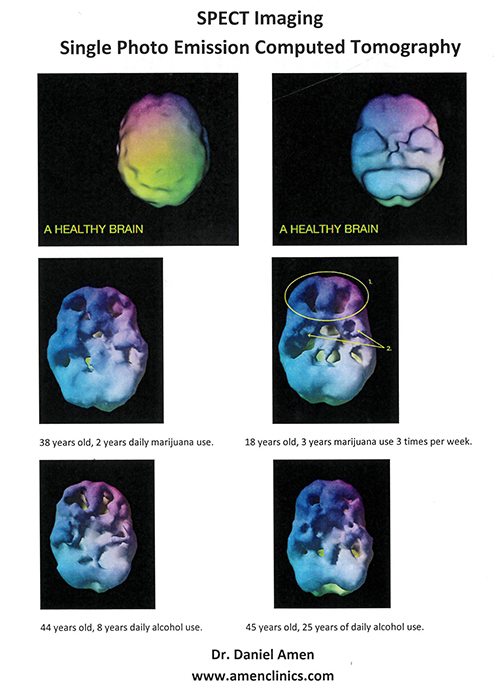
As part of COPE’s mission to provide education on drug use and abuse, Penner shared images of brain scans from Dr. Daniel Amen, who works with Amen Clinics around the country. One image displays a color scan of a healthy brain, with others showing brains after two years of daily marijuana use and eight years of daily alcohol use.
“This shows how different drugs and caffeine affect the brain, which is helpful in education because kids see it and go, ‘Oh,’” she said. “We do interventions and show those brain scans to the families and it really helps them to understand how compromised their family member is and how that kind of affects everything. Just using alcohol with pretty great frequency for three years, I mean there is so much semi-permanent damage to the brain, and most people who have a problem with alcohol have been doing it a lot longer than three years.”
One concern Penner shared through her years of counseling experience is the limited resources available to kids who are having trouble with alcohol.
“I’ve been doing counseling for 25 years now and I’ve had kids that have been drinking every single day since they were 12,” she said. “If you do that until you’re 16, you’re in tough shape. They do that to kill pain, or to kill emotional pain, and that changes the state of their brain.”
Penner said she is working on putting together a list of resources for youth treatment, but has found that to be limited in Central Nebraska.
“There is a youth treatment center in Lincoln, but basically to get in you have to take them to the ER drunk,” she said. “They have to be admitted through the ER, then one of the counselors there will do an evaluation while they’re there in the ER, and that’s how you get them in. There’s just not a lot of youth alcohol treatment for somebody who is at a really dangerous or chronic level already.”
COPE’s goal
COPE’s goal is to prevent drug use and abuse by sharing information and including parents and community members in coordinating drug-free events for families. The group also strives to reduce risk factors and increase protective factors that could help prevent underage drinking, drinking and driving, and all other substance abuse.
COPE was inactive during COVID, though Penner is now working to get more people involved in what she believes is an important awareness campaign.
“Our group meets monthly, talking about resources available and trying to identify the problems,” she said. “Besides the monthly meetings, we have an event or activity about quarterly, like dating safety and internet safety, and then in April we have the family wilderness event at Bader Park.”
The next meeting is scheduled for Friday, Jan. 16, 2026, from noon to 1 p.m.
In addition to the current committee members, the sectors which Penner said COPE needs representation from include the faith community — any pastor, youth pastor or church secretary or organizer — the medical community, local government and parents of school-age kids.
Anyone who would like to attend the January meeting or would like more information can contact Penner at 308-227-9271.