
Lessons from Denton regenerative farmer Brian Brhel
Editor’s note: This is the first in a new monthly series from the UNL Institute of Agriculture and Natural Resources, titled “Soil Health Stories,” featuring Nebraska farmers and ranchers. Each month, a new article will highlight producers who are demonstrating innovative practices and practical lessons that can inspire others across the state.
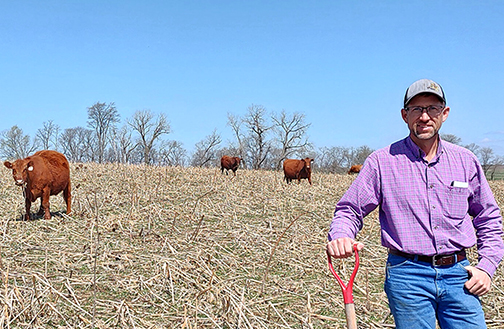
Nebraska farmer Brian Brhel has become known for his adaptive and thoughtful approach to soil stewardship. Farming near Denton, Brhel integrates diverse cover crops, grazing and rotations into his system to improve soil health, build resilience and support his community. He has said, “The question is not if soil health principles work, it is, ‘How do I make them work on my farm?’”
For Brhel, diversity is at the heart of soil health. He experiments with different combinations of crops that bring multiple benefits to his farm.
“I like to be able to do one thing and get multiple benefits,” Brhel said. “I like to plant multiple seeds together. One of those is oats and peas, and I’d like to include other seeds in those mixes as well — like flax, or even mustards.”
By planting mixtures that include buckwheat, hairy vetch, oats, peas and flax, Brhel creates rotations that improve soil structure, provide forage or grazing options, and open potential for niche marketing.
The challenge of markets & cash flow
While the benefits to soil are clear, Brhel was candid about the realities of making regenerative systems financially sustainable.
“We can talk about all the fun, diverse rotations, but it really comes down to cash flow,” he said. “If you don’t have cash flow, all these fun things don’t seem so fun anymore.”
Brhel has developed a market for his oat and pea seed, making it a consistent part of his crop rotation. Still, finding steady buyers for less common crops remains challenging.
“It’s been difficult to find a steady market for some of the diverse crops I’m growing, even though they might be very valuable,” he said. “Some of it is just patience — eventually I have been able to sell most of it.”
Growing a cover crop for grazing has been a dependable source of income and supports our goals of soil improvement as well.
Soil health & the business of farming
Brhel’s approach balances agronomic goals with economic realities — a lesson many producers can relate to.
“I can create all the soil health I want, but at the end of the day, I need the business to be sustainable,” he said.
Key takeaways for producers
From Brhel’s experience, several insights stand out for other Nebraska farmers who are curious about regenerative practices:
*Start with diversity that connects to your market. Mixes like oats and peas can improve soil while meeting demand for feed and may also complement the seed market of small grains.
*Design for multiple benefits. Systems that allow both soil health gains and opportunities for grazing or marketing are more resilient.
*Balance agronomy and economics. Regenerative agriculture is only sustainable if it works for both the soil and the farmer’s bottom-line.
*Be patient with markets. Growth in niche crops and cover crop seed markets takes time to develop.
*Connect with extension and peers. Working in silos is no longer the norm and is not advisable; seek out support and stay up to date on research and information relevant to your crops and systems of interest.
Looking ahead
Brhel continues to try new cover crop mixes and explore ways to connect them with market opportunities. His story reflects a broader shift among Nebraska producers who are working to weave together conservation, profitability and community health.
Written by Chirstine Noku, undergraduate student UNL Environmental Science; Brian Brhel, Nebraska soil health advanced producer; Katja Koehler-Cole, Extension educator; Carolina Córdova, Department of Agronomy and Horticulture assistant professor and statewide soil health specialist.