
AHS students, teachers react to new cell phone ban 12 weeks into the school year
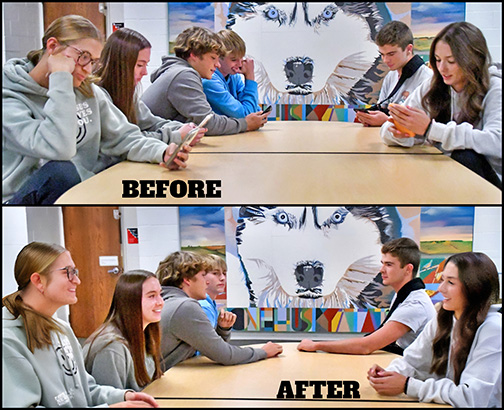
Twelve weeks ago at the beginning of the new school year, students and staff alike at Aurora High School had their doubts and reservations about a new policy banning the use of cell phones during school hours. But today, well into the first semester of school without the distraction of the ubiquitous buzzing, beeping and squawking devices, the consensus seems to be that it has been a positive change.
Having heard reports duirng a recent 4R school board meeting that the new policy was going over well, ANR decided to talk to students and staff members themselves about the difference the phone ban had made. At the end of a school day last week six students gathered in the high school commons to discuss their reactions and observation to the change in school policy instituted at the first of the year. The group included Rylan Gilliland, Ashlyn Kottwitz, Carter Schuetze, Madelyn Ramaekers, Jayke Krueger and Brooks Handrup.
Asked first for their reactions and those of their fellow students when first hearing of the rule change last summer, most said at first they were not happy about it.
“I didn’t really like the idea of it,” said Krueger. “Just because when we had free time in class and stuff, we could look at our phones or whatever, and if something funny happened, you could take a picture of it to remember it, or something like that.”
“I liked beforehand how I could listen to music in my classes,” Ramaekers said. “Or just like when I had free time at the end of my classes, so at first I was wondering how that would all work out.”
Handrup, who said he was on his phone all the time at school last year, such as during lunch period or in the hall between classes, said he wasn’t sure what to think when the new rule was announced.
“I didn’t know what to think right away,” he said. “I mean, I wasn’t excited for it.”
For his part, Schuetze said he was doubtful the change would be permanent.
“At first, I kind of thought it was gonna be like a joke, and I didn’t really know if it’d make it through the whole school year,” he said. “Because, kind of like the dress code, it starts off pretty strict, and then they don’t really care as much towards the end of the year, I kind of thought that’s how I was gonna be with the phones.”
Since none of those interviewed appeared to have had an extreme reaction to the announcement of the phone ban, they were asked about the responses of their friends.
“Just people, like, complaining about it,” recalled Krueger. “Nothing like super specific, just a lot of negative thoughts towards it.”
However, when asked if any of their friends had said something like “I don’t know how I’m going to make it through the day without my phone, nearly everyone in the group laughed and agreed that there were those who had expressed that sentiment or something like it. But even before the line of questioning had moved on to what things were like now, several students made statements like, “I mean, it’s really not that big a deal now;” “It’s been fine without it” and “after the first week you just get into a groove and you just don’t really need it anymore.”
And the students were also in near universal agreement that a number of things about the school day have improved since the ban went into effect.
“Almost 100 percent of the time, like at lunch, we’d all sit there on our phones and have our heads down,” volunteered Handrup. “And then, like during the passing period, we’d all be on our phones, and any free time in class, we’d also all be on our phones. But this year, no one’s on their phones, obviously, since they’ve been taken away.”
And the students also agreed it has had a positive effect.
“I don’t think I was on it, like, 100 percent of the time,” recalled Krueger. “But if I was ever bored or had free time, or just didn’t know what to do with myself, I’d just pull out my phone, but now I am interacting with people and actually using my time. I feel like I’m just talking to people more because you can’t just sit on your phone, so you make conversation with people, and whether they’re already some of your closest friends or not, you talk more in depth about whatever’s happening in your life.”
“I’m a lot more focused on getting my work done, too,” said Ramaekers. “When I have extra time at the end of my classes, I don’t automatically run to my phone, because I can’t. So I do extra work, or I talk to people, and I just get to know the people around me better instead of just going on my phone. I think a lot of the time last year, I was just like, ‘Oh, yeah, I go to school with them’ with a lot of people that I see every single day. But now this year, I’m like, ‘Yeah, they’re in my class!’ We talk a lot because we have the time where we have the opportunity to have those conversations now without any distractions.”
The students said the increase in face-to-face interactions has extended to the hallways and lunch room as well.
“I think we already kind of mentioned this, but in the hallway most time during passing periods, people would just like be on their phones in the hallway,” Krueger said. “But now, pretty much, most people are like having conversations and walking to the next class with somebody, and talking to them, instead of just like having their face in their phone.”
Asked whether the absence of cell phones during school hours has improved academics the students once agreed it had.
“I think a lot of people’s grades have gone up because of no more phones,” Handrup stated, “because instead of spending your class time on your phone, you’re actually doing your work and actually paying attention.”
The teachers’ take
The two teachers ANR talked to were also positive about the change, but like the students, they said they were a bit skeptical about the change in the beginning.
Lindsey Pohlmeier teaches 11th grade English and Rod Havens is the journalism/yearbook advisor and teaches 9th grade English.
“I thought there would be a little more pushback from the students than there was,” Pohlmeier said as Havens nodded in agreement. “It’s been smoother than I thought it would be. My classroom is definitely louder because there’s more talking, but that’s good. Overall it has been a phenomenal, much-needed change.”
“For me it’s different,” Havens said, noting that his incoming 9th graders had never experienced school with the presence of phones, adding it was an easy transition for them.
“But, that being said, I can notice a difference between 9th grade this year and 9th grade last year because it’s not there,” he said. “They’re more engaged.”
Havens said he had experienced some issues with students who wanted to use headphones and listen to the music apps on their phones while working independently in class. And he admitted some students seem to work better when they can use music to shut out distractions, but he also said some students would spend more time flipping through their playlist than actually studying. Overall, he said it was a welcomed change because he sometimes had trouble in the past getting students back on task after allowing them to listen to music.
“That’s probably the biggest thing they ask for is ‘Can I listen to my music?’ That’s all they want for the most part,” Pohlmeier said.
The teacher also said while she understands the desire to listen to music, she noted that they are not allowed to do that when they take their ACT test so believes the absence of personal music in the high school classroom is good conditioning for that.
Both teachers said the increase in interpersonal communications within the school has been a breath of fresh air.
“They are talking to each other!” exclaimed Pohlmeier. “They’re all facing each other and having a conversation and it’s wonderful. And to not have to fight that battle in my classroom is amazing. Because that’s all it was... Constantly I was saying, ‘Put it away.’”
Havens added that he occasionally sees students slip up and reach for their phones or actually have them out in class, but he said they are also self-regulating.
“They reach for it and then they catch themselves,” he said.
And the teachers agreed that enforcement of the new rule hasn’t been a problem. They said the first layer of consequences when a student is caught with a phone out in class is to have them put the phone on the teacher’s desk, but neither said they had even had to do that once.
The teachers also agreed that the absence of phones and the cooperation of the students has
made for a more pleasant and less adversarial atmosphere in the classroom. They noted that last year it seemed they were constantly asking students to put their phones away.
Previously, cell phone policy was left up to the individual teachers and varied from classroom to classroom.
“It’s just nice to have everybody doing the same thing all the time, so they can’t say, ‘Well so and so lets me,’” Pohlmeier said.
Both also they had concerns at the beginning of the year that the ban would not be enforced across the board, but they said they have been pleasantly surprised that everyone is on the same page.
“We’re not going back!” Havens said, to the agreement of Pohlmeier.
A communication downside
One drawback to the policy cited by students and teachers alike has been the disruption of a traditional form of communication between staff – especially coaches – and students during the school day. Several students mentioned that by taking away the phones it was harder for coaches to get the word out about last-minute changes in practice schedules and so on.
“I do feel like it’s harder for sports coaches to get a hold of their athletes, because you don’t get notifications on your Chromebook,” Kottwitz said. “So it’s just harder to get consistent updates from your coaches.”
“Yeah, from the communication side, it’s probably a lot worse,” Handrup agreed. “Like you just don’t know what’s going on, you can’t really contact anybody. But I’d say, everything else is better. I’d say it’s helped a lot of things.”
Havens and Pohlmeier said they understood that concern and Havens noted his journalism students have also had to adjust the way they make school social media posts. Instead of using their phones as they did last year, he said they had to learn how to post from their school Chromebooks, which he called more of an adjustment than an inconvenience.
Administration reaction
School administrators say they are also pleased with the social and academic changes that have taken place as a result of of the cell phone ban. Principal Doug Kittle called the response from the students to the change “great.”
“I couldn’t have asked for a better response from students, and I think faculty probably would echo those comments,” Kittle said, adding that parents have been supportive as well. “Not that we haven’t had some cell phone issues, but it went over much better. They’ve handled themselves in a mature way, and we appreciate that.”
Kittle said he had also witnessed an uptick in social interactions between students.
“It’s kind of nice to do lunch supervision and having kids talking to each other, or going down the hallways talking to each other, having conversations with staff or their peers, their classmates,” he said. “And those are the things that I don’t think people understand, the way it was prior with everybody’s face glued to their screen. And so way more positives than negatives. In fact, I can’t think of a negative.”
And Kittle said the positive comments about the policy aren’t just coming from within the school.
“I’ve gotten a lot of positive remarks from business and industry, just saying thank you, because they see the same problem at their job sites,” he said. “And so, you know, we’re trying to prepare these kids to be successful outside of school and when they enter the workforce and I think this is one step that they need to know how to handle in a mature way. They’ve done a really great job, so I’m very pleased.”
Under the policy as spelled out in the student handbook, a range of consequences exist for student phone use in school. Those range from as mild as having to turn the phone over to the teacher (and get it back at the end of the school day) to in-school and then out-of-school suspension. While Kittle says some students have tested the policy and a small number have had to serve in-school suspension, enforcement has gone better than expected.
“We were probably expecting the worst for the first couple of weeks of school, and it hasn’t materialized,” the principal said. “It’s been great, so it’s been a good change.”