
Century ago celebration of local pioneers drew crowd of nearly 15,000
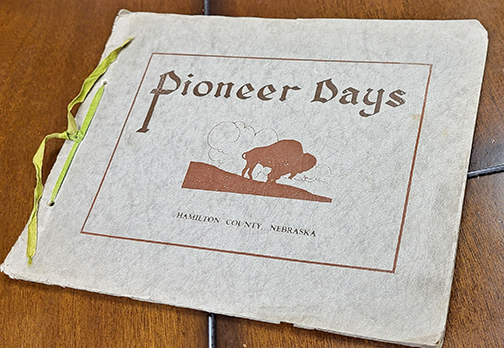
One hundred years ago, on October 8-9, 1924, Hamilton County hosted the biggest celebration in its history up to that point. The event was called “Pioneer Days,” and its purpose was to commemorate those who had settled the region as pioneers – remembering those who had passed on and honoring those still living.
The organization of the event was led by the Aurora Chamber of Commerce and the Business Women’s League. Despite scattered rain showers on the first day of the celebration, the event was well-attended with an estimated 12,000 - 15,000 people coming over the course of both days. Of those that attended, 362 were registered as original Hamilton County pioneers. (To qualify for the registered list of pioneers, individuals had to be 21 years of age or older in 1884.) These pioneers were given special ribbons to wear throughout the occasion, recognizing them as event honorees. The oldest Nebraska pioneer in attendance was Peter Starr of Dunning, who was said to be 106 years old and was the oldest man in the state of Nebraska at the time.
In addition to receiving special ribbons, several of the pioneers were also given opportunities to tell stories, recite poems and give presentations about their life on the frontier. A series of these presentations was held at the Christian Church in Aurora, with former Lieutenant Governor of Nebraska – Hon. A. W. Agee – leading the event. Other Pioneer Days features included a grand parade (the largest Hamilton County had seen up to that point), a replica sod house built by the Horseshoe Club, a Pioneer Days King and Queen (Mr. & Mrs. M. R. Worthington), traditional handcraft demonstrations, storefronts and notable buildings displaying pioneer artifacts and photographs, recognition of members of the GAR (the Grand Army of the Republic, i.e. the Union Army in the Civil War), various contests and games, the film “Covered Wagon” being shown at the Mazda Theatre, vendor booths, baseball games, a special dance performance by members of the Omaha Indian Reservation, additional old-fashioned music and dance activities and other free performances.
Pioneer life on the plains
From the homesteader testimonies given during the event attendees were given a glipse of conditions during those early pioneer days in Nebraska. The following is a summary of what was shared:
“In the early days of settlement on the Great Plains, the pioneers came to Nebraska via covered wagons and the railroad. Upon arrival, pioneers worked to establish homesteads, with many of the first ones in Hamilton County being along its rivers and creeks, as having a reliable water source was crucial for survival. Some of the most notable sources of water in the region were the Blue River, Beaver Creek, Lincoln Creek and the North Blue River. For several years, lumber was a scarce resource on the plains, so the go-to structures for many early pioneer homes were the sod house and the dugout.
Many of the early pioneers in Hamilton County were former Civil War veterans, most of whom came from Iowa, Illinois, Indiana and Wisconsin. There were also many immigrants from European countries, as well as a few former slaves who came out west seeking a new life. In addition to many families and young single men coming to claim land in the region, there were also single women who claimed land as homesteaders, with some of them working as local schoolteachers. Several pioneers also recounted the days when the Pawnee traveled in hunting groups across the plains, with the months from June to October being their most active hunting season.
In the 1870’s, crop production began to pick up in Hamilton County. The soil proved to be very rich, and the advancement of agricultural implements and methods made the land prime for cultivation. Of course, there were still many hardships that faced early farms in Hamilton County. Some of these hardships included drought, grasshopper swarms, prairie fires, destructive storms, and loss of livestock and work horses.
Education was held in very high regard for the pioneers, with the first schoolhouse in Aurora being built in 1872. Mr. Reuben W. Graybill was the school’s first teacher. In those early days, about one-half of the land in Hamilton County was owned by the United States, and of this land one-ninth was given for the use of public schools. The schools were also known for being centers for community life, and people from various walks of life would come together to learn and to hold events there.”
Seeds of growth
As the years went by, the homesteads and townships of Hamilton County continued to grow and advance. One of the signs of a town growing in those days was the planting of trees. There is a Greek proverb that says, “A society grows great when old men plant trees in whose shade they shall never sit.” During the Pioneer Days celebration in 1924, most of the pioneers of Hamilton County had passed on, though the seeds they planted – both literally and metaphorically – were still growing for those coming after them to enjoy. While none of the pioneers remain with us today in 2024, we can still find ourselves enjoying the “trees” of our predecessors’ labors as our communities continue to grow here on the plains. May we take some time to remember them on this 100th anniversary of Hamilton County’s Pioneer Days Celebration!
The author of this article, Kathryn Larson, is social media communications director at the Plainsman Museum in Aurora.