
Special service, dinner set for Sunday
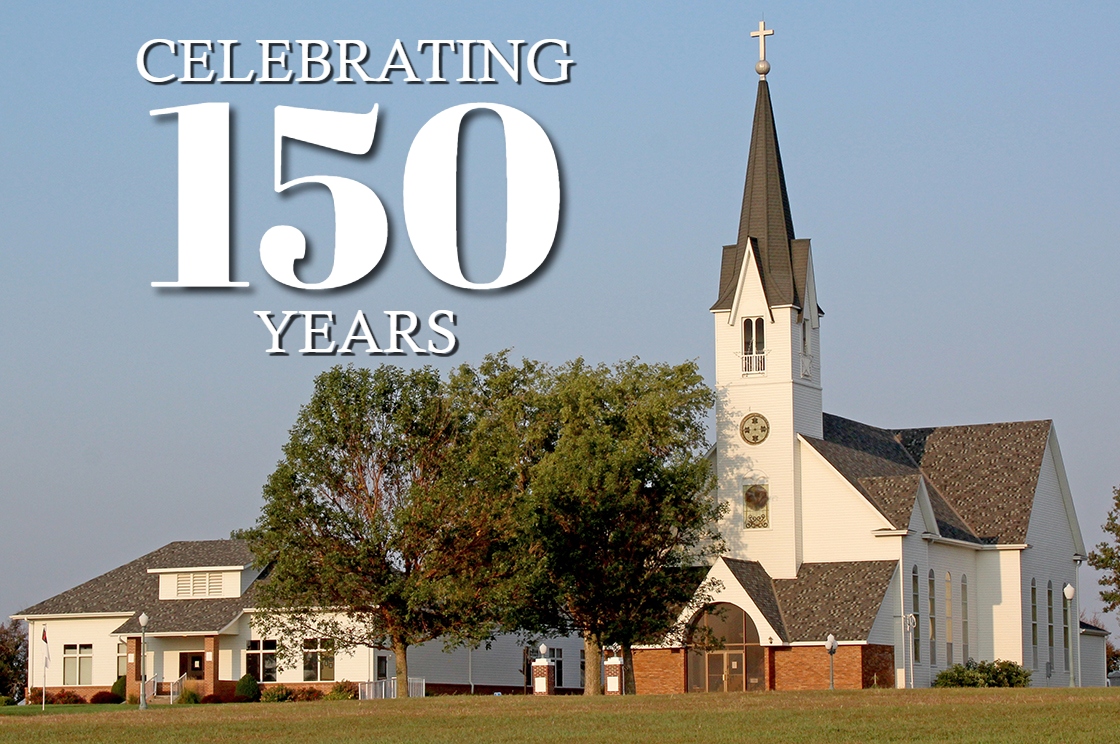
When German Lutheran immigrants were homesteading in eastern Hamilton County in the late 1860s, they knew they needed two things — a place to worship and a place to educate their children. They could not have imagined that 150 years later, that same community of faith would still be in existence and be celebrating a milestone anniversary. However, this Sunday, Sept. 17, Zion Evangelical Lutheran Church, officially recognized by the Missouri Synod of the Lutheran Church in 1973, will be celebrating its sesquicentennial with a special 10 a.m. worship service to be followed by a catered meal.
Leading in the service will be the Rev. Dr. Russ Sommerfeld, a former district president for the Lutheran Church Missouri Synod, who is also a special assistant to the president for church relations at Concordia University in Seward. As of last count, 350 people were expected to participate in the dinner which is being provided by J.W. Catering of York. The dinner will take place in a tent to be set up on the concrete driveway between the church and fellowship hall, which will also be open for dining.
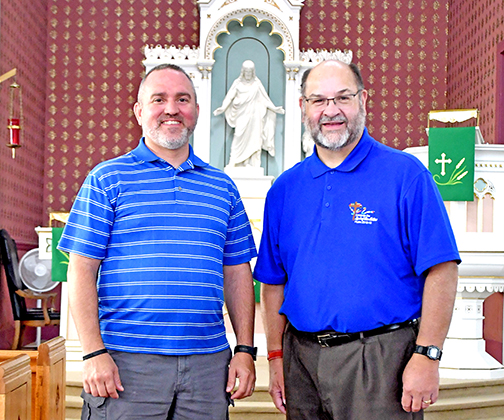
Planning for the observance has been a two-year process which started in 2021, according to the congregation’s current pastor David Feddern, who has served Zion since 2016. He said the planning committee has been meeting regularly since that time and has involved “a lot of work by a lot of wonderful volunteers.”
“Fortunately this congregation has done a wonderful job of keeping its history intact,” Feddern noted. “Not all churches do unfortunately, but Zion has done a wonderful job of maintaining its history.”
The Zion Lutheran Church building sits on a hill northeast of Hampton overlooking Lincoln Creek, its tall steeple pointing to the heavens is visible from miles around. The 30-acre campus is home to the 126-year-old church house, the church cemetery, a Christian education center constructed in 2010 and homes for the pastor and a newly-hired director of Christian education. A large green space stretches to the east toward Y Road and an undeveloped acreage on the south side is put up for hay once a year and will someday be used for expansion of the cemetery.
Homestead beginnings
The founding of Zion Lutheran Church goes almost as far back as Nebraska has been in the Union. (Nebraska received statehood on March 1,1867) Feddern says when this part of Nebraska was opened to settlement under the Homestead Act of 1862, German Lutheran immigrants began to settle on the border between York and Hamilton Counties about a mile east of the current church campus.
Feddern says the area was “wide open prairie” when those first settlers arrived and they occasionally had interaction with the Pawnee Indians who were still living on the river north of Hordville. The churches and schools they built in their rural neighborhoods predate the nearby towns and villages they are associated with today.
For instance, Zion was officially founded in 1873 but the village of Hampton, three miles to the southwest, wasn’t established until local stockman Joshua Cox founded the village and circulated a petition for the Burlington-Northern railroad to be built through it in 1879. (On June 19, 1891, Cox and his brother James, became the first stockmen to ship cattle from the United States to Liverpool, England.)
“Virtually every rural congregation that was started began out in the countryside,” Feddern said. “They didn’t necessarily start in the communities because they came before the communities oftentimes existed, so their community was the church. Their whole life revolved around the church and the school and all the activities between those two entities.”
First meeting for worship in individual homes, Feddern says the founders of Zion soon began to make plans for a house of worship and a school.
“That was really the formula for those early Missouri Synod congregations that began here in Nebraska,” Feddern stated. “You had a church, you had a school, you had homes for the only teacher/principal and the pastor and his family and a place (the cemetery) for those who are waiting for Judgment Day. You look at the state of Nebraska as a whole and, where all the German Lutheran settlements are, that formula is almost identical everywhere you go — church, school, cemetery, homes for the professional church workers who served the school and served the church.”
“They picked out this site due to its height, the view and water to the south on Lincoln Creek,” Feddern said, adding that the land was donated to the congregation.
Feddern said the congregation’s early pastors were circuit riders who came from as far away as east of Seward and took about three months to visit all the congregations in their circuit.
Once the congregation received official status from the synod in 1973 it was able to call its first pastor who had been trained at the denomination’s seminary in St. Louis. Since then it has had 14 pastors, plus three men who served as interim pastors for up to two years during pastoral vacancies.
A tradition of education
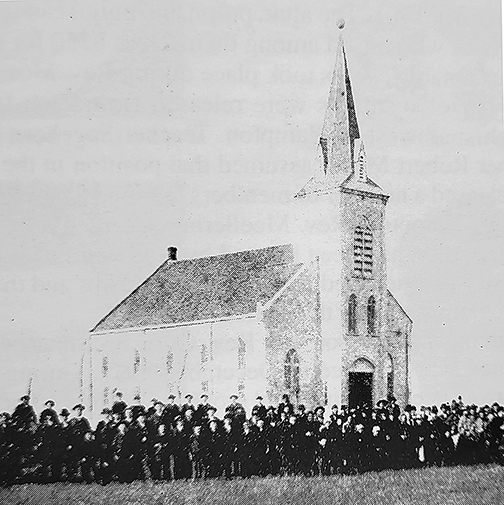
As Feddern stated, education of children has always been an important part of the church’s mission and he says the congregation had a school from the very beginning. The first classes were held in a sod building constructed on the banks of Lincoln Creek and the first wooden church building built in 1877 served a dual role of both church and school. As the congregation continued to grow it was decided that a bigger church building was needed and a wooden structure with a high steeple was built and dedicated in 1883. That building was struck by lightning and burned to the ground three years later but fast-acting members of the congregation were able to save the altar, pulpit, lectern and Italian marble baptismal font even as the flames worked their way down from the attic of the structure. The furnishings were preserved and included in the present structure built in 1897 and are still in use today.
The original church building continued to be used as a school and a second school building was also constructed at a location north of the current site and was operated by the church until 1941. The original school at Zion operated until 1969 when it was closed and consolidated with the St. Peter Lutheran School in Hampton, which is a daughter congregation of Zion. The two churches operated that school jointly for over 50 years until it closed in May of 2022.
There have been numerous changes to the campus over the years including the construction of the current fellowship hall in 2010 which made use of that original church/school building. The cemetery contains graves that go back to the earliest founding days of the church. The oldest grave is that of Maggie E. Stuart who was buried there in 1969. No date of birth is listed on her headstone and Feddern speculates she may have been a settler who died on the trail west and, being Lutheran, was buried in the nearest church cemetery.
Three other graves date back to the year the church was founded and there are also several Civil War veterans buried there.
Still thriving
Feddern said he believes Zion is the oldest Missouri Synod church between here and California but, yet today, its influence is broad and the congregation continues to thrive.
“We currently have members from 10 different communities in Hamilton, York, Clay and Seward counties,” Feddern said, “so obviously in some cases people are driving past sister congregations to go to church here at Zion because this was either the church of their grandparents or their parents or they, themselves grew up here... So that is very unique for a rural congregation... You don’t see that in many places.”
Feddern said present day congregants have addresses as far east as Beaver Crossing, as far south as Sutton and Clay Center and draws from Phillips in the west and the Hordville area on the Platte River to the north. Also, there are families still in the church who can trace their heritage back to some of the earliest founders of the church.
One indicator of the health of the congregation, according to Feddern, is the calling of the church’s first-ever director of Christian education, Ben Venteicher earlier this year. A graduate of Sutton High School and Concordia University, Venteicher is in charge of the educational programming of the church, overseeing midweek classes for grades 4-8 and catechism classes for the upper grades. He and his wife, Michelle have five children and the family lives in the former teacher’s residence on the south side of the campus.
Feddern and his wife, Deanna, live in the parsonage situated to the west of the church building. They have two grown children.
Feddern said the footprint of the church’s influence actually stretches all the way to Omaha. At the 100th anniversary celebration in 1973, the offering collected that day was designated to help start a mission plant in the town Millard which is now part of Omaha on the southwest side. That mission church became Divine Shepherd Lutheran Church which is now the largest and one of the fastest growing churches in the entire synod.
In the months leading up to the anniversary celebration, members of Zion have been wearing special anniversary t-shirts made for the occasion at parades around the area. They are also being asked to wear them on Sunday.
Feddern said items from previous celebrations will be available for purchase that day, including a decorative plate from 100th anniversary and a cookbook made for the 125th celebration which contains some recipes dating back to original founding member families. A new pictorial directory, which includes an updated history since the 125th anniversary, was also published earlier this year and copies will be available.