
IWS helping foreign truck drivers live American dream

Subhead

Downtown Aurora venture already expanding to include training center, dorms
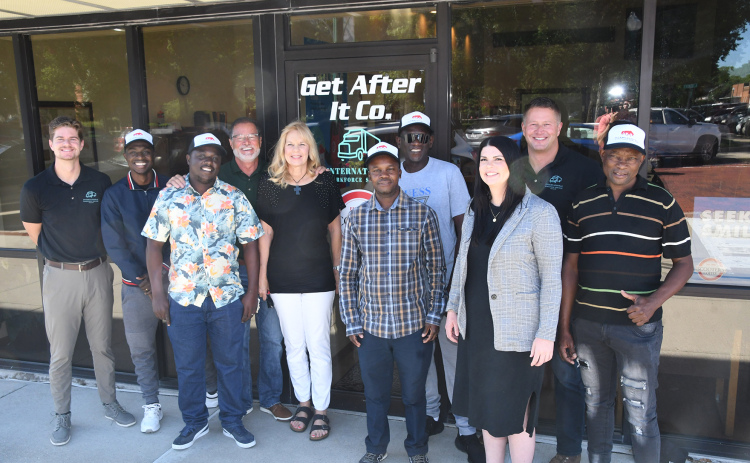
A new business is quickly gaining momentum in downtown Aurora, helping relocate and train truck drivers from all over the world to drive big rigs here in America.
International Workforce Services (IWS) officially launched its LLC in February, though David Vettel said he has been developing the concept for several years. A local native who moved his family to Illinois in 1993, Vettel returned to Aurora last year and is excited with the rapid progress he’s seeing in this his second career.
“Six years ago I was contemplating joining another company… gearing up to do what I’ve done my whole life, which is traveling and conducting business all around the world,” Vettel explained. “So when I did that, an opportunity presented itself to explore trying to find good laborers from a region outside the country through immigration.”
Vettel’s focus was on the trucking industry, specifically, which reports a shortage of some 60,000 truck drivers here in the United States alone. He worked in the industry to learn the ropes, so to speak, earning his Commercial Driver’s License (CDL), driving some himself and developing a strategy to recruit and train international drivers.
His initial plan hit a roadblock when the U.S. government denied the proposal for various reasons, but a year later Vettel was contacted by Visa Solutions, a global company with headquarters in Houston, giving him a new path forward.
“Visa Solutions is a firm of attorneys that specializes in naturalized citizen processing,” noted Todd Vettel of Aurora, one of David’s three sons, with Tim of Manhattan, Kan., and Trevor of Omaha also involved in IWS operations under the GetAfterIt umbrella. GetAfterIt LLC also includes several 9Round fitness franchises and the new Scooter’s Coffee here in Aurora. David is affiliated only with IWS, fitting in well with the company’s participatory management philosophy.
“We’ve been talking about it for years and when the timing was right we thought we would scale it and do it independently, not just with one trucking company but a number of them, basically building off his experience,” Todd noted.
“They are the biggest player and we are their key partner in the trucking industry,” David said, noting that Visa Solutions also works to recruit exclusively international laborers for the healthcare industry and general workforce. “That’s what we’ve been developing for the last three to four months.”
Early success
Years worth of brainstorming is paying off in a visible way now in Aurora. Just four months after forming the LLC, the Vettels began welcoming foreign drivers from Mexico, South Africa, England and Poland to the community in March, providing food and housing while getting behind the wheel of an 18-wheeler with their clients to help earn their American CDL. 
The process actually begins more than a year before the clients arrive on American soil. IWS works with Visa Solutions to select foreign truck drivers seeking employment in America, all of whom are required to speak English, then waits 14 to 18 months until candidates receive their EB-3 (Green Card). The first stop is Denver, where IWS clients receive their standard driver’s license and confirm all the necessary immigration paperwork, before getting on a bus bound for Grand Island, where the Vettels greet them and bring them to Aurora.
“What we’re doing for them is coaching them along the way so they kind of have a heads up of what to expect when they go to their job,” David said, noting that all their clients were pre-selected by a U.S. trucking company through Visa Services, thus they know they have jobs once completing an eight-step immigration process and earning their CDL. Those jobs can pay from $80,000 to $150,000, depending on the loads they’ll be hauling. 
“We have a general understanding of these companies so we can kind of develop an understanding of how they operate, but in the end you don’t know all their routines or what their mission or standards are,” he said. “We are coaching these guys along the way to get them prepared so when they get there they know they’ll be in a world of training, getting to know people and the company’s policies and regulations.”
David said he appreciates the role and lifestyle of over-the-road truck drivers, as his own father was a trucker years ago.
“I remember looking at truck drivers as being cool,” he said. “They were professionals. Something has happened to the culture in our country, or maybe it’s just a workforce thing in general, but people don’t look up to truck drivers like they used to. These guys don’t know that. They might be third-generation drivers and they’re coming here proud to be an over-the-road truck driver in the United States.”
“They’re all here for the American dream,” Todd added. “They’re here to put roots in and that’s why I think we’re talking about the next American generation because they’re here, working with a quality work ethic and they’re building a new life.”

IWS culture
Companies all across the United States have begun offering this type of relocation services for truck drivers, Todd noted, though he believes IWS’s approach is unique.
“We welcome them as new Americans,” he said. “They have dinner at our places. They are invited to go to our church, which is not something you are going to see in a large HR department. We specialize in being multicultural and treat them with politeness and kindness, whereas some of the schools push them through whether their English is up to par or not.”
That personal touch makes a difference, David said, reflecting IWS’s culture and that of its home state.
“So much of what we do is relocation services,” he said. “They already know how to drive a truck so what we’re doing is introducing them to what they need to get their CDL. What we do for them while they’re with us, I’ll guarantee you we do it to an extreme in order to take care of these guys. They’re every need, whatever it is, is going to be met while they are with us … Some of these bigger companies have their own schools, but they push them through like cattle and what comes out are people who don’t know what they’re doing. That’s why we see a lot of accidents and mishaps.”
How long IWS clients are in Aurora can vary, based on the first few months of experience. Some have a better command of the language and are able to complete the CDL training quickly, while others take more time. The record thus far is 19 days.
“This is not just about coming to America to drive a truck,” David said, his voice cracking when recalling the highs and lows he’s experienced with clients. “This is a life-changer for these guys because they’re wanting to establish a better way of life for their families well into the future.”
“One of our clients was struggling to the point where he failed the first time and he was crying,” he shared. “That’s how important it is. And then on the opposite of that when he passed yesterday, oh my gosh, he was in the clouds. It’s so cool to be a part of that because you’re changing lives. This is changing us, too, in a sense.”

Expanding local capacity
Pleased with the early success of IWS’s business plan, the Vettels are confident they can grow as needed to be able to recruit and train as many as 250 truck drivers per year.
In its first year, with no history to draw from, the company set a goal of training 133 drivers, though IWS is already on pace to exceed that number.
“In my mind, knowing the way this is going and will continue to go, could we not gear up to do 20 a month?” David said. “Why not say that we are going to fully be geared up with human resources, with trucks and space to take on 250 drivers? We can do that.”
In order to expand its current capacity, IWS recently purchased a building on the downtown square with plans to renovate that structure to create a training center and multiple door rooms. Additional housing will continue to be leased as needed.
“This is about to blow up,” Todd agreed. “The gates have been reopened and it’s just starting to take off.”
Visa Services has established offices in Mexico, South Africa, Poland and the Philippines, working to recruit workers for the healthcare industry and general workforce in addition to the trucking sector. Todd said he believes IWS could eventually broaden its mission to include other aspects of the workforce as well.
“Our mission is basically fulfilling the needs of the American economy,” he said. “With the supply chain issue and all of this pandemic stuff there is an obvious demand and I think any trucking company that wants to survive is going to have to dabble in this, so here we are.”
“I feel like we’ve got it figured out and that we’re just going to continue what we’re doing,” David concluded. “My hope and my dream is that everything I’ve been able to do for the short-term will continue on for a long, long time.”
For more information, log on to internationalworkforceservices.com