
ANR part of national study focused on changing business model
by Teri Finneman
Remember this number: 85 cents.
It’s the number I’m repeating as I work with local newspapers as part of a national experiment to help save local news.
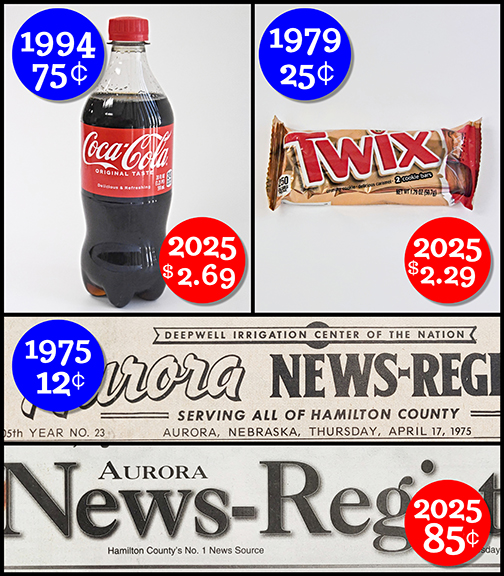
That number, 85 cents, is about how much it costs you as a subscriber to get this paper every week with your $44 annual subscription.
Eighty-five cents.
Put another way, that’s 12 cents a day to support local news.
A Twix and a bottle of pop – both machine-produced within seconds – each cost over $2.50 at a gas station I recently stopped by. Yet this newspaper that took hundreds of hours of manual labor to assemble this week is selling for 85 cents.
Put another way: In the past 80 years, the cost of this paper has gone up 80 cents total. That’s one penny per year in a price increase since 1942.
Imagine if your workplace only charged 12 cents a day for its products and services. Or only increased its price by one penny per year for the next 80 years. You wouldn’t be in business much longer. It is literally insane in 2025.
And it’s why more than 3,200 U.S. newspapers have closed in the last 20 years, leaving 206 counties as news deserts, according to research by Northwestern’s State of Local News project.
What does it mean to lose a newspaper? Researchers know from the communities without one.
It means significant impacts on taxpayers when no one monitors local governments and their spending. It means more corruption. Reduced voter turnout. Loss of knowledge of civic matters.
It means increased polarization – think this country is in this mess by coincidence? The rise of cable news and social media with their nonstop misinformation combined with the decline in local news is directly connected to the current state of this country.
And then there’s the social impact. Residents who lost their newspaper told my friend and fellow researcher Nick Mathews that they felt a loss of a sense of community, increased isolation and diminished pride in their town.
Without a newspaper anymore and only Facebook to use, one Virginia resident said virtually no one showed up to his event: “It’s a shame. It’s a sad thing. Things have changed because people aren’t getting the information. Then they lose interest in it. I see it. It’s not just a theory, it’s happening.”
The current business model for newspapers began in 1833. That’s not a typo. Andrew Jackson was president, that’s how long ago this was. That’s when the penny press model started that determined news should be dirt cheap. Throughout the 1800s and ever since, newspapers increasingly relied on advertising to stay afloat.
Now, too many advertisers would rather turn to Facebook and line the pockets of billionaire Mark Zuckerberg – while their posts are mostly hidden by a computer bot algorithm that decides the small amount of posts you get to see – than support the newspaper.
As far as readers, a global Reuters Institute study found 57 percent of people didn’t think they should have to pay for news at all. Apparently 85 cents a week to live in a functioning democracy is too much while they pull up to Starbucks for a $6 coffee.
Without an immediate change in how newspapers do business, the future is increasingly troubled. These were conversations that I had with local residents in your community during a focus group session in July.
They came up with some great ideas, which we’ll be sharing in the weeks ahead, of how to change the Aurora News-Register’s business model to help ensure not only its future, but that of newspapers around the country.
A lot is riding on what happens here in Aurora and Hamilton County with this experiment. And it’s going to take help from all of you to make this a beacon for how to save local news across the country. We hope you’ll be part of it in the weeks ahead.
Teri Finneman is a journalism professor at the University of Kansas and co-author of the book Reviving Rural News.