
Goltz gives kitten 2nd chance to thrive
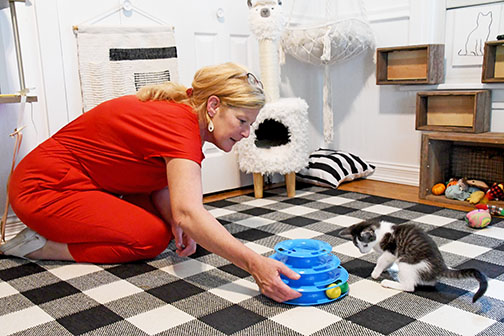
When renovating a room for her two cats, Aurora Adopt-A-Pet board member Shannon Goltz didn’t foresee the potential in using it to provide cats and kittens a second chance on life.
The TNR (Trap, Neuter, Release) founder was inspired to create a cat enrichment room in her home based on an idea she had for the animal shelter.
“I saw this black and white cat room (online) and it’s not like this one, but it was cute,” Goltz commented. “I sent it to Kathy (Pollard) and I said, ‘Oh, if we get a new building, we’re doing one of the rooms like this.’ Then over the winter, we were traveling, I said, ‘You know what, I’ve got plenty of bedrooms. I’m going to do a room.”
Having her husband Greg on board, the couple renovated the room on the first floor into a cat enrichment room in May and the outdoor ‘catio’ in July.
“When we decided to start the project, we call it ‘Go into the plant,’” she said. “We get up early and work like we’re going eight hours a day, like we’re working, and we got it done.”
Initially designed to help stimulate her cats both inside and outside of her house, the room became a special area for a unique kitten that had entered Goltz’s care.
Bonnie, a two-month old kitten, was one of the recent additions to Aurora Adopt-A-Pet when she, her mother and her littermates was picked up at seven weeks of age in June.
Appearing as a clumsy but happy kitten, her wobbling steps that come across as cute stemmed from a more serious condition.
“She’s got CH (cerebellar hypoplasia), which means they only get it if their mom had parvo,” Goltz explained. “Her mom wasn’t vaccinated and her and another kitten were the only ones to make it out of the group.”
Nicknamed ‘wobbly kitten syndrome,’ Goltz explained that CH affects Bonnie’s coordination and balance, particularly with her hind legs.
“When she runs, her front half is running and walking fine,” she commented. “It’s almost like her brain isn’t telling her back end what’s going on, so it flops and flips and goes all over.”
With the kitten being in her care since July, Goltz has been using the room to provide a safe space for Bonnie to grow and gain the motor skills needed to survive.
“We can’t put her in a big enclosure (at the shelter), because she could fall and get hurt,” Goltz explained. “I’ve got to have eyes on her 24/7 because if she gets up (on shelves) and falls, she’s dead.”
On the left side of the room, the Goltzs installed six shelves with a hole carved in each shelf. In addition to a scratching post, the shelves gives Goltz’s cats and Bonnie room to climb.
“A lot of times cats will use the front claws, but as they get older they will use their back claws,” she said. “I want to see her start going up here, getting on the shelf and realize that she can get through the holes.”
On the right side of the room, a TV is placed against the wall which plays videos of birds and other animals for the cats to watch or touch the screen.
“They can have reptiles, mice, squirrels and I leave it on 24/7,” Goltz commented.
When the weather is nice and sunny, her cats are able to go into a ‘catio’ which has beds and platforms that allow them to rest outside through a doggy door in the cat’s room.
“They long for a little bit of fresh air and we spend a lot of time in the backyard, so it’s a way they could spend time with us, too,” Goltz said. “My Himalayan will go out there and she loves to sun herself and it’s safe.”
Including toys that are placed throughout the space, Goltz made the enrichment room to give her cats the stimulation they need.
“I know enrichment sounds weird and a lot of people don’t think of animals needing enrichment, but if you think about it, a lot of pet owners are already doing that,” she said. “When you play frisbee with your dog, that’s enrichment. When you take them for walks, take them in different routes, that’s enrichment because dogs are constantly being enriched by different smells and that they’re learning and their brains have to work. If you take different routes, you’re stimulating them.”
Providing that enrichment to Bonnie, Goltz said the small kitten has made a lot of progress since living in their home.
“She’s using those back legs together almost like a rabbit to jump forward when she runs,” she noted. “She’s only two months old, but she’s already learning how to adapt in a week. It’s actually pretty amazing to see.”
While Bonnie’s adoption page is up at Aurora Adopt-A-Pet, Goltz stated they will be very strict in finding her forever home.
“(We’re looking for) somebody who has the time to work with her,” Goltz said. “So when she gets a little bit bigger, she’ll have already learned all these skills.”
To give her a healthy life, Goltz wants Bonnie’s owners to “make sure they’re adopting her, because they want to give her a chance, a great life and stimulate her.”
Continuing her TNR program once more in the fall, Goltz emphasized the importance for feral cats to be spayed or neutered as well as vaccinated.
“If your cats are outside and there’s other cats that haven’t been vaccinated and they’re carrying the virus, your cat could get it,” Goltz said. “Then if they’re not spayed or neutered if they have it, you will lose a bunch of kittens and you might have cats like this.”
To help other cats that are waiting for their forever home at Aurora Adopt-A-Pet, the board member shared that the animal shelter welcomes pet owners and animal lovers interested in fostering both cats and dogs.
“If anybody’s interested in fostering, we always need fosters for kittens,” Goltz concluded. “For kittens, we get all stages in, wee ones that have been abandoned that will need to be fed every two hours. We also get ones that are already eating that just need a little mire time to get stronger before they can get their shots and come into the shelter.”